


A conversation can change when someone finally calls out the disagreement. The facts may be the same; the question has become clearer. The Ace of Swords enjoys that zingy moment. Other members of its suit are less convinced that a sharp sentence solves everything. One has put the swords down to rest. Another has won the argument...but is looking at what it cost. The Queen holds her blade upright while keeping her other hand open.
Swords belong to tarot’s Minor Arcana, the four suits that bring tarot's questions into the realities of ordinary life. Their concern is thought in contact with experience: perception, words, decisions, disagreement, and the difficulties that thinking alone can’t make disappear. This suit has room for curiosity and fairness as well as sorrow. A clear view can help; it can also reveal something painful we aren't sure we're ready to see.
Like the Major Arcana, these fourteen cards have distinct characters. They aren’t a forecast of fourteen events or a way to diagnose the person asking a question. A reading gives each card particular company and emphasis. Open any linked name for its fuller upright and reversed Tarot Library entry. Here, the pictures introduce the voices and consider what themes carry across them.
What a clear thought can achieve
Ace of Swords — the precise speaker
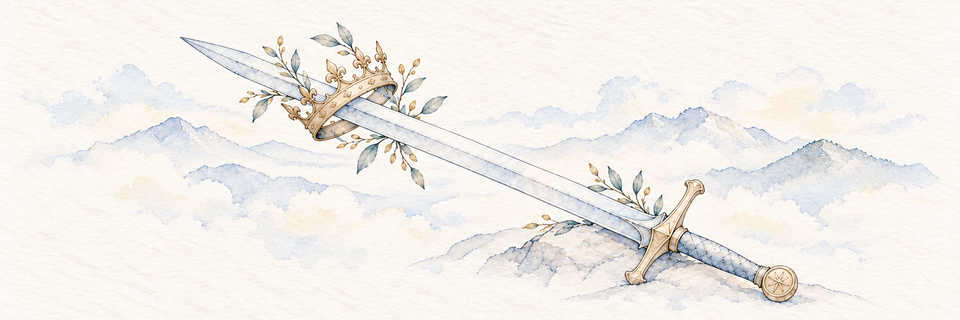
The Ace raises one upright blade through a gold crown, with curved leafy branches and mountains around it. A hand has given the thought a definite form. This card prefers a question you can actually answer, a distinction that makes sense, a decision stated plainly enough for action to flow from it.
Reversed, the sentence may sound more precise than the understanding behind it can really support. A clever label has wrapped around a question that needed another look. The Ace still wants precision. It can revise the claim until its resounding certainty fits what is known, rather than letting an impressive blade do all the persuading.
Two of Swords — the keeper of an uneasy balance
The Two sits beside water, blindfolded, with forearms crossed and two blades angled outward. The figure stands still behind the two blades: different considerations can keep each other in place when a decision isn’t yet clear; a temporary truce may give people time to think. The Two asks what that silence makes possible, and what it leaves untouched.
Reversed, the balance becomes harder to judge. Advice, pressure and unresolved details arrive all at once. Confusion deserves more thoughtful attention than “just choose.” Which fact can be checked? Which decision actually belongs to the person being asked? The Two wants those questions separated before another voice joins the chorus.
Three of Swords — the one who names the hurt
Three blades pierce a pale, anatomically drawn heart, with fine rain lines behind. The Three gives hurt a central place. It has no interest in a neat explanation that makes the pain disappear on paper: a cutting exchange, a separation, a difficult recognition can hurt even when the facts are understood.
Reversed, the way of living with that hurt may begin to change. Talking through it gets easier; a memory takes up less of an afternoon. An uneven return of sorrow doesn’t undo that change. The Three doesn't require forgiveness, renewed contact, or gratitude for what happened.
Four of Swords — the quiet recluse
The Four has stopped rehearsing the answer. A robed figure lies with eyes closed beneath an arch, three swords above and a fourth along the front ledge. The thoughts linger. Rest can still happen without settling what's unknown or uncertain, and it needn’t produce a revelation to earn its time.
Reversed, the moment is less restful. Demands keep intruding, or the practical space to stop is missing. The Four looks at those conditions: time, shelter, help, an exchange that can wait. A pause can need support. Simply telling someone to take one won’t always supply it.
What happens between people
Five of Swords — the uncomfortable victor
The Five holds three swords beside a rocky shore while two figures walk away; their two blades lie on the ground. There are many swords, but considerably less ease between the people. An argument can be won while trust or dignity is damaged. Leaving the contest may also be a considered choice.
The picture doesn’t assign you a part. Reversed, an argument may have ended while regret or grievance remains. An apology or changed conduct can matter, but repair might still need more. Peace can require distance. It doesn’t require everyone to take equal blame or become close again.
Six of Swords — the ferryman and passengers
The Six brings outside support into the picture. An older figure guides a wooden boat while a seated adult holds a child beside six upright swords. Concern continues to travel with them; after all, support doesn't mean everything's been resolved. A passage toward more manageable conditions might still include sadness, practical help, and a pace nobody would call effortless.
Reversed, the crossing may stall or double back. An obligation is unresolved; a route needs reconsidering; help hasn’t become available. The Six asks what would let the passage proceed, without declaring a return a failure or promising that the farther shore will solve everything. The boat still needs tending.
Seven of Swords — the ingenious solitary
The Seven carries five swords away from tents, glancing back toward two left standing. This character has found a route of its own (and left something to return to). Independent work, selective disclosure and a workaround can all belong here. Ingenuity deserves credit and inspection in the same breath.
Reversed, the explanation is second-guessed by the very person who offered it. What has been left out that could change the plan? A private note or candid advice may reveal the part that's sitting awkwardly. The Seven can prefer a different approach to keeping its clever tale intact.
When the view grows narrow
Eight of Swords — the constrained figure
The Eight stands blindfolded on a stony path, cloth swaddling the upper body and wrists, four swords on either side. Restriction and uncertainty share the scene. Pressure from others, limited information or material circumstances may have narrowed what choices remain available. Some obstacles need resources or outside help; they won’t yield to a more encouraging thought.
Reversed, an old refusal or repeated criticism may become part of what seems possible. Those expectations can be examined alongside the conditions that still exist. Seeing an option and being able to use it are different things. The Eight asks for a wide enough lens to include both.
Nine of Swords — the wakeful thinker
The Nine sits upright in bed, one hand at the cheek and the other at the forehead. Nine horizontal swords hang behind; a lamp is lit, and a crescent shows through the window. The thoughts keep returning without bringing an answer. The anguish matters, whether its cause is known, feared, or still partly uncertain.
Reversed, that distress may be difficult to share. A careful disclosure can give another person a chance to hear it, with room to choose whom to tell and how much to reveal. The accompanying worry isn’t proof of guilt or of a future doom. The Nine has no verdict to deliver from the bedside.
Ten of Swords — the figure at an ending
The Ten lies on one side among flowers, with ten swords planted behind and a low sun between distant mountains. (In this deck, unlike Waite's, the blades aren’t driven into the figure.) But the meaning still recognizes a painful ending: something that can’t be argued back into its former shape. There is room to name that finality without declaring everything lost.
Reversed, life may continue in small, uneven ways while the consequences remain. An ordinary task becomes possible; support makes a day less difficult. Neither orientation predicts physical death. The low sun allows a wider picture without demanding that the ending be welcomed in with open arms.
Four voices with a blade
The court’s titles name approaches to thought and judgment. These qualities can appear in anyone; they don’t assign an age, gender, or permanent social role.
Page of Swords — the lively questioner
The Page holds a long sword in both hands, feet wide on rocky ground, looking to the side as a blue cloak streams outward. Something beyond the blade has caught their attention. The Page would like to know how it works, and is willing to ask questions before appearing knowledgeable.
Reversed, the next question may arrive before the answer has landed. A small clue snowballs into a complete explanation. The Page needs enough patience for the message to resonate: the rest of the message, the overlooked detail, the reply that changes what seemed obvious. Curiosity gets more interesting when it listens too.
Knight of Swords — the decisive advocate
The Knight raises a sword diagonally above a pale horse, reins in the other hand and blue cloak streaming behind. A thought is being acted on. A question taken up directly, a clear argument, a necessary reply: conviction can carry a useful response into motion. This Knight is capable of thinking while moving forward.
Reversed, the forward rush may convert an objection into a battle. Speed starts serving the wish to prevail, rather than the end itself. A pause long enough to understand what is being answered can restore the purpose of the reply. Strong conviction can still leave another person time to finish a sentence.
Queen of Swords — the discerning listener
The gray-haired Queen holds an upright sword and extends an open hand. Experience has sharpened her judgment without ending the conversation. She can entertain another view and still retain her right to choose, refuse, or ask a follow-up question.
Reversed, judgment fixes too quickly. One mistake becomes an account of a whole person; an old disappointment supplies the answer to a new explanation. The Queen wants words exact enough to describe the actual problem. A firm refusal can stand without contempt, and hearing someone out can stop short of excusing what happened.
King of Swords — the accountable judge
The gray-haired, bearded King faces outward from a carved throne, holding a long upright sword; a butterfly appears above the distant mountains. Practiced judgment can state its reasons. Facts are examined, knowledge is sought, and the people affected remain part of the decision. Authority has something to answer to.
Reversed, the reasoning protects a conclusion from being questioned. Expertise or a polished explanation makes an objection seem inadmissible before anyone hears it. The King asks whether evidence and consequences can still change the choice. An argument’s elegance matters less if it has stopped noticing whom the decision reaches.
An edge worth attending to
A thought becomes more useful when you can hear what kind of work it is doing. Is it asking, deciding, defending, remembering? Is another sentence needed, or would a genuine interval of quiet reveal more? The Swords give those differences a visible form.
Start with the card that makes you pause, then open its Library entry. Let its fuller meaning complicate the first impression. You can value clarity without requiring every question to be easy to answer, every sorrow to teach a lesson, or every disagreement to end with your starting point intact.
Explore the rest of the deck
For our coverage of the rest of the deck: