

Swords
Eight of Swords
The Eight of Swords names constriction when options are narrowed and a way through is hard to see.
- restriction
- limited options
- uncertainty
- assistance
Read the card in its own right, then follow its meaning through the spread.
Two orientations
The card’s meaning
Swords connects this Eight’s restriction with thought, information, judgment, and conflict, without reducing material or interpersonal obstacles to a state of mind. Its rank does not make escape a required achievement.
Upright
The Eight of Swords names constriction when options are narrowed and a way through is hard to see.
The Eight of Swords describes restricted movement and difficulty seeing a way through. Pressure from other people, limited information, material circumstances, or feared consequences can narrow the choices that seem available. The blindfold and bindings make both restriction and uncertainty visible. Some limits may be open to question; others require protection, resources, or outside help before they can change. The card calls for an accurate view of what is restricting action, without making the trapped person responsible for creating every obstacle.
- restriction
- limited options
- uncertainty
- assistance
Reversed
The Eight of Swords reversed examines restrictions that have become expectations about what is possible.
The Eight of Swords reversed concerns the ways restriction can become part of a person’s view of themselves. Repeated criticism may make a wish seem unreasonable, or a past refusal can make asking again feel pointless. Such expectations deserve examination alongside the conditions that still exist. There may be more room to act than first appears, though recognizing an option and being able to use it are different. The card invites careful testing, with whatever information or support that requires.
- internalized limits
- self-doubt
- reconsideration
- possible choice
How the reversal changes the emphasis
The upright experience of restriction becomes a way of anticipating what is permitted or possible. This selects the modern inward-constraint reading, with room for changed understanding; it neither makes all barriers self-created nor reproduces Waite’s more ominous reversed list.
The question changes the emphasis
Reading this card in context
Each spread gives its cards different roles. The examples below explore this card as an influence, a situation or challenge, and advice or support. Begin with the question your position asks, wherever it falls in the spread.
As an influence
Upright
A restrictive arrangement, missing information, or concern about the consequences of acting may have narrowed the options that brought this question into focus.
Reversed
A repeated refusal, criticism, or a restriction learned in an earlier setting may still influence which possibilities seem worth considering now.
As a situation or challenge
Upright
Identify what limits movement and what remains unknown; a real barrier, an untested assumption, and a missing resource can call for different responses.
Reversed
Consider whether an expectation about what you can do still fits the present conditions, including any restrictions that genuinely remain in place.
As advice or support
Upright
Seek reliable information or practical help with one specific restriction, and assess any possible opening without assuming it is safe or easy to use.
Reversed
Examine one assumed limit with reliable information or someone able to help, then decide whether a small, safe test is possible or useful.
Read through a particular life focus
Open reading
Examine where a choice feels restricted and what information, practical change, or support would be needed to assess the available options.
Love & relationships
Where speaking, declining, or making a choice feels difficult, consider the actual pressure and available support without treating fear as proof of another person’s intentions.
Work & direction
Rules, access to information, resources, or expected criticism may narrow an undertaking; identify the particular restriction before deciding what could change it.
Home & family
Consider whether rules, dependence, or practical conditions around a living situation limit choice, and what information or assistance could put an option within reach.
Self-growth
An expectation learned through restriction can be examined without blaming yourself for the circumstances that taught it or assuming that thought alone can change them.
Look a little closer
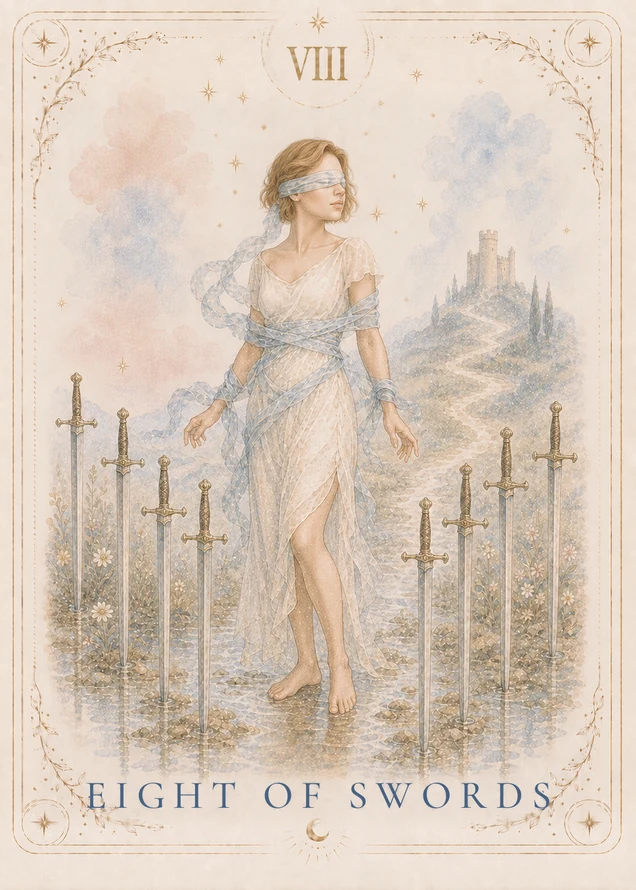
The imagery
Blindfold
A pale blue patterned strip covers the figure’s eyes.
Limited sight makes uncertainty part of the restriction: a possible route may be difficult to assess from the person’s position.
Cloth around the body
Patterned cloth crosses the upper arms and torso and wraps around the wrists, with loose ends visible.
The binding gives restriction a bodily presence. Its origin and ease of removal cannot be known from the image.
Eight standing swords
Four swords stand on either side of the figure, their points meeting the ground.
The blades frame a narrow place to stand. Visible space between them does not prove that moving through would be easy or safe.
Path and distant tower
A stony path continues behind the figure toward a tower on a hill.
The wider setting remains present beyond the immediate restriction, without establishing who controls it or whether it offers refuge.
Similarities & differences
Related cards
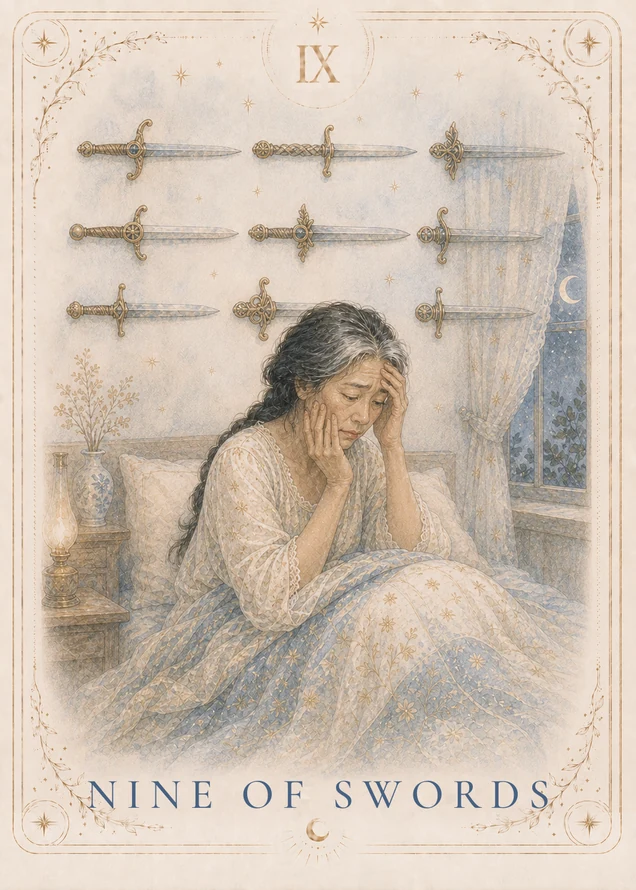
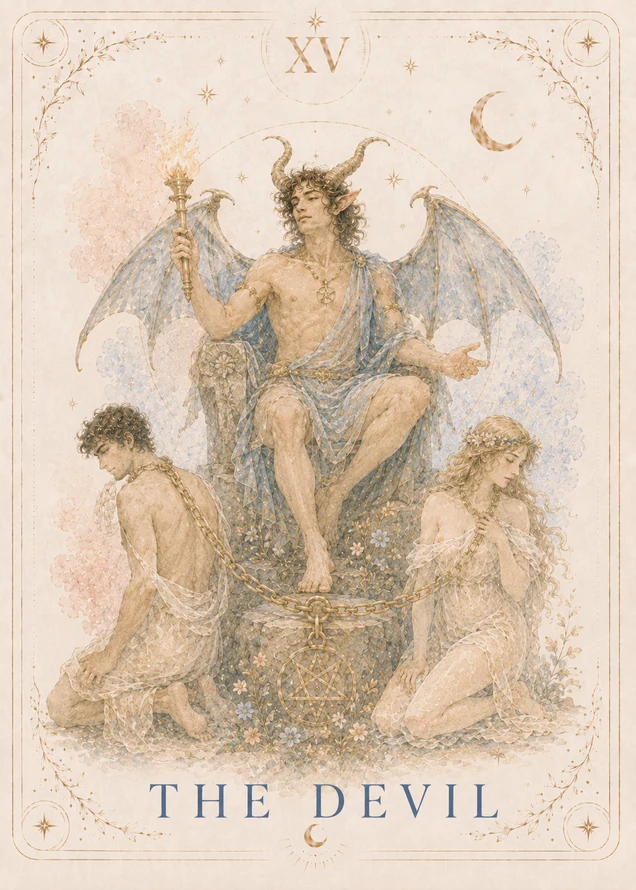
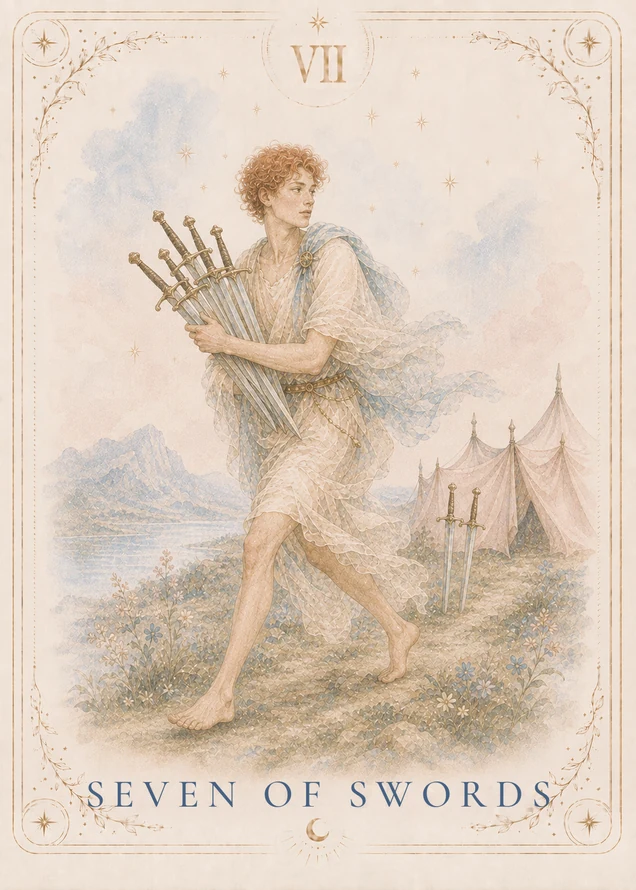
Tradition & Lunaire’s interpretation
The traditional foundation
Waite describes a bound, blindfolded figure and calls the restriction temporary rather than irretrievable. His main upright list includes crisis, censure, constrained power, conflict, slander, and sickness; the reversal includes difficulty, opposition, accident, treachery, the unforeseen, and fatality. The additional upright entry predicts scandal concerning a woman, while the additional reversal gives a relative’s departure.
Lunaire’s reading
Lunaire preserves restriction and limited sight while treating the source’s severe predictions and gendered scandal as historical material. The chosen inward-constraint reversal follows a documented contemporary interpretation; release is another modern reversed interpretation. Unlike readings that make all the bindings self-imposed, this meaning allows real external barriers and does not promise that changing an attitude will remove them.
Read the source in The Pictorial Key to the Tarot ↗
Waite: additional divinatory meanings ↗
Biddy Tarot: Eight of Swords ↗
Arthur Edward Waite. The Pictorial Key to the Tarot. W. Rider; [1911]. Illustrations by Pamela Colman Smith. Source edition details ↗