


Major Arcana
The Devil
The Devil names the attachment that offers something real while quietly setting its terms.
- attachment
- desire
- cost
- bargain
Read the card in its own right, then follow its meaning through the spread.
Two orientations
The card’s meaning
The Devil brings attachment and constraint into view within the Major sequence. Its concern is the relationship between what holds appeal and what limits choice, including how that relationship can be questioned.
Upright
The Devil names the attachment that offers something real while quietly setting its terms.
The Devil concerns attachments that limit choice while providing something wanted or familiar. Pleasure, relief, security or habit may help explain why an arrangement persists even when its costs are clear. Its appeal belongs in the examination alongside the freedom it restricts and the actions that sustain it. Desire is not evidence of weakness, and recognizing a constraint does not establish how easily it can be changed.
- attachment
- desire
- cost
- bargain
Reversed
The Devil reversed shows an attachment being questioned without pretending its pull has disappeared.
The Devil reversed describes an attachment being questioned as its costs become clearer. Its pull may be weakening, but a habit, obligation or connection can still provide something wanted. Recognition and practical change are different stages: an altered action, arrangement or source of support may be needed for more choice to become possible. Questioning the bond does not promise release or make continued attachment a failure of will.
- questioned attachment
- release
- changed terms
- practice
How the reversal changes the emphasis
This reversal does not guarantee release. It brings the attachment into question and asks what practical change would make that recognition visible.
The question changes the emphasis
Reading this card in context
Each spread gives its cards different roles. The examples below explore this card as an influence, a situation or challenge, and advice or support. Begin with the question your position asks, wherever it falls in the spread.
As an influence
Upright
A habit, obligation or appealing arrangement may have shaped the question, particularly where its benefits made its costs less noticeable.
Reversed
An earlier effort to change a binding pattern may still shape how much freedom feels possible and what the old arrangement continues to provide.
As a situation or challenge
Upright
Consider whether an attachment is narrowing choice, including what it provides and what it asks in return.
Reversed
Bring attention to the difference between naming a constraint and actually changing the arrangement that keeps it in place.
As advice or support
Upright
Look for a change within reach that would reduce the cost of an attachment while taking its remaining appeal seriously.
Reversed
Choose a repeated action or condition you could change, with attention to the support needed to make that change possible.
Read through a particular life focus
Open reading
Consider whether something appealing or familiar is narrowing choice, including what a realistic change would need.
Love & relationships
Examine the appeal and limits of a connection without using the card to label another person or infer hidden intentions.
Work & direction
A commitment or reward may be considered for the choices it permits and the costs of maintaining it.
Home & family
A familiar arrangement can be examined for both support and restriction without deciding that belonging itself is the problem.
Self-growth
Notice a pattern’s remaining appeal alongside any wish to change it, and consider what support would make a different response possible.
Look a little closer
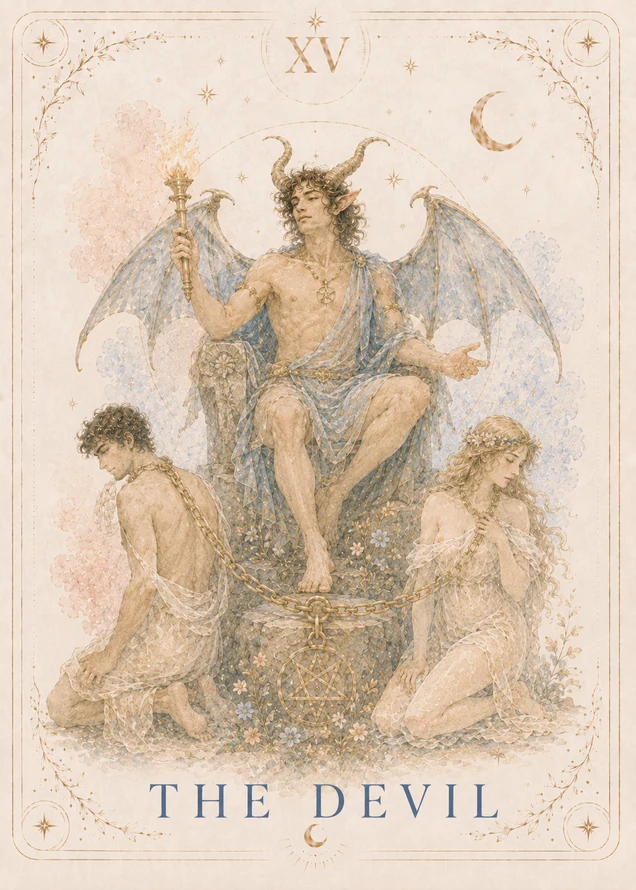
The imagery
Shared chain
A gold chain joins both kneeling figures to a ring on the pedestal.
The bond is visible and shared, showing how a useful, desired, or familiar arrangement can also limit choice.
Flaming torch
The horned figure holds a bright torch upright in one hand.
The visible flame gives desire force and attraction; that attraction can make a cost harder to acknowledge.
Pedestal and pentagram
The chain meets a ring above a gold pentagram on the stone pedestal.
The attachment has acquired terms and structure; what began as an impulse may now be supported by a routine, role, or bargain.
Similarities & differences
Related cards

Tradition & Lunaire’s interpretation
The traditional foundation
Waite describes material bondage through the chained figures and emphasizes that their apparent master will not rule forever. His symbolic account uses a Christian moral framework that Lunaire does not transfer into judgments about desire or character.
Lunaire’s reading
Lunaire interprets the bond through attachment, genuine appeal and restricted choice. Questioning that bond in reversal is a selected modern reflective lens, not a literal reproduction of Waite’s reversed list. Change may require support as well as recognition; the card establishes neither consent to a constraint nor a diagnosis.
Read the source in The Pictorial Key to the Tarot ↗
Arthur Edward Waite. The Pictorial Key to the Tarot. W. Rider; [1911]. Illustrations by Pamela Colman Smith. Source edition details ↗