



Cups
Eight of Cups
The Eight of Cups leaves familiar satisfaction in search of something more sustaining.
- departure
- search
- disappointment
- meaning
Read the card in its own right, then follow its meaning through the spread.
Two orientations
The card’s meaning
Cups makes this Eight’s journey a question of fulfillment and meaning. The visible walking away supports a departure interpretation without deciding that a reader must end a relationship, leave work, or dismiss something previously valued.
Upright
The Eight of Cups leaves familiar satisfaction in search of something more sustaining.
The cups are still standing, and the figure is walking on. The Eight of Cups recognizes that something once worth pursuing may no longer answer the need that made it meaningful. There can be disappointment here, and a search for deeper meaning. An old pursuit doesn’t have to become worthless before attention can turn elsewhere. The card gives weight to that departure, including the care and practical support a real change of course would need.
- departure
- search
- disappointment
- meaning
Reversed
The Eight of Cups reversed lingers between a familiar life and an uncertain departure.
Knowing that something feels incomplete may not settle whether to stay or leave. The Eight of Cups reversed pauses inside that unfinished decision. Affection for what would be left behind, uncertainty, or the practical cost of changing course can make departure difficult. There may also be something worth returning to with a clearer purpose. Look at what would make staying a renewed choice, and what would make departure possible, rather than letting the question decide itself through delay.
- hesitation
- attachment
- reconsideration
- unfinished change
How the reversal changes the emphasis
Departure is delayed, reconsidered or partly reversed. This selects a documented modern interpretation of hesitation and return, materially different from Waite’s reversed joy and feasting; it does not establish that leaving is the correct choice.
The question changes the emphasis
Reading this card in context
Each spread gives its cards different roles. The examples below explore this card as an influence, a situation or challenge, and advice or support. Begin with the question your position asks, wherever it falls in the spread.
As an influence
Upright
A withdrawal, an abandoned pursuit, or a recognition that an old source of satisfaction no longer suffices may be part of this question’s background.
Reversed
A departure postponed, a return to something familiar, or uncertainty about leaving may be keeping an earlier question active in the present.
As a situation or challenge
Upright
Consider what continuing still offers and, if leaving has appeal, what that wish is reaching toward; both can inform a considered change of course.
Reversed
Consider what could make staying worthwhile and what might make leaving difficult; an actual preference and a practical obstacle deserve different responses.
As advice or support
Upright
Make room to explore a more sustaining direction, with a considered next step and the support that changing course would actually require.
Reversed
Clarify one condition that would make staying worthwhile or leaving possible, giving the unsettled decision something concrete to work with.
Read through a particular life focus
Open reading
A familiar pursuit can be considered through what it still gives and what a wish to move beyond it is seeking.
Love & relationships
In questions of closeness, examine dissatisfaction and the possibility of change without using the card to decide another person’s feelings or whether a connection must end.
Work & direction
A direction that once mattered may invite reconsideration of its purpose and what changing course would involve.
Home & family
A familiar way of living can be examined for what it still sustains and what would be needed to make a different choice.
Self-growth
Notice whether the search for greater meaning calls for a changed relationship to an existing pursuit or movement beyond it.
Look a little closer
The imagery
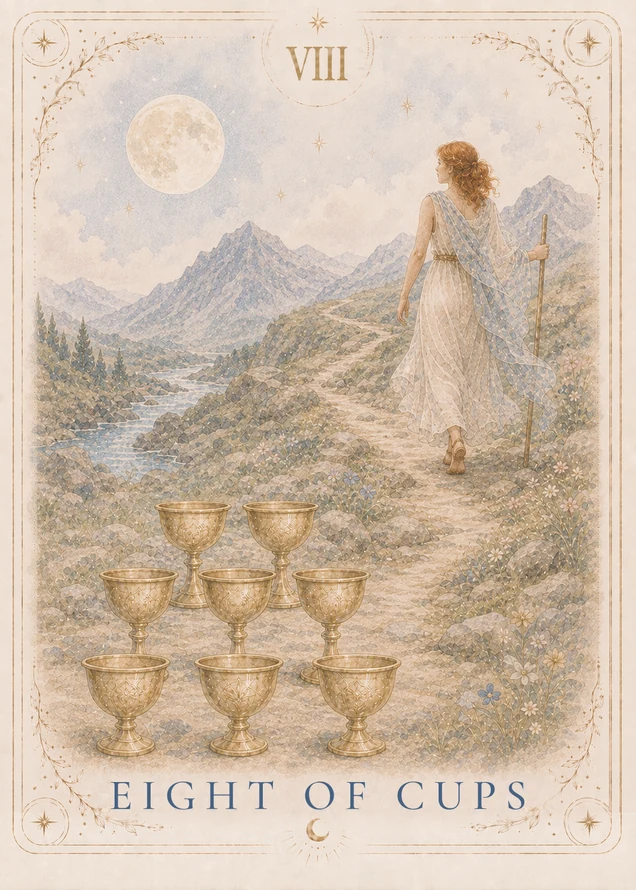
Cups left standing
Eight gold cups remain upright in the foreground in rows of three, three and two.
Something can retain value even when continuing to seek fulfillment there no longer feels sufficient.
Walking figure and staff
The figure faces along the mountain path and holds a tall staff beside the body.
Departure is pictured as a journey requiring support and steps, rather than the disappearance of everything that came before.
River and mountain path
A winding river runs below the path as it continues toward distant mountains.
The search extends beyond what is already gathered, with the destination still open.
Similarities & differences
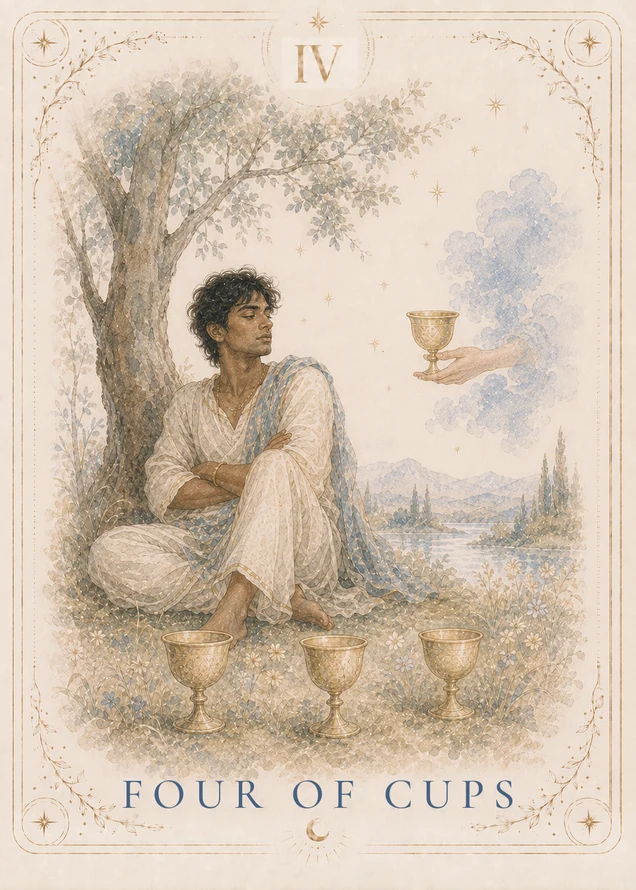
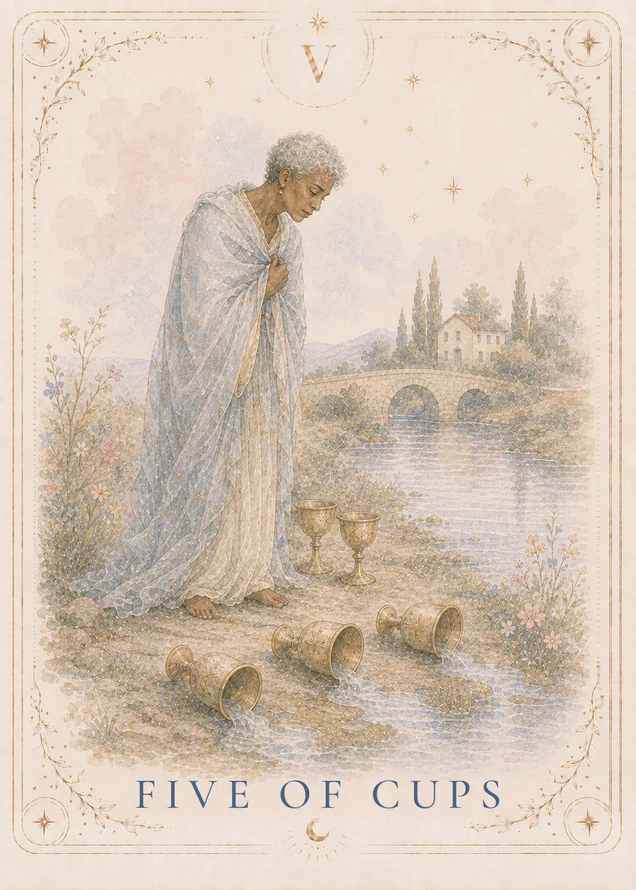
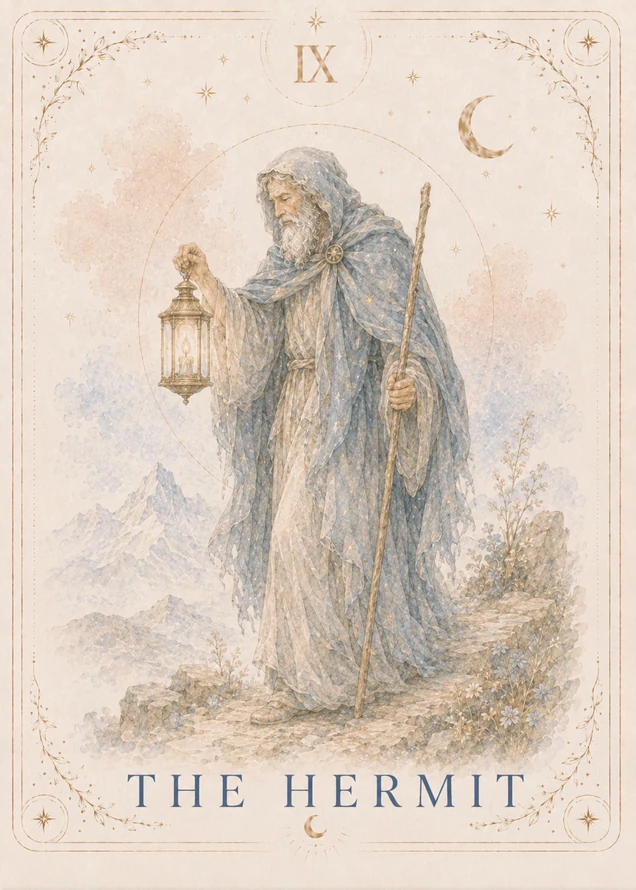
Related cards
Tradition & Lunaire’s interpretation
The traditional foundation
Waite’s image and main account concern leaving a former source of happiness or a matter losing importance, while he acknowledges conflicting upright readings. His reversal gives joy and feasting; the additional list gives satisfaction.
Lunaire’s reading
Lunaire develops the departure and search visible in the image without declaring the old pursuit worthless. The unfinished-departure reversal follows a modern hesitation/return interpretation, not Waite’s celebratory reversal. The source disagreement is retained, and no orientation decides that the reader must leave.
Read the source in The Pictorial Key to the Tarot ↗
Waite: additional meanings for Eight of Cups (Part III §4) ↗
Arthur Edward Waite. The Pictorial Key to the Tarot. W. Rider; [1911]. Illustrations by Pamela Colman Smith. Source edition details ↗