
Major Arcana
Death
Death marks an ending that changes the form of what can come next.
- ending
- transition
- release
- change
Read the card in its own right, then follow its meaning through the spread.
Two orientations
The card’s meaning
Death centers an ending that changes what can follow. Within the Majors it can share transition with other cards while giving particular weight to the completion of a former arrangement.
Upright
Death marks an ending that changes the form of what can come next.
Death concerns an ending that changes the form of what can follow. A role, relationship, commitment or established way of living may no longer continue as it did. The emphasis is on recognizing what has ended, what remains, and how life changes around that difference. What follows may still be unclear, and grief can continue alongside practical change. The card is not a prediction of physical death and does not make an ending painless or automatically beneficial.
- ending
- transition
- release
- change
Reversed
Death reversed holds an ending in suspension, where release is resisted or incomplete.
Death reversed describes an ending whose consequences are not yet fully accepted or carried through. Habit, fear, unfinished feeling or practical needs may keep an old arrangement in place after its role has changed. Recognition may arrive before the emotional or practical work is complete. Understanding what remains unfinished can reveal what care or action is needed; it does not require an immediate break or complete emotional release.
- resistance
- ending
- stagnation
- transition
How the reversal changes the emphasis
This reversal does not make change impossible. It notices where the old form still weighs upon you.
The question changes the emphasis
Reading this card in context
Each spread gives its cards different roles. The examples below explore this card as an influence, a situation or challenge, and advice or support. Begin with the question your position asks, wherever it falls in the spread.
As an influence
Upright
The roots may lie in a real ending or irreversible change, whether or not its meaning has settled.
Reversed
A delayed ending or unfinished transition may still loom, keeping part of the past active and whatever comes next from taking shape.
As a situation or challenge
Upright
Consider what, if anything, has reached an ending, and which parts of the situation still have a purpose.
Reversed
If an ending feels difficult to complete, consider what still needs care and what habit or fear may be prolonging.
As advice or support
Upright
If an ending is clear, acknowledge what it changes before deciding what should follow.
Reversed
Identify a part of a recognized ending that you can complete, while allowing time for the feelings that remain.
Read through a particular life focus
Open reading
Consider whether an ending or change of form is relevant, and what it leaves intact or unfinished.
Love & relationships
A changed connection can be considered without using the card to predict a breakup or decide another person’s intentions.
Work & direction
If a role, method or commitment has ended, distinguish its practical consequences from what remains available to carry forward.
Home & family
A change in home, role or belonging may need acknowledgment without assuming bereavement or any particular family event.
Self-growth
Consider whether an old self-description still fits and what accepting a change would involve, without requiring immediate emotional closure.
Look a little closer
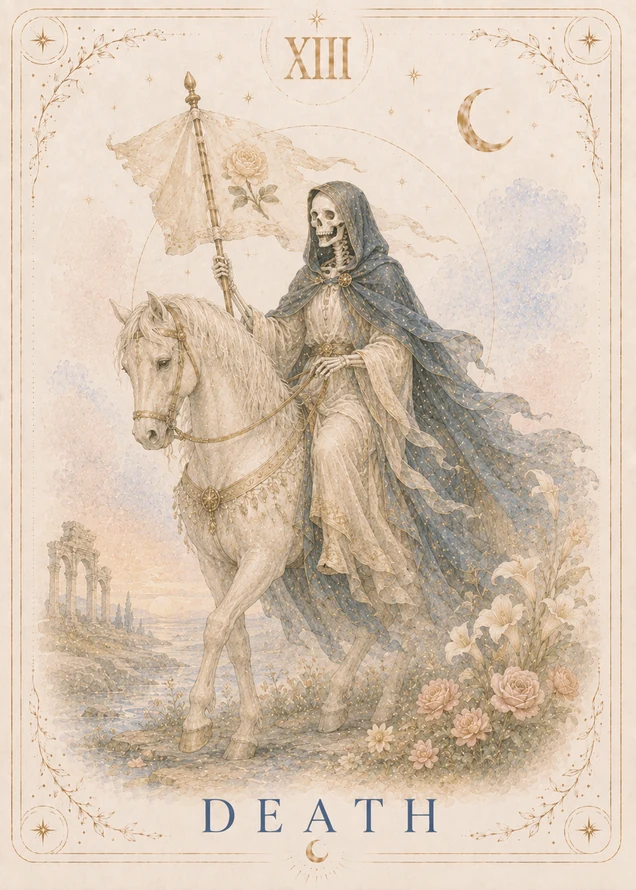
The imagery
Pale horse
A skeletal rider moves forward on a pale horse.
The moving horse presents an ending as a transition with consequences beyond the moment it is recognized.
Rose banner
The rider carries a weathered banner marked by a pale rose.
The flower keeps life and beauty inside the image of ending, refusing to make change only a scene of loss.
Ruined columns
Broken classical columns stand in the distance beside the water.
A former structure can remain part of the landscape after the life organized around it has changed.
Water among the rocks
A narrow watercourse runs among rocks below the distant ruined columns.
The surrounding landscape keeps continuity visible alongside the ending, without specifying the next form life will take.
Similarities & differences
Related cards
Tradition & Lunaire’s interpretation
The traditional foundation
Waite’s symbolic account links Death with transformation and passage, and describes the banner’s rose as a sign of life. His discussion allows both bodily and mystical senses; it is not identical to Lunaire’s reflective use.
Lunaire’s reading
Lunaire selects endings and changes of form as reflective meanings and explicitly makes no physical-death prediction. The delayed-transition reversal connects stagnation with difficulty carrying an ending through, while leaving room for grief and practical unfinished work. It does not guarantee renewal or require an abrupt break.
Read the source in The Pictorial Key to the Tarot ↗
Arthur Edward Waite. The Pictorial Key to the Tarot. W. Rider; [1911]. Illustrations by Pamela Colman Smith. Source edition details ↗