
Major Arcana
The World
The World brings a cycle to completeness as its separate parts become a coherent whole.
- completion
- integration
- wholeness
- accomplishment
- culmination
Read the card in its own right, then follow its meaning through the spread.
Two orientations
The card’s meaning
The World concerns how the parts of a cycle belong together and when that whole can be acknowledged. Completion can be substantial without being perfect, permanent or the final event in a life.
Upright
The World brings a cycle to completeness as its separate parts become a coherent whole.
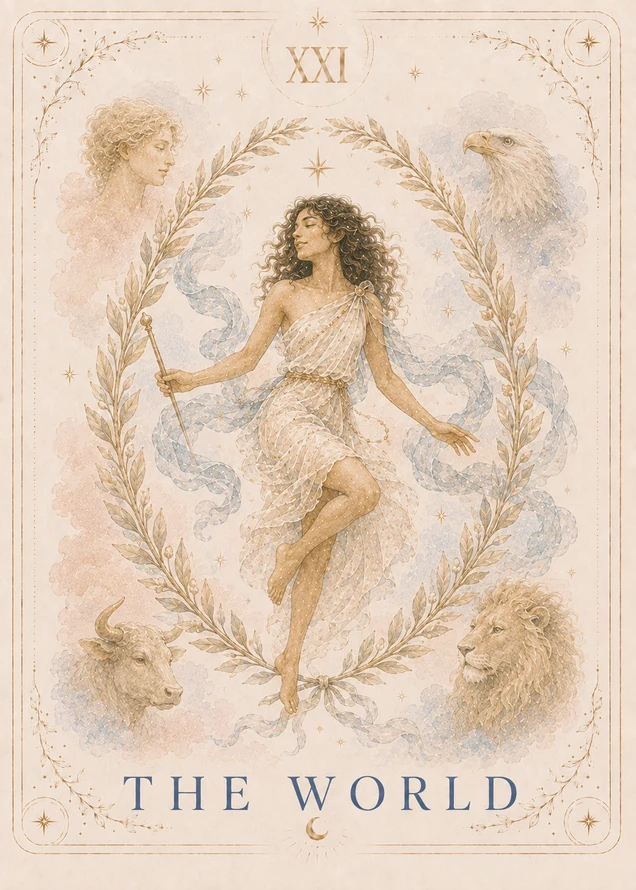
The World places a floating figure inside a completed wreath, with the whole journey gathered around one center. It represents culmination, integration, accomplishment, and the recognition that separate parts now belong to one coherent cycle. The card does not guarantee that every unfinished matter will resolve or that nothing follows. Its completion is specific: this work, chapter, or passage may be ready to stand as a whole. The question is what has truly come together, what deserves acknowledgment, and what no longer needs another revision to be real.
- completion
- integration
- wholeness
- accomplishment
- culmination
Reversed
The World reversed holds a cycle near completion while a piece, recognition, or ending remains outside the wreath.
The World reversed describes a circle that has not quite closed. One piece may remain unfinished, recognition may be withheld from work already done, or a shortcut may have reached the ending without creating a sense of completion. Delay is not failure, and closure cannot always be manufactured on demand. The card asks what the cycle still requires, whether that requirement is practical or emotional, and which loose end truly belongs to this chapter rather than being proof that the whole journey is incomplete.
- unfinished cycle
- missing piece
- delayed closure
- shortcut
- near-completion
How the reversal changes the emphasis
The reversal does not erase accomplishment. It marks the missing piece, delayed acknowledgment, or unfinished transition that keeps the cycle from settling.
The question changes the emphasis
Reading this card in context
Each spread gives its cards different roles. The examples below explore this card as an influence, a situation or challenge, and advice or support. Begin with the question your position asks, wherever it falls in the spread.
As an influence
Upright
A completed passage, hard-earned accomplishment, or growing sense of wholeness may help shape the question.
Reversed
An unfinished cycle, skipped step, or accomplishment never fully acknowledged may still shape why the present question feels incomplete.
As a situation or challenge
Upright
Look at what has actually come together, including the connections between parts that once seemed separate or unfinished.
Reversed
Consider what genuinely remains unfinished in this cycle and which unresolved matters belong elsewhere.
As advice or support
Upright
Consider how a completed part of the work or experience could be acknowledged before deciding what follows.
Reversed
Complete or consciously release one remaining piece, then let the finished portion stand without reopening the whole journey.
Read through a particular life focus
Open reading
Consider what has come together and what kind of acknowledgment fits it. Reversal may concern a specific remainder or a completion that has not yet been recognized.
Love & relationships
Explore whether a passage in a connection feels integrated or whether something relevant remains unaddressed. A completed phase can coexist with an ongoing relationship.
Work & direction
Look at the scope of the work and what would count as its completion. Separate the tasks needed to finish it from additional work that belongs to another project or phase.
Home & family
Consider a household transition, shared accomplishment or family chapter that could be acknowledged. People may reach a sense of completion at different times.
Self-growth
Explore what has been learned or integrated through a passage. A feeling of closure may follow its own pace, while particular accomplishments can still be recognized.
Look a little closer
The imagery
Oval laurel wreath
Two leafy branches form a tall oval around the central figure and meet in a blue bow below.
The wreath frames a completed cycle without sealing it shut; what has come together can be recognized while life continues beyond it.
Floating figure and flowing ribbons
The central figure floats with a slender gold wand while cream fabric and long blue ribbons move around their body.
The suspended pose feels active rather than fixed; the gathered work can be inhabited before movement begins again.
Four surrounding figures
A human face, eagle, bull, and lion appear in pale clouds around the four sides of the wreath.
The four witnesses hold different aspects around one center, suggesting wholeness built from coordinated difference.
Similarities & differences
Related cards
Tradition & Lunaire’s interpretation
The traditional foundation
Waite’s symbolic World concerns fulfillment and the completed order of a cosmos, with a spiritual vision of the whole. His account links material completion with a more expansive image of things understood together, while rejecting several rival identifications of the central figure.
Lunaire’s reading
Lunaire brings this image of wholeness to a particular chapter, passage or body of work whose parts can be integrated and acknowledged. The selected delayed-completion reversal includes a practical remainder, missing acknowledgment or an ending not yet felt as whole. It preserves achieved value while asking what this cycle still needs.
Read the source in The Pictorial Key to the Tarot ↗
Arthur Edward Waite. The Pictorial Key to the Tarot. W. Rider; [1911]. Illustrations by Pamela Colman Smith. Source edition details ↗