


Cups
Ten of Cups
Shared affection and belonging make room for a life that feels emotionally whole.
- fulfillment
- belonging
- harmony
- affection
Read the card in its own right, then follow its meaning through the spread.
Two orientations
The card’s meaning
The Ten gathers the emotional life of Cups into shared fulfillment: affection can become a sustaining sense of belonging. This is a picture of happiness with others, available through many forms of connection, rather than a guarantee of marriage, children, or a permanent happy ending.
Upright
Shared affection and belonging make room for a life that feels emotionally whole.
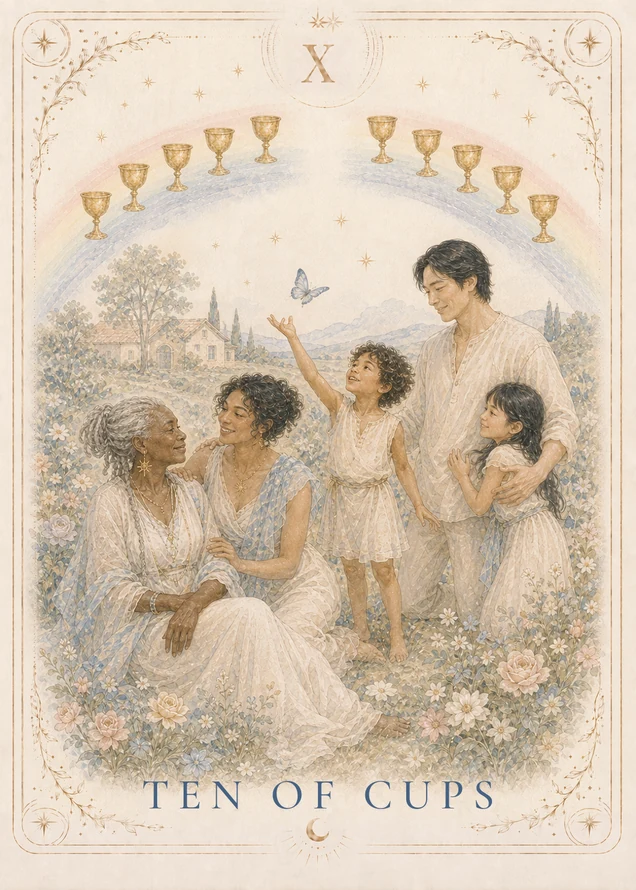
The Ten of Cups names a happiness that has room for more than one person. Affection, trust, and a sense of belonging come together into a life people can enjoy sharing. A circle of friends, a partnership, or another chosen bond may give that fulfillment a home. The rainbow holds all ten cups in one curve, while the figures below remain themselves. This is shared contentment, capable of including different needs and imperfect days.
- fulfillment
- belonging
- harmony
- affection
Reversed
Shared happiness is strained when belonging cannot make room for the feelings actually present.
The Ten of Cups reversed brings the strain inside a hoped-for togetherness into view. People may care about one another and still want different lives, or find that a shared ideal leaves some feelings unspoken. Discord matters even when the picture looks complete. This card asks what kind of belonging can be honest about the people involved, including when harmony cannot be restored simply by trying harder. A wish for happiness needs room for the truth of an imperfect bond.
- discord
- disconnection
- expectation
- belonging
How the reversal changes the emphasis
The shared fulfillment of the upright card is difficult to inhabit because connection is strained or a common ideal excludes real differences. This selects a reflective lens for disharmony; it does not predict the fate of a relationship or require reconciliation.
The question changes the emphasis
Reading this card in context
Each spread gives its cards different roles. The examples below explore this card as an influence, a situation or challenge, and advice or support. Begin with the question your position asks, wherever it falls in the spread.
As an influence
Upright
An experience or hope of shared happiness may have shaped what feels worth protecting, choosing, or building in this question.
Reversed
A hope of keeping people happy together, or a difference that hope could not contain, may be part of the question’s background.
As a situation or challenge
Upright
Notice where affection and belonging are already real, and whether the picture of a good life makes room for everyone involved.
Reversed
Look for a difference between the shared ideal and what can honestly be felt, said, or lived by those involved.
As advice or support
Upright
Make time for a form of togetherness that people can enjoy freely, allowing different needs to belong within the same circle.
Reversed
Name a real point of agreement and a real difference, then consider what form of connection can make room for both.
Read through a particular life focus
Open reading
Consider what shared emotional fulfillment would mean in this question and whose experience belongs within that picture.
Love & relationships
A bond can be considered through the affection, ease, and belonging it allows, with room for each person’s account of happiness.
Work & direction
A shared undertaking may invite attention to the quality of belonging and satisfaction it makes possible for those taking part.
Home & family
Home can be explored as a form of emotional belonging, whether it involves relatives, chosen family, community, or an idea still taking shape.
Self-growth
Notice how a personal idea of a good life makes room for connection and for differences within it.
Look a little closer
The imagery
Rainbow of ten cups
Ten gold cups follow the curve of a rainbow across the top of the scene.
Emotional fulfillment can include several lives and feelings within a shared sense of belonging.
Group of five figures
Two adults sit at the left; another stands at the right with an arm around a child, while a second child reaches toward a blue butterfly.
Affection takes different forms within a shared life, allowing both closeness and individual delight.
House beyond the flowers
A small house stands beyond the flowering foreground, with trees and hills behind it.
The idea of home can give shared happiness a place to be lived, without prescribing a particular household or family structure.
Similarities & differences
Related cards
Tradition & Lunaire’s interpretation
The traditional foundation
Waite associates the Ten with settled contentment, fulfilled affection and friendship, and residence; his reversal names damaged peace and serious discord. His additional account adds marriage upright and sorrow or quarrel reversed.
Lunaire’s reading
Lunaire retains shared emotional fulfillment and its disruption while widening belonging beyond Waite’s gendered marriage and household predictions. The reversal addresses discord and the gap between an ideal of togetherness and actual feeling; it does not forecast violence, separation, or reconciliation. The illustrated group is not assigned a genealogy.
Read the source in The Pictorial Key to the Tarot ↗
Waite: additional meanings for Ten of Cups (Part III §4) ↗
Arthur Edward Waite. The Pictorial Key to the Tarot. W. Rider; [1911]. Illustrations by Pamela Colman Smith. Source edition details ↗