
Pentacles
Ten of Pentacles
Lasting security grows through resources and arrangements that can support more than one life.
- continuity
- inheritance
- shared security
- legacy
Read the card in its own right, then follow its meaning through the spread.
Two orientations
The card’s meaning
The Ten gathers material attainment into continuity beyond an individual moment or accomplishment. Wealth, family, inheritance and property are traditional associations; Lunaire also makes room for chosen communities, shared knowledge and practical support without claiming these erase the older meanings.
Upright
Lasting security grows through resources and arrangements that can support more than one life.
The Ten of Pentacles gathers material well-being into something that can last and be shared. A home, accumulated resources, practical knowledge, or an established undertaking may support lives beyond the person who first built it. Inheritance includes what is received and what is carried forward. This card values continuity, provision, and belonging through tangible support. That support can take many forms; it does not require a conventional family, property ownership, or a tradition that must remain unchanged.
- continuity
- inheritance
- shared security
- legacy
Reversed
Lasting support is harder to rely on when shared or inherited arrangements come under strain.
The Ten of Pentacles reversed examines strain in the arrangements meant to provide lasting support. Resources may be uncertain, their benefits unevenly shared, or inherited expectations poorly suited to the people now involved. Something can endure without giving everyone a dependable place within it. The card asks what continuity would need to include or change to remain supportive. It does not predict a loss or require preserving a family, institution, or agreement at any cost.
- insecurity
- unequal support
- inherited expectations
- revision
How the reversal changes the emphasis
The upright promise of durable shared support is obstructed by fragility, unequal access or expectations that no longer fit. These are related ways continuity can fail to support people, not predictions of a particular dispute or financial event.
The question changes the emphasis
Reading this card in context
Each spread gives its cards different roles. The examples below explore this card as an influence, a situation or challenge, and advice or support. Begin with the question your position asks, wherever it falls in the spread.
As an influence
Upright
An inherited resource, established arrangement, or experience of lasting support may have influenced what security and continuity mean in this question.
Reversed
Uncertain support, an inherited expectation, or an unequal share in a common resource may have brought continuity into question.
As a situation or challenge
Upright
Consider what makes support dependable over time, who can share in it, and what its continued care requires.
Reversed
Look at what the arrangement promises, what it provides in practice, and whose needs or contributions are difficult to include.
As advice or support
Upright
Tend a shared resource or pass on useful knowledge in a way that makes its benefit easier for others to continue.
Reversed
Clarify what support is dependable and whether access or expectations could be revised, allowing practical limits to shape what can safely change.
Read through a particular life focus
Open reading
Consider what can provide support over time and what is being received, maintained, or passed onward.
Love & relationships
A connection’s practical future can be considered through how support and commitments are shared, without assuming that affection requires a particular household or family form.
Work & direction
An undertaking may raise questions about the resources, knowledge and arrangements that allow its benefits to continue beyond one person’s effort.
Home & family
Consider which inherited or chosen arrangements make everyday life dependable, and what changes would let that support include the people who need it.
Self-growth
The resources and customs received from others can be examined for what they enable and what you would choose to carry forward.
Look a little closer
The imagery
Figures of different ages
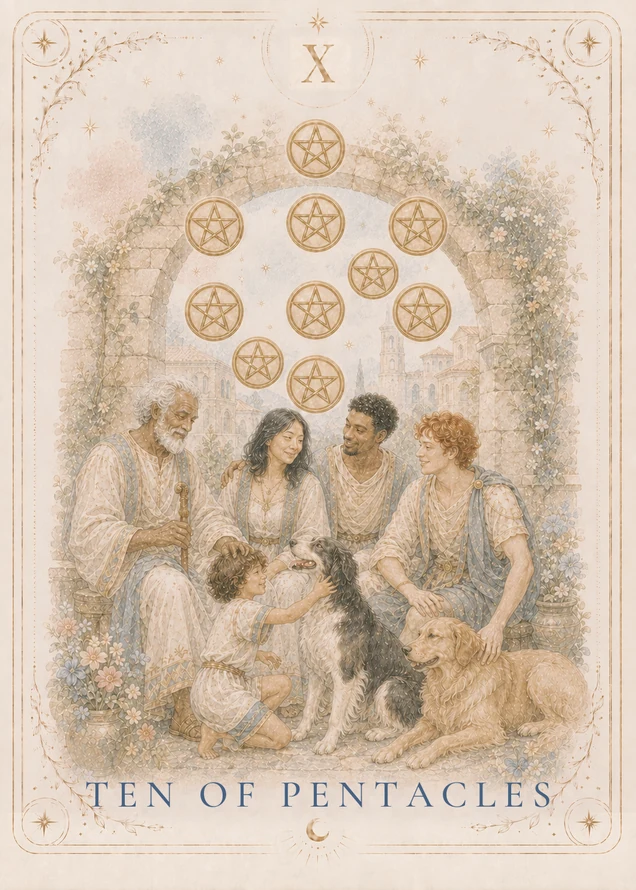
A gray-haired figure with a staff sits beside three younger adults and a child; two dogs rest among them.
Several lives share the scene, giving continuity a wider scale than one person’s accomplishment; their exact relationships are not established by the image.
Stone arch and town
A flowering stone arch frames the group, with substantial buildings visible through it.
Lasting support can take forms that outlive a moment: shelter, shared places and arrangements people maintain together.
Ten pentacles above the group
Ten gold disks occupy the space across and beneath the arch, above the figures.
Material abundance belongs to the larger arrangement, inviting attention to how its benefits are shared and carried forward.
Similarities & differences
Related cards
Tradition & Lunaire’s interpretation
The traditional foundation
Waite places an older figure, adults, a child and dogs within a household setting. Upright, he names wealth, family matters, records and ancestry; reversed, he includes chance, loss, theft and gambling, but also gifts, marriage provision and pensions. Part III §4 makes the dwelling’s meaning depend on neighboring cards and allows either favorable or unfavorable circumstances reversed.
Lunaire’s reading
Lunaire retains material continuity, inheritance and provision while widening belonging beyond bloodline or property ownership. Biddy Tarot’s account supports long-term shared security and, reversed, questioning the life expected of someone or confronting instability. Lunaire selects blocked shared support, without predicting a loss, diagnosing a household, or requiring preservation of an inherited arrangement. The native group’s additional adult remains an artwork observation, not an invented family relationship.
Read the source in The Pictorial Key to the Tarot ↗
Biddy Tarot: Ten of Pentacles ↗
Arthur Edward Waite. The Pictorial Key to the Tarot. W. Rider; [1911]. Illustrations by Pamela Colman Smith. Source edition details ↗