

Major Arcana
The Hierophant
The Hierophant carries knowledge through shared forms, linking personal understanding with inherited practice.
- tradition
- teaching
- shared practice
- belonging
- institution
Read the card in its own right, then follow its meaning through the spread.
Two orientations
The card’s meaning
The Hierophant concerns how people receive knowledge, meaning, and belonging through shared forms. Its scope includes teachers, institutions, customs, and rituals, along with the personal judgment involved in entering, maintaining, or revising them.
Upright
The Hierophant carries knowledge through shared forms, linking personal understanding with inherited practice.
Teaching, ritual, and shared practice carry knowledge between people in The Hierophant. A teacher or institution may preserve experience that would be difficult to recreate alone, offering a way to learn and a sense of belonging. Participation can begin before every reason behind a practice is understood. The value of the tradition rests in what it teaches, what it asks of those taking part, and whether its authority deserves trust.
- tradition
- teaching
- shared practice
- belonging
- institution
Reversed
The Hierophant reversed examines inherited authority and the beliefs expressed through familiar practices.
The Hierophant reversed brings inherited beliefs and familiar practices under personal examination. A teaching may need to be understood in new terms; an institution’s rules may conflict with its stated values; belonging may ask for silence where questions matter. The response can involve keeping, revising, or leaving a practice. Its meaning comes from considered belief and participation, with room to understand what remains valuable and what no longer fits.
- personal belief
- questioning tradition
- nonconformity
- chosen practice
How the reversal changes the emphasis
Tradition may still carry meaning; custom simply can no longer answer for it without personal examination.
The question changes the emphasis
Reading this card in context
Each spread gives its cards different roles. The examples below explore this card as an influence, a situation or challenge, and advice or support. Begin with the question your position asks, wherever it falls in the spread.
As an influence
Upright
A teacher, institution, family custom, or inherited belief may have supplied the language through which the question is now understood.
Reversed
An inherited rule, a contested teaching, or the cost of belonging may still shape which answers feel acceptable now.
As a situation or challenge
Upright
Consider what an established practice teaches, what taking part requires, and whether you trust how its authority is used.
Reversed
Consider what you believe beneath the custom, how you arrived at it, and whether there is room to ask questions.
As advice or support
Upright
Return to the source of the teaching, understand its purpose, and deliberately choose what deserves to be carried forward.
Reversed
Understand what the practice means to you before deciding which parts to keep, adapt, or leave behind.
Read through a particular life focus
Open reading
Consider which teaching, practice, or institution offers useful guidance, and what you would need to understand before choosing how to take part.
Love & relationships
Look at the beliefs or shared practices that shape what commitment means to you, and where another person’s understanding may differ.
Work & direction
Consider what a mentor, established method, or professional community can teach you, alongside the judgment you need to bring to it.
Home & family
Look at a family custom or shared ritual: what it carries, who it includes, and which parts you want to continue or adapt.
Self-growth
Examine a belief or practice at its source and consider how learning, questioning, and personal experience affect what you choose to keep.
Look a little closer
The imagery
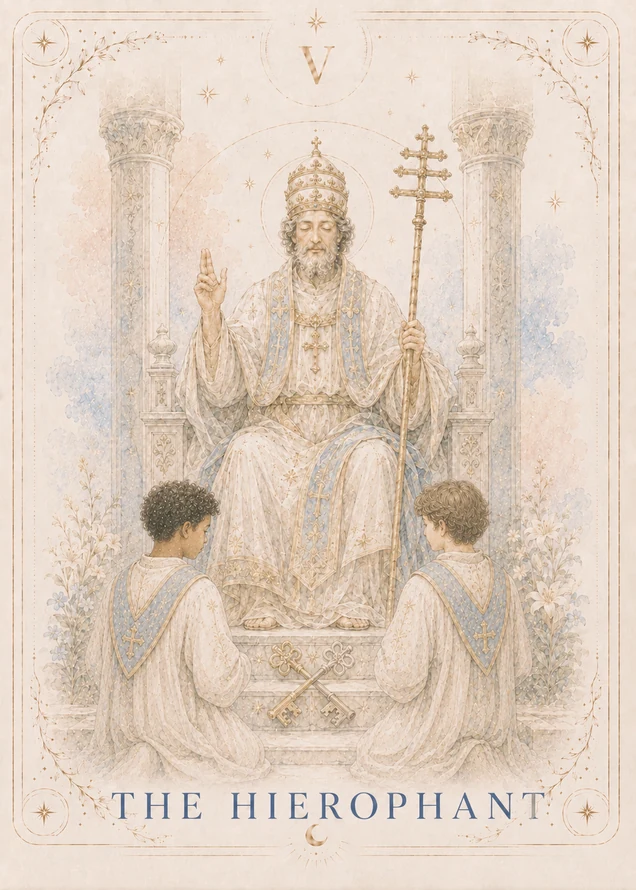
Blessing gesture and attendants
The seated figure raises two fingers while two robed attendants kneel before the steps.
Learning can happen through a teacher and shared form, provided participation does not replace personal judgment.
Triple cross
A tall gold staff with three horizontal bars is held beside the seated figure.
The staff marks an office carrying inherited knowledge; its authority comes from a lineage or institution as well as the individual.
Crossed keys
Two ornate gold keys cross on the front of the lowest stone step.
The keys suggest access through teaching and initiation; tradition can open meanings that private invention might miss.
Similarities & differences
Related cards
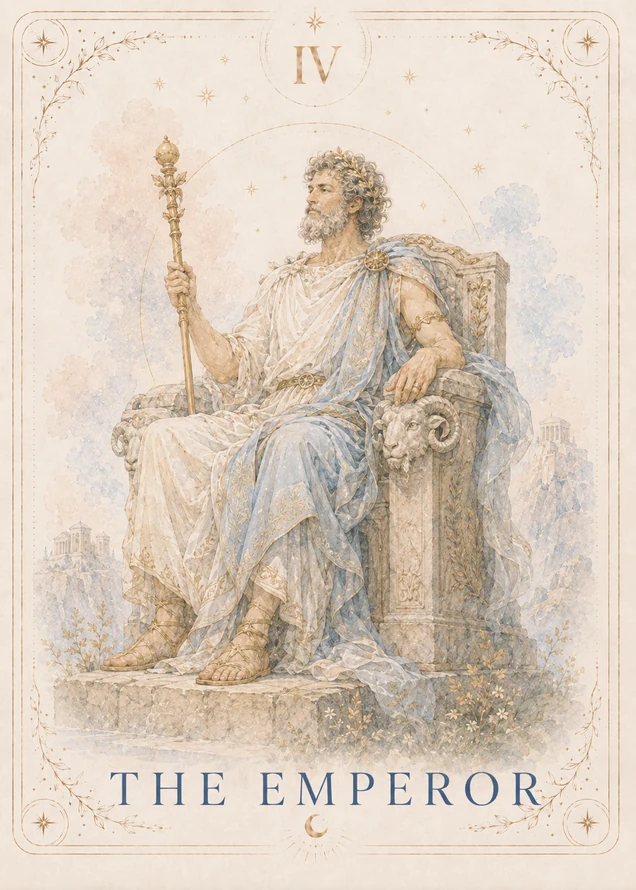
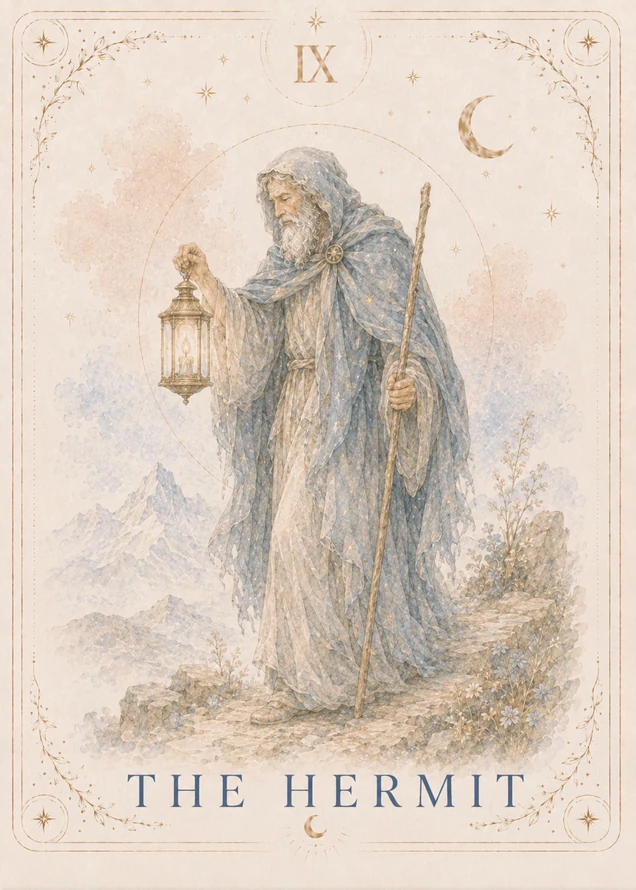
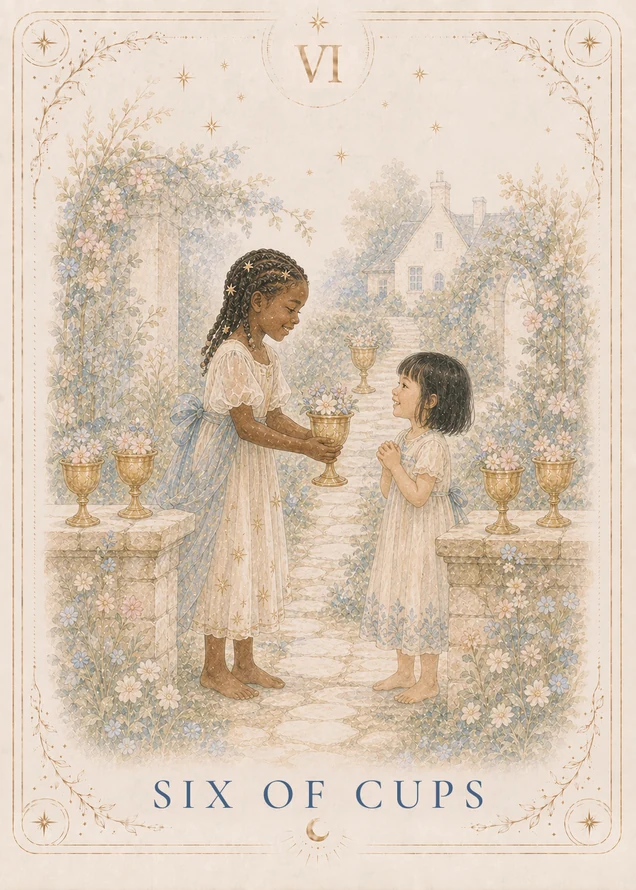
Tradition & Lunaire’s interpretation
The traditional foundation
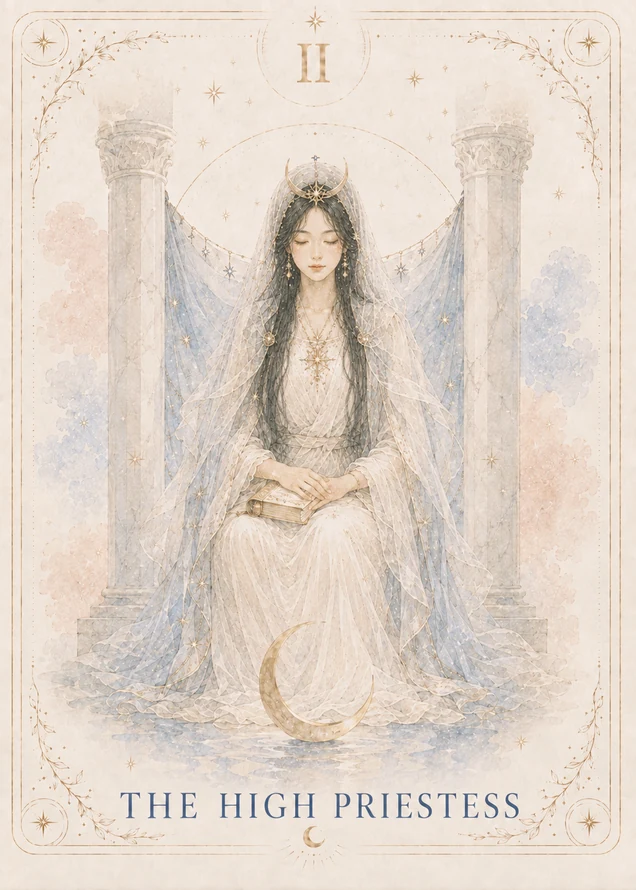
A. E. Waite, The Pictorial Key to the Tarot, Part II §2, The Hierophant: outward religion, recognized hierarchy, teaching, and access through an established institution, contrasted with the inward mystery of the High Priestess; compare Part III §3 for divinatory variants.
Lunaire’s reading
Lunaire broadens the historical religious office into teaching, tradition, ritual, and shared practice, while retaining the institution and what participation in it asks of people. Its selected blocked-or-resisted reversal examines inherited belief and possible revision. This is a modern interpretive choice, not Waite’s literal reversed list; examination can also lead to keeping a tradition.
Read the source in The Pictorial Key to the Tarot ↗
Arthur Edward Waite. The Pictorial Key to the Tarot. W. Rider; [1911]. Illustrations by Pamela Colman Smith. Source edition details ↗