



Cups
Six of Cups
The Six of Cups brings remembered warmth into the kindness available now.
- memory
- kindness
- familiarity
- innocence
Read the card in its own right, then follow its meaning through the spread.
Two orientations
The card’s meaning
Cups gives this Six a language of remembered affection and simple exchange. The pictured young figures can suggest childhood or innocence, without requiring a happy childhood, a family reunion, or a return to a former relationship.
Upright
The Six of Cups brings remembered warmth into the kindness available now.
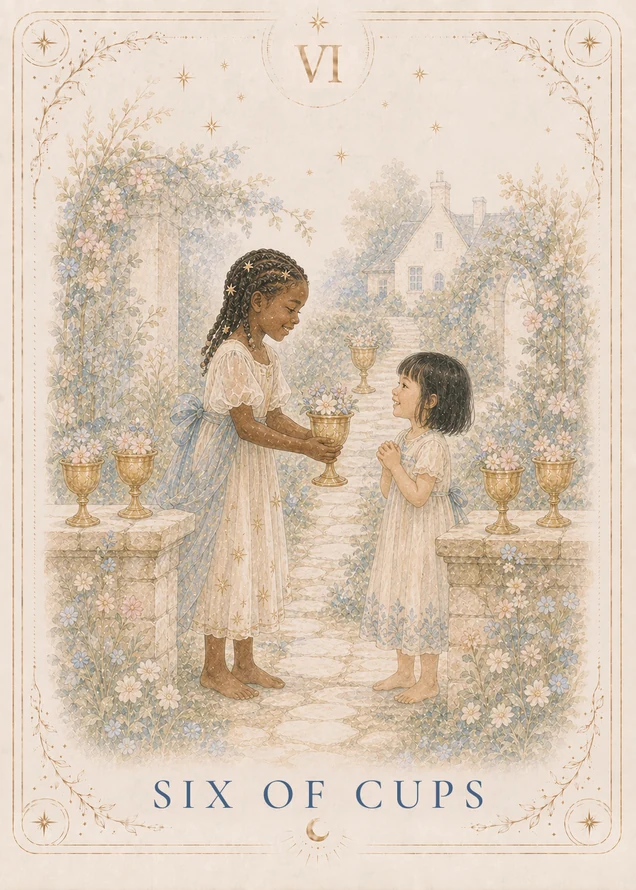
An old song can bring back the ease of a particular afternoon. The Six of Cups gives that remembered sweetness a place: affection, play, and the simple pleasure of giving something just because it will be liked. Its flower-filled cup passes between two figures. A familiar gesture can carry care across time, making an earlier joy available in a present form. The past offers something to receive, share, or enjoy again.
- memory
- kindness
- familiarity
- innocence
Reversed
The Six of Cups reversed asks memory to make room for the present.
The Six of Cups reversed describes nostalgia that makes change difficult to welcome. A familiar role may be kept intact, or a pleasure expected to feel exactly as it once did. The flowers in the offered cup remain an image of affection. In this reversal, the concern is whether fondness for an earlier time limits attention to the person or experience available now, and whether something valued can continue in a different form.
- nostalgia
- attachment
- change
- recognition
How the reversal changes the emphasis
The comfort of memory becomes an insistence on repetition. This selects a modern excess lens; Waite’s reversed future and renewal remain a different historical reading.
The question changes the emphasis
Reading this card in context
Each spread gives its cards different roles. The examples below explore this card as an influence, a situation or challenge, and advice or support. Begin with the question your position asks, wherever it falls in the spread.
As an influence
Upright
A remembered kindness, an old pleasure, or a familiar way of showing affection may be part of what makes this question matter.
Reversed
An old expectation, a familiar role, or comparison with a cherished time may have helped shape what seems acceptable in the present question.
As a situation or challenge
Upright
Notice what a memory offers now: the gesture, quality of company, or simple enjoyment that still deserves a place in the present.
Reversed
Consider whether a cherished memory is asking the present to stay the same, and what the person or pleasure involved is offering now.
As advice or support
Upright
Revisit a pleasure that still feels welcome, or pass on a small kindness in a form suited to the people involved now.
Reversed
Keep one valued part of a memory while allowing its expression to change; discover what can be enjoyed without recreating the whole scene.
Read through a particular life focus
Open reading
A familiar pleasure or remembered kindness may show what still has value in the present question.
Love & relationships
In questions of closeness, an old gesture of affection can be considered alongside the people and wishes present now.
Work & direction
A pleasure in learning or making something may be worth revisiting, with room for how interests and abilities have changed.
Home & family
A familiar ritual, object, or way of welcoming someone may carry warmth without needing an earlier household to be recreated.
Self-growth
Look at what an earlier delight still offers, and where familiarity may be deciding more than it needs to.
Look a little closer
The imagery
Offered cup
The taller figure holds a gold cup of small flowers toward the smaller figure.
A simple gift gives affection an ordinary, recognizable form.
Flower-filled cups
All six cups hold flowers: four rest on the low walls, one is offered, and one stands farther along the path.
Pleasure can be carried and shared through familiar gestures, with memory giving them additional warmth.
Garden path and house
A stone path runs between flowering walls toward a pale house.
A familiar place can hold remembered ways of being welcomed; that symbolic possibility does not establish the reader’s history.
Similarities & differences
Related cards
Tradition & Lunaire’s interpretation
The traditional foundation
Waite centers remembered enjoyment and childhood in the upright Six, while acknowledging a contrary reading of unfamiliar surroundings and new connections. His reversal points toward the future and renewal.
Lunaire’s reading
Lunaire retains memory, simple affection and the gift in the scene. The reversed insistence on a cherished past selects a modern reading of excessive nostalgia, rather than reproducing Waite’s future-oriented reversal; both are possible interpretive approaches.
Read the source in The Pictorial Key to the Tarot ↗
Arthur Edward Waite. The Pictorial Key to the Tarot. W. Rider; [1911]. Illustrations by Pamela Colman Smith. Source edition details ↗