

Major Arcana
Judgement
Judgement gathers the past into one audible pattern and asks for a present response.
- reckoning
- awakening
- self-review
- calling
- renewal
Read the card in its own right, then follow its meaning through the spread.
Two orientations
The card’s meaning
Judgement gathers experience into a recognition that can change how life is answered now. The call can be modest and practical; it does not need to establish destiny or require an exceptional transformation.
Upright
Judgement gathers the past into one audible pattern and asks for a present response.
Judgement concerns the recognition that becomes possible when memories, choices and consequences are considered together. A larger pattern may become clear enough to revise an old conclusion or answer a long-felt call. Its renewal comes through response: understanding the past changes what can be chosen in the present. Honest review includes responsibility and the possibility of a different course, rather than reducing a person to a fixed verdict about what has already happened.
- reckoning
- awakening
- self-review
- calling
- renewal
Reversed
Judgement reversed hears the call but resists review or response, or doubts the self-trust needed to answer.
Judgement reversed keeps the trumpet audible while the answer remains uncertain. The past may be reviewed through a punishing standard that leaves no room to learn, or review and reflection may be avoided altogether because acknowledging what they reveal would require a change in position. Self-doubt is one possible obstruction, not a verdict on character. The card asks whether reflection is producing understanding or only repeated accusation, which recognition has already arrived, and what makes answering it feel more difficult than continuing as before.
- avoided call
- self-doubt
- harsh self-judgment
- delayed response
How the reversal changes the emphasis
The reversal does not declare the call false. It shows review or response delayed by avoidance, self-doubt, or an unforgiving standard.
The question changes the emphasis
Reading this card in context
Each spread gives its cards different roles. The examples below explore this card as an influence, a situation or challenge, and advice or support. Begin with the question your position asks, wherever it falls in the spread.
As an influence
Upright
An earlier decision, repeated lesson, or moment of awakening may have gathered enough meaning to bring the present question forward.
Reversed
A delayed decision, repeated self-accusation, or call left unanswered may still shape why a different response feels difficult to make.
As a situation or challenge
Upright
Consider what pattern emerges across past choices or experiences, and what response it may invite now.
Reversed
Consider whether reviewing the past is creating understanding, repeating blame, or being avoided, and what could make a fair response possible.
As advice or support
Upright
Choose a present action that answers a clear recognition, allowing what has been understood to influence what follows.
Reversed
Replace the verdict with an account: name what happened, what it changed, and one response that belongs to the present.
Read through a particular life focus
Open reading
Consider what becomes recognizable when several experiences are viewed together, and how it could influence a present choice. Reversal can concern difficulty with the review or its response.
Love & relationships
Explore what the history of a connection makes clearer about choices now. An honest account can support change without declaring reconciliation, separation, or another person’s intentions.
Work & direction
Review work, decisions or experience for a pattern that can inform direction. A felt call can be considered alongside what the review actually shows, without being treated as a command.
Home & family
Consider what a family pattern or shared history invites people to acknowledge, if relevant. Responsibility can be specific without turning the review into a fixed judgment of anyone’s worth.
Self-growth
Explore the difference between reflection that enables learning and review that becomes accusation or avoidance. A present response can be small enough to practice.
Look a little closer
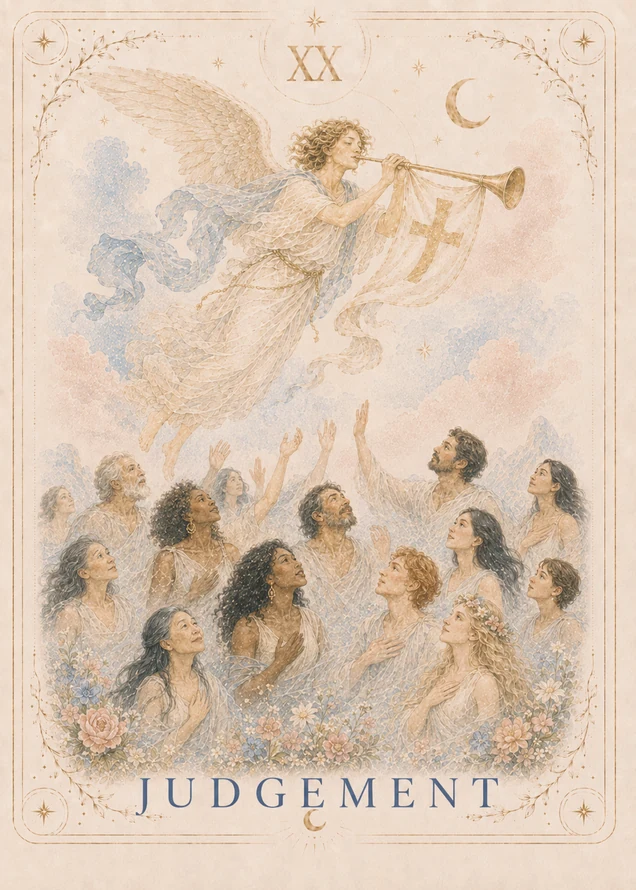
The imagery
Golden trumpet
The winged figure holds a long gold trumpet to their lips above the gathered crowd.
The call makes a recognition audible enough to require a response; what has been heard cannot return to silence unchanged.
White banner with gold cross
A pale banner bearing a large gold cross hangs from the trumpet.
The cross belongs to the card’s inherited imagery; it marks a summons larger than private preference, not proof of approval or condemnation.
Raised hands and open faces
People of varied ages and skin tones look upward through blue and pink flowers with their hands raised.
The image emphasizes response rather than sentencing; recognition becomes consequential when it changes what follows.
Similarities & differences
Related cards


Tradition & Lunaire’s interpretation
The traditional foundation
Waite’s Judgement depicts a bannered trumpet and figures rising in response. His symbolic account emphasizes transformation through a summons heard and answered inwardly, beyond a purely literal Last Judgement or bodily resurrection.
Lunaire’s reading
Lunaire translates the call into recognition reached through review and a present response that can renew direction. Responsibility remains part of this movement, while no outside verdict of worth is inferred. The blocked reversal gives room to avoided reflection, delayed response and self-judgment so harsh that learning becomes difficult.
Read the source in The Pictorial Key to the Tarot ↗
Arthur Edward Waite. The Pictorial Key to the Tarot. W. Rider; [1911]. Illustrations by Pamela Colman Smith. Source edition details ↗