

Major Arcana
Justice
Justice asks for a clear account of what was chosen, promised, given, and received.
- fairness
- proportion
- accountability
- consequence
Read the card in its own right, then follow its meaning through the spread.
Two orientations
The card’s meaning
Justice concerns the relationship among facts, agreements, choices and effects. Its fairness depends on how a judgment is made and applied, allowing better evidence to change the conclusion.
Upright
Justice asks for a clear account of what was chosen, promised, given, and received.
Justice asks for an account that includes the fact, the choice, and the effect. Fairness here is not a promise that everything will balance itself, nor a verdict that difficulty was deserved. It is the work of comparing what was agreed with what occurred, giving each claim its proper weight, and accepting that decisions create consequences. The card favors clear standards and proportion over punishment, with enough honesty to revise a judgment when better evidence appears.
- fairness
- proportion
- accountability
- consequence
Reversed
Justice reversed finds the account incomplete, the measure uneven, or responsibility separated from consequence.
Justice reversed concerns an incomplete or uneven judgment. Important facts may be missing, one consideration may be given too much weight, or different people may be held to different standards. Responsibility can also be admitted without changing what is done. The concern is how evidence, decisions and effects are connected, and what would make the assessment more consistent. This does not establish dishonesty, guilt or a legal wrong.
- imbalance
- selective evidence
- avoided consequence
- revision
How the reversal changes the emphasis
No verdict of guilt follows from this card. Look instead for the partial account and the change that would restore proportion.
The question changes the emphasis
Reading this card in context
Each spread gives its cards different roles. The examples below explore this card as an influence, a situation or challenge, and advice or support. Begin with the question your position asks, wherever it falls in the spread.
As an influence
Upright
An earlier agreement, decision, or imbalance may have established the terms by which the present question is still being measured.
Reversed
An uneven standard, an incomplete account, or a consequence left unacknowledged may still be defining the present terms.
As a situation or challenge
Upright
Compare any relevant promises with what happened, and consider what evidence might support or change your present judgment.
Reversed
Check which facts receive weight, which are being left out, and whether the same measure is applied throughout.
As advice or support
Upright
Choose one fair standard, apply it consistently, and let the decision include responsibility for its likely effects.
Reversed
Look for an omission that can be corrected or a responsibility that can be made specific, using a consistent standard.
Read through a particular life focus
Open reading
Consider what is known, what was agreed and what followed, then ask whether the same standard is being applied throughout.
Love & relationships
An exchange can be examined for clear expectations and fair responsibility without declaring fault or inferring another person’s motives.
Work & direction
Compare relevant commitments with actions and effects, including what evidence could clarify or revise a decision.
Home & family
Consider how responsibilities or shared resources are understood and whether each person’s circumstances receive appropriate weight.
Self-growth
Review a judgment with enough honesty to accept responsibility and enough proportion to avoid turning one mistake into a verdict on character.
Look a little closer
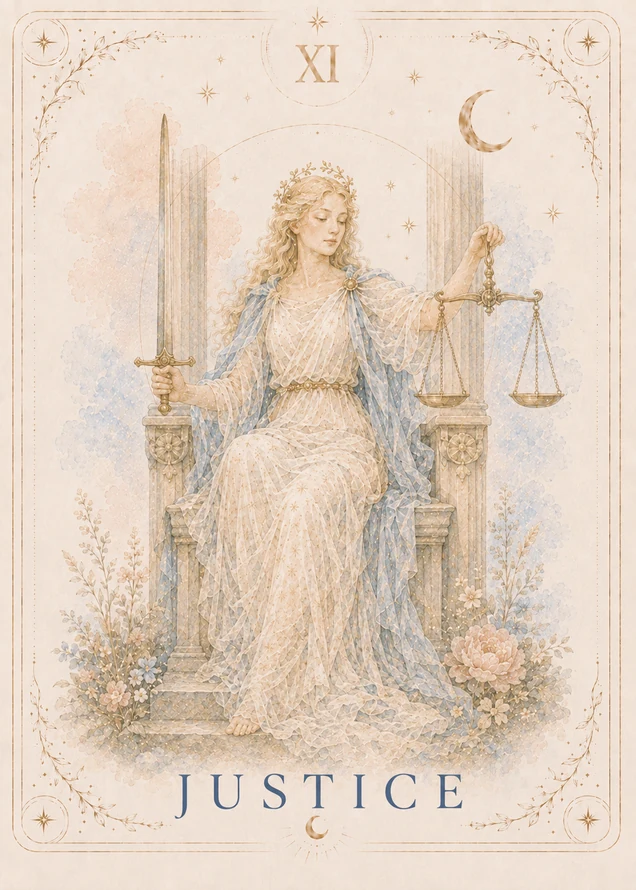
The imagery
Suspended scales
Two shallow gold pans hang from a balance held in the figure’s raised left hand.
Fairness requires comparison and proportion; balance is not always the same as giving every claim identical weight.
Upright sword
A long straight sword is held upright in the figure’s right hand.
A clear account eventually asks for a decision. Discernment becomes meaningful when it changes what follows.
Stone columns
The throne stands between two tall, evenly spaced stone columns.
Accountability needs a stable standard; the measure should not quietly change with the preferred result.
Similarities & differences
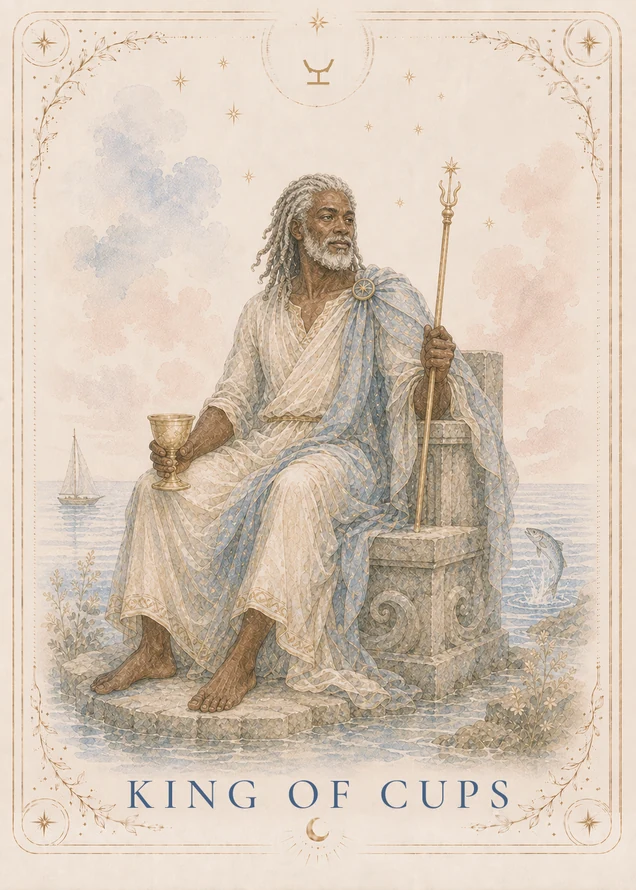
Related cards
Tradition & Lunaire’s interpretation
The traditional foundation
Waite distinguishes Justice’s moral weighing of conduct and consequences from his account of spiritual election. His seated figure between pillars carries a standard of assessment; Lunaire uses that relationship reflectively rather than as a promise of cosmic reward.
Lunaire’s reading
Lunaire retains evidence, proportion, responsibility and consistent standards. The blocked-energy reversal describes an incomplete or uneven assessment and the possibility of correction. It makes no finding about guilt, dishonesty, deserved suffering or a legal result; the task is to examine the account available.
Read the source in The Pictorial Key to the Tarot ↗
Arthur Edward Waite. The Pictorial Key to the Tarot. W. Rider; [1911]. Illustrations by Pamela Colman Smith. Source edition details ↗