

Swords
Seven of Swords
An indirect approach can create room, while leaving part of the matter unresolved.
- strategy
- discretion
- workaround
- omission
Read the card in its own right, then follow its meaning through the spread.
Two orientations
The card’s meaning
Swords makes this Seven an examination of planning and selective information, rather than a blanket verdict of dishonesty or proof of a hidden enemy.
Upright
An indirect approach can create room, while leaving part of the matter unresolved.
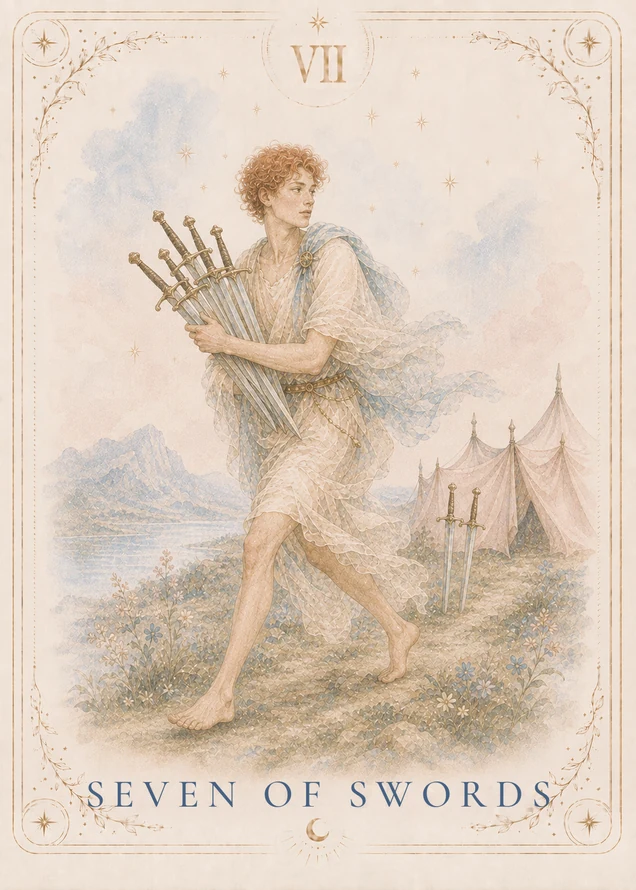
The figure carries five swords away and leaves two standing near the tents. The Seven of Swords concerns an approach taken partly out of view: working independently, choosing what to disclose, or finding a route around an obstacle. There can be ingenuity here, and something unfinished. A workaround deserves a close look at what it accomplishes, what it leaves for later, and whether another person needs information to make a choice of their own.
- strategy
- discretion
- workaround
- omission
Reversed
A private plan becomes easier to reconsider when its missing piece is admitted.
Reversed, the Seven of Swords turns the clever explanation back toward its maker. A plan can sound persuasive while leaving out the very detail that would change it. Honest reconsideration may begin privately, with a note that names the inconvenient part, or through advice from someone able to question the plan. There is room for a different approach once keeping the explanation intact matters less than understanding what it leaves behind.
- self-examination
- counsel
- omitted detail
- reconsideration
How the reversal changes the emphasis
The upright work of devising a route becomes examination of the explanation behind it, allowing counsel and omitted facts to alter the approach.
The question changes the emphasis
Reading this card in context
Each spread gives its cards different roles. The examples below explore this card as an influence, a situation or challenge, and advice or support. Begin with the question your position asks, wherever it falls in the spread.
As an influence
Upright
An independent plan or a choice to leave something unsaid may have shaped the question as much as the visible steps did.
Reversed
A plan may have started to change when an omitted detail was acknowledged or another view made the old explanation less convincing.
As a situation or challenge
Upright
Examine what the current approach leaves out, especially where that omission affects a promise, another person’s choice, or the plan itself.
Reversed
Ask what a trusted, well-informed person might question about the plan, and whether that question changes what seems possible.
As advice or support
Upright
Choose a route you can follow while naming what it leaves unfinished; share the information someone needs before asking them to rely on the plan.
Reversed
Write out the plan, including the inconvenient part, then seek a useful second view before deciding how much of it to keep.
Read through a particular life focus
Open reading
An indirect route may deserve attention for both its usefulness and the loose ends it leaves.
Love & relationships
In questions of closeness, the distinction between personal privacy and information needed for a shared choice may matter.
Work & direction
A workaround could keep an effort moving while leaving a dependency or promise that still needs to be addressed.
Home & family
Where belonging is involved, a private arrangement may need to be considered alongside any shared expectations it affects.
Self-growth
A candid private note could show where an explanation protects an aim and where it keeps that aim from being reconsidered.
Look a little closer
The imagery
Five carried swords
The moving figure holds five swords together across the front of the body.
A chosen approach takes some things forward while leaving others outside the plan.
Two planted swords
Two swords remain upright in the ground near the tents.
What a plan leaves behind can still affect whether it works.
Backward glance
The figure’s face turns toward the tents while the body moves away.
An indirect course carries awareness of what remains unaddressed; the picture alone does not establish a motive.
Similarities & differences
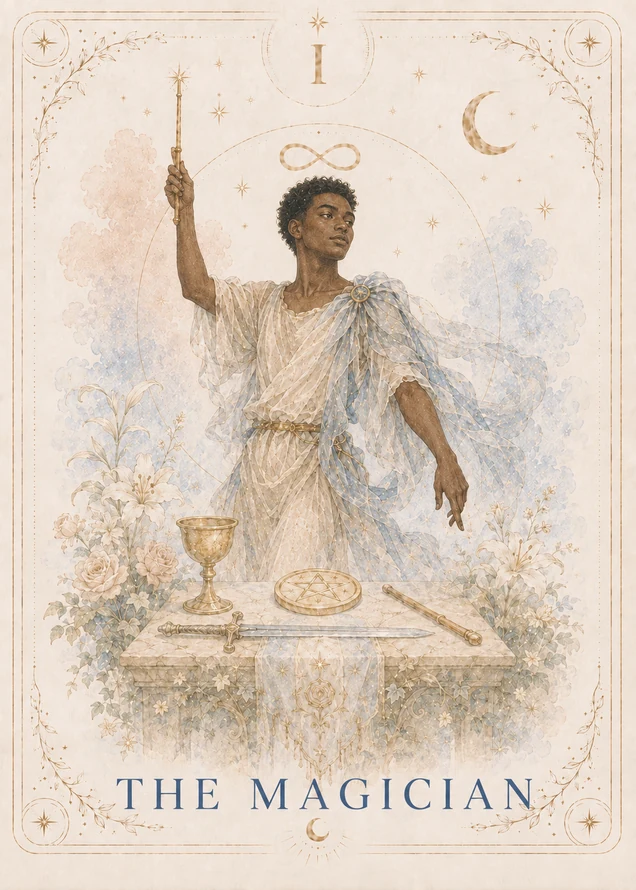
Related cards
Tradition & Lunaire’s interpretation
The traditional foundation
Waite describes five swords being carried away, two left behind, and a nearby camp. He offers plans, attempts and possible failure with conflicting meanings; reversal includes counsel as well as harmful talk.
Lunaire’s reading
Lunaire develops strategic choice and omission without declaring theft or deception. The inward reversed examination draws on the possibility of counsel while deliberately declining fortune-telling, slander verdicts or compulsory confession.
Read the source in The Pictorial Key to the Tarot ↗
Arthur Edward Waite. The Pictorial Key to the Tarot. W. Rider; [1911]. Illustrations by Pamela Colman Smith. Source edition details ↗