

Swords
Nine of Swords
The Nine of Swords describes the anguish of thoughts and fears that will not settle.
- anguish
- worry
- regret
- sleeplessness
Read the card in its own right, then follow its meaning through the spread.
Two orientations
The card’s meaning
Swords gives this Nine a focus on anguished thought and the difficulty of finding rest. The number and the nighttime scene do not diagnose a condition, establish guilt, or turn a fear into a prediction.
Upright
The Nine of Swords describes the anguish of thoughts and fears that will not settle.
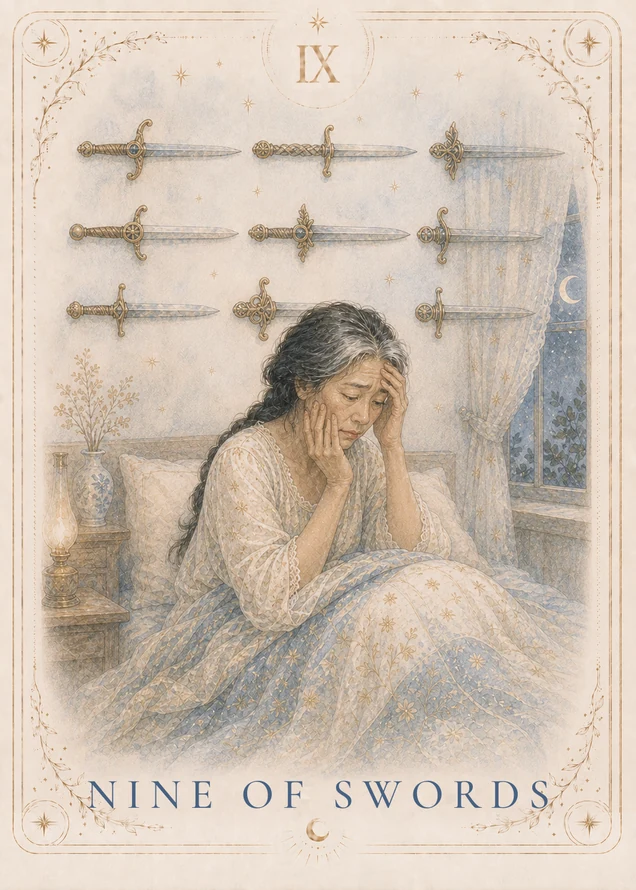
The Nine of Swords gives form to anguish that makes rest difficult: recurring fears, regret, or thoughts that return without bringing an answer. The figure sits awake beneath the swords, absorbed in distress. The feeling can be intense whether its cause is a real difficulty, an uncertain possibility, or a mixture of both. Its intensity does not prove that a feared event will happen or that someone is guilty. The card asks for the suffering itself to be taken seriously.
- anguish
- worry
- regret
- sleeplessness
Reversed
The Nine of Swords reversed attends to distress that has become difficult to share.
The Nine of Swords reversed concerns distress that others may not see and that can be hard to put into words. A worry may stay private through shame, uncertainty, or concern about burdening someone else. That privacy can leave a person with fewer chances to be heard or helped. A careful disclosure can make support more possible, with room to choose whom to tell and how much to say. The card does not establish a guilty secret, require confession, or promise immediate relief.
- private distress
- shame
- disclosure
- support
How the reversal changes the emphasis
The upright anguish is held privately or is difficult to put into words. This modern selection draws on the historical shame and doubt without endorsing suspicion, and keeps gradual relief as a possibility rather than a guaranteed reversed outcome.
The question changes the emphasis
Reading this card in context
Each spread gives its cards different roles. The examples below explore this card as an influence, a situation or challenge, and advice or support. Begin with the question your position asks, wherever it falls in the spread.
As an influence
Upright
A painful experience, unresolved worry, or repeated anticipation of what might go wrong may be shaping how heavily the present question is felt.
Reversed
Concern about being judged, difficulty explaining a worry, or an earlier response that felt unhelpful may have made a troubling question harder to share.
As a situation or challenge
Upright
Notice which concern keeps returning, what is actually known about it, and how the distress itself could receive attention or support.
Reversed
Consider whether a concern is remaining private by choice or because there seems to be no safe place to speak about it.
As advice or support
Upright
Name a specific worry to someone able to listen, or set down what is known and what remains feared, without demanding an immediate answer.
Reversed
Choose a person or setting where one part of a worry could be heard, and say what kind of response would help.
Read through a particular life focus
Open reading
Let a persistent worry be examined alongside the strain of carrying it, rather than asking the card to confirm the feared outcome.
Love & relationships
Concerns about a connection can be heard and checked against what is known without taking fear as evidence of another person’s feelings or actions.
Work & direction
Worry about a decision, result, or possible mistake may need a factual check and a chance to be heard, rather than another round of solitary rehearsal.
Home & family
A concern about home or belonging may be hard to set down, and deserves a response that takes both the circumstances and the distress seriously.
Self-growth
Explore the difference between understanding a painful thought and repeatedly passing judgment on yourself, with room for support that does not depend on earning reassurance.
Look a little closer
The imagery
Seated figure
The figure sits upright under a patterned cover, with hands at the cheek and forehead and the face still visible.
The posture gives distress and troubled thought a human presence without identifying their cause.
Nine horizontal swords
Nine swords form three rows behind the figure, with part of a lower blade obscured by the hair.
The repeated blades support an interpretation of thoughts or fears that keep returning; they are not shown striking the person.
Bed and wakefulness
The figure is sitting up in a bed beside a lit lamp.
A place associated with rest is occupied by someone who appears unsettled, making difficulty finding repose central to the scene.
Similarities & differences
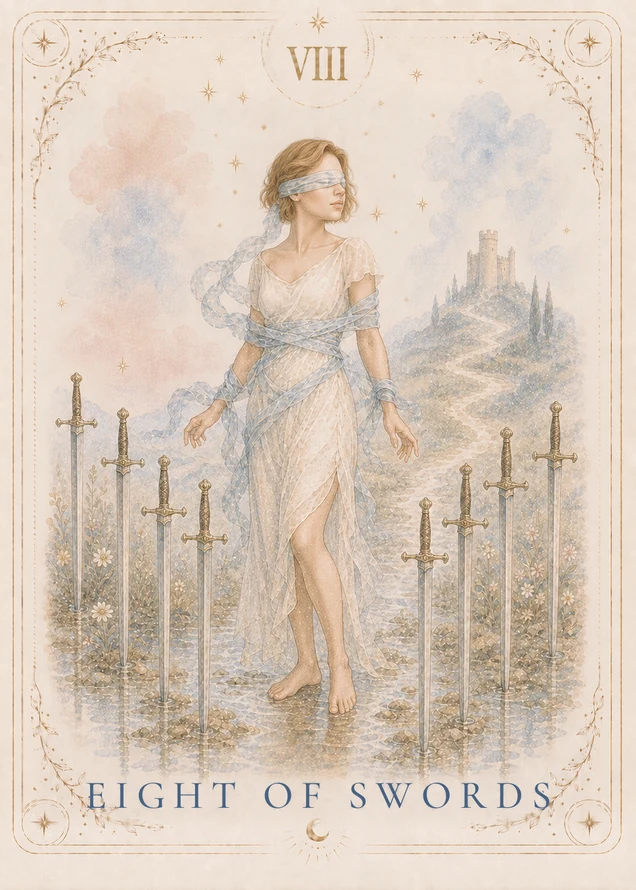
Related cards
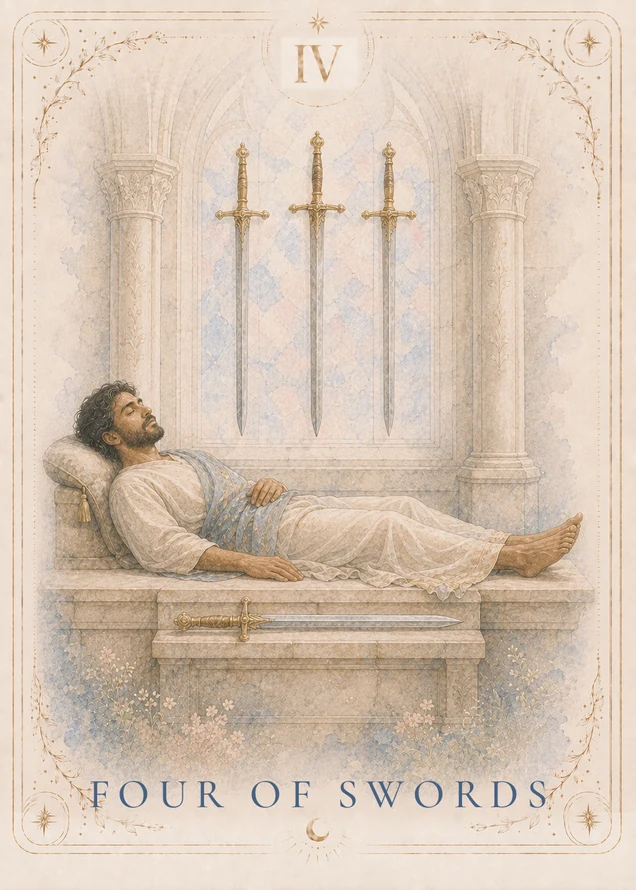
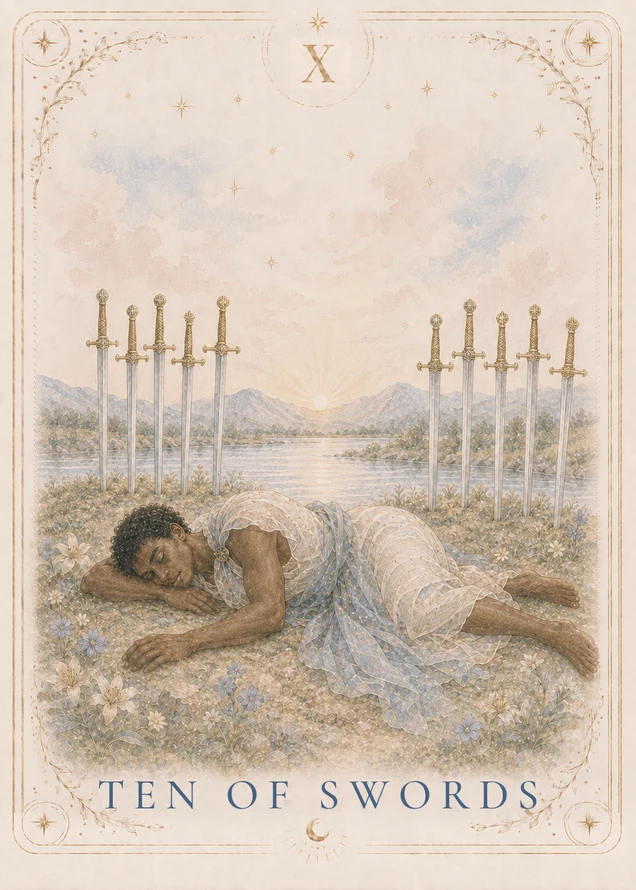

Tradition & Lunaire’s interpretation
The traditional foundation
Waite describes a seated figure in lamentation and profound desolation. His main upright list includes death, failure, miscarriage, deception, disappointment, and despair; his reversal includes imprisonment, suspicion, doubt, reasonable fear, and shame. The additional upright entry includes a priest and a bad omen, while the additional reversal endorses suspicion of a doubtful person.
Lunaire’s reading
Lunaire retains anguish and troubled thought while declining predictions of death or pregnancy loss and unsupported judgments of guilt or another person’s intentions. The selected private-distress reversal develops the historical shame and doubt through a documented modern interpretation. Biddy Tarot also gives recovery as a reversed alternative; Lunaire acknowledges this alternative without promising relief or adopting claims that worry brings a feared event into being.
Read the source in The Pictorial Key to the Tarot ↗
Waite: additional divinatory meanings ↗
Arthur Edward Waite. The Pictorial Key to the Tarot. W. Rider; [1911]. Illustrations by Pamela Colman Smith. Source edition details ↗