
Swords
Ten of Swords
The Ten of Swords names a painful ending without making it the whole future.
- painful ending
- defeat
- finality
- aftermath
Read the card in its own right, then follow its meaning through the spread.
Two orientations
The card’s meaning
Swords brings the Ten’s finality into the experience of painful conclusions and their aftermath. This is more than temporary respite, but neither the numbered rank nor the image proves that a reader has reached an ending or that no further difficulty is possible.
Upright
The Ten of Swords names a painful ending without making it the whole future.
The Ten of Swords describes the hurt of reaching an ending that cannot be argued or endured back into its former shape. Defeat, a broken expectation, or a final disappointment can leave little room for the next thought. The card allows that finality to be named without requiring gratitude for it. A painful ending is not proof that everything is lost, and the image does not predict physical death. What follows can begin with care for what has been affected.
- painful ending
- defeat
- finality
- aftermath
Reversed
An ending can be real while recovery is still unfinished and uneven.
The Ten of Swords reversed concerns the passage beyond a painful ending while its effects are still being lived with. Relief may be partial: an ordinary task becomes possible, a thought loses some of its sting, or support makes the next day less difficult. Recovery does not require denying what happened or calling it beneficial. The emphasis is on what helps life continue, while allowing grief, practical consequences, and renewed interest to move at different speeds.
- recovery
- aftermath
- gradual relief
- renewed possibility
How the reversal changes the emphasis
The ending does not instantly complete the passage beyond it. Lunaire selects gradual recovery within that unfinished transition, rather than treating continuing pain as a refusal to move on or promising that every difficulty is over.
The question changes the emphasis
Reading this card in context
Each spread gives its cards different roles. The examples below explore this card as an influence, a situation or challenge, and advice or support. Begin with the question your position asks, wherever it falls in the spread.
As an influence
Upright
A defeat, a painful break, or the realization that something could not continue may have given the present question its shape.
Reversed
A painful ending and the uneven work of living beyond it may be shaping what feels possible in this question.
As a situation or challenge
Upright
Consider what has actually ended, what the loss changes, and which parts of life remain outside that ending.
Reversed
Notice what has become a little easier and what still needs support, without using one to dismiss the other.
As advice or support
Upright
If a painful ending is clear, name what it changes and seek support for the immediate aftermath without requiring an explanation that makes it worthwhile.
Reversed
Consider a small return to ordinary life or a source of practical help, leaving the pace of recovery open to change.
Read through a particular life focus
Open reading
Where an ending is already evident, the card can help distinguish the pain of that ending from a conclusion that every possibility is gone.
Love & relationships
A painful change in connection may call for honest recognition and support, without assuming betrayal, predicting separation, or deciding whether contact should continue.
Work & direction
If a plan or undertaking has ended, attention can turn to its practical consequences before a replacement is expected to restore confidence.
Home & family
A disrupted expectation in private life may need care for its immediate effects without deciding that every source of belonging has been lost.
Self-growth
Recovery can include small returns of interest while leaving the meaning of a painful experience unresolved.
Look a little closer
The imagery
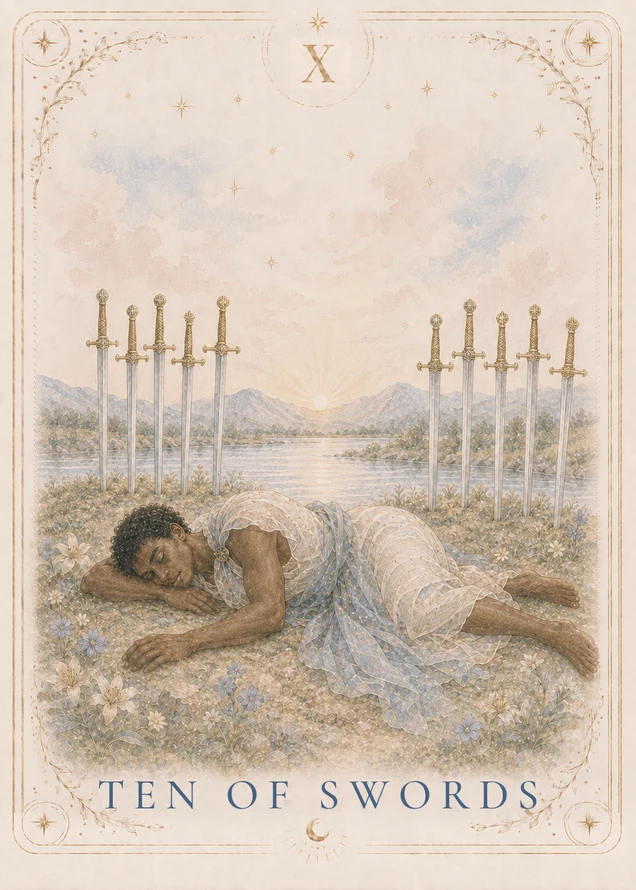
Figure on the ground
The figure lies on one side, with eyes closed and one arm beneath the head; no sword pierces the body.
The lowered posture can accompany the meaning of reaching a painful limit, without establishing injury, sleep, or death.
Ten planted swords
Five swords stand in the ground on each side behind the figure.
The complete group gives the ending a sense of finality; their placement is a deliberate visual difference from the pierced figure Waite describes.
Low sun beyond the water
A bright sun sits low between mountains across the water.
Light beyond the foreground can leave room for a future beyond an ending, without promising when relief will come.
Similarities & differences
Related cards
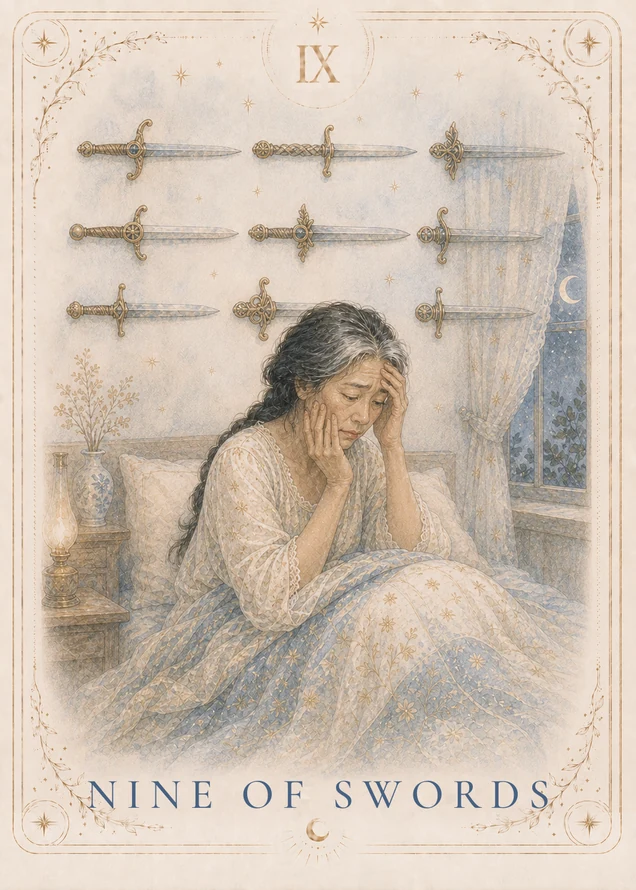
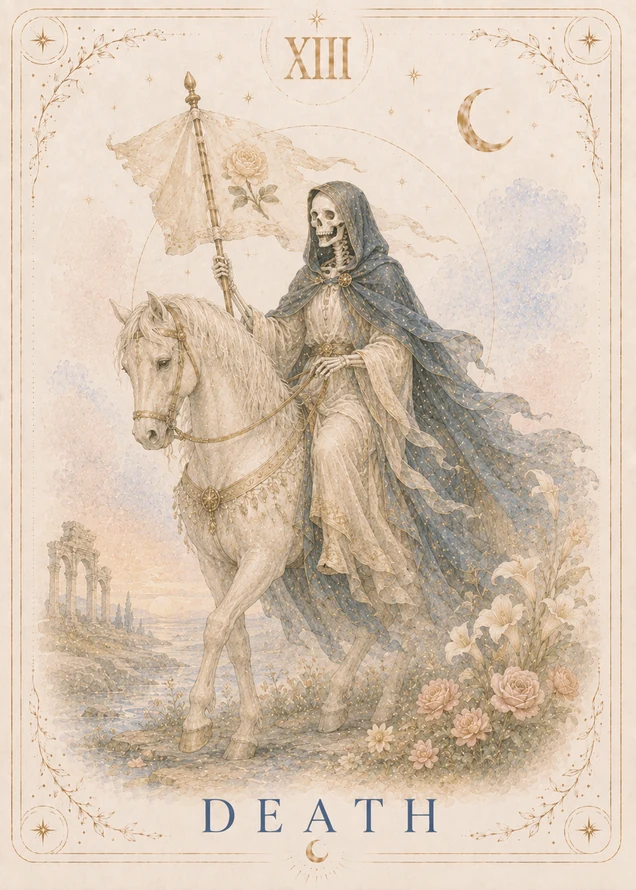
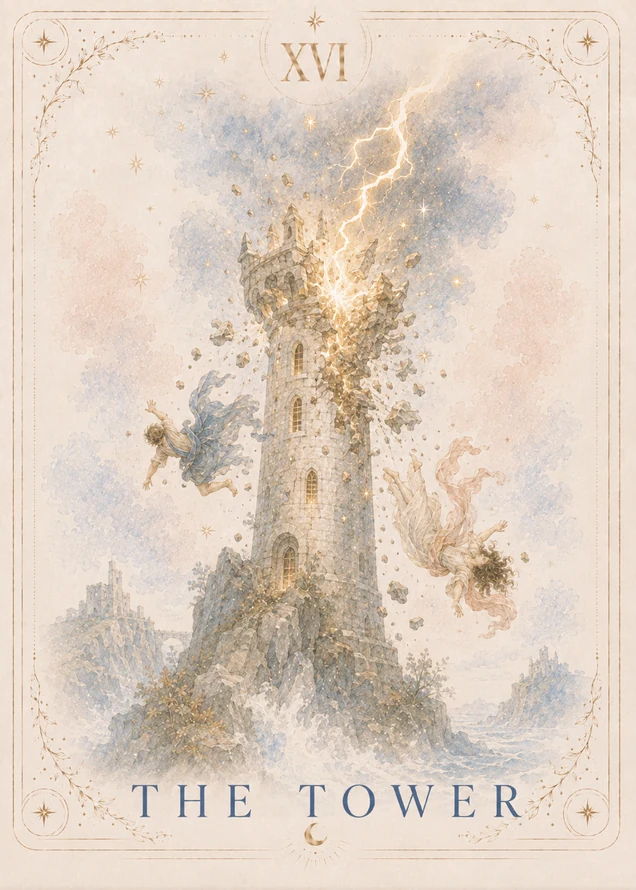
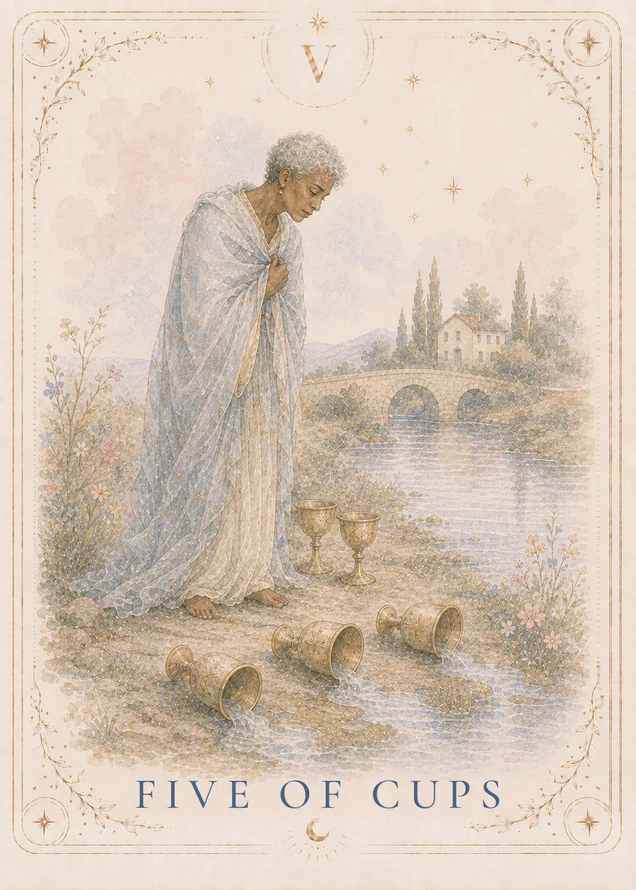
Tradition & Lunaire’s interpretation
The traditional foundation
Waite’s main upright entry names pain, affliction, sorrow, and desolation, while specifically qualifying the image’s association with violent death. His reversal includes temporary advantage, success, favor, power, and authority. In the additional list, upright carries imprisonment tied to a particular card sequence and a gendered prediction of betrayal; reversed predicts military victory and resulting fortune.
Lunaire’s reading
Lunaire keeps the painful ending recognizable and reads the reversal as unfinished recovery. Biddy Tarot provides a contemporary reference for painful endings upright and recovery among the reversed possibilities; this is a selected modern interpretation, not Waite’s literal reversed list. Lunaire does not adopt predictions of death, imprisonment, betrayal, or inevitable improvement, and does not require suffering to have happened for a beneficial reason.
Read the source in The Pictorial Key to the Tarot ↗
Waite: additional meanings for Ten of Swords (Part III §4) ↗
Arthur Edward Waite. The Pictorial Key to the Tarot. W. Rider; [1911]. Illustrations by Pamela Colman Smith. Source edition details ↗