
Swords
Two of Swords
The Two of Swords holds competing positions in balance while a decision remains unresolved.
- impasse
- deliberation
- truce
- uncertainty
Read the card in its own right, then follow its meaning through the spread.
Two orientations
The card’s meaning
Swords places this Two’s balance in judgment and communication: a decision, disagreement, or truce remains suspended between positions that have not yet been reconciled.
Upright
The Two of Swords holds competing positions in balance while a decision remains unresolved.
The Two of Swords describes an impasse: different considerations hold each other in place, and no clear choice has emerged. A temporary truce or a pause before deciding can keep disagreement from becoming a fight. It can also leave an important question untouched. The card asks what sustains the balance, what information is missing, and whether silence is giving people room to think or keeping them from saying what matters.
- impasse
- deliberation
- truce
- uncertainty
Reversed
The Two of Swords reversed finds a decision harder to make as pressure and confusion gather.
The Two of Swords reversed concerns a stalemate that becomes harder to think within. Conflicting advice, pressure to take a side, or too many unresolved details can leave no option easy to judge. Avoiding an unwelcome fact may contribute, but confusion does not establish dishonesty or unwillingness. The task is to separate what can be checked from what must remain uncertain, and what is yours to decide from what others are asking you to settle.
- indecision
- conflicting advice
- pressure
- clarification
How the reversal changes the emphasis
The upright ability to hold competing considerations is blocked by confusion or pressure; the reversal does not prove deceit or require an immediate choice.
The question changes the emphasis
Reading this card in context
Each spread gives its cards different roles. The examples below explore this card as an influence, a situation or challenge, and advice or support. Begin with the question your position asks, wherever it falls in the spread.
As an influence
Upright
Competing priorities, incomplete information, or an agreement to postpone a difficult discussion may have helped keep the present question open.
Reversed
Pressure to settle competing demands, contradictory advice, or an unresolved fact may have made a decision increasingly difficult to approach.
As a situation or challenge
Upright
Notice what each position protects, what remains unknown, and whether the current pause still allows an honest decision to develop.
Reversed
Consider which uncertainty matters to the decision and whether someone is being asked to resolve a disagreement that belongs to others.
As advice or support
Upright
Clarify the question being decided, seek a relevant missing fact, and make room for a preference that has not yet been expressed.
Reversed
Reduce the question to the part that can be decided, verify a relevant claim, and seek time or support where the pressure is real.
Read through a particular life focus
Open reading
Explore the competing considerations in an unresolved question and what would make choosing more informed.
Love & relationships
A quiet interval in a connection may allow thought or leave a disagreement unspoken; consider whether each person can express a preference freely.
Work & direction
For a choice about study, a project, or direction, distinguish information that would change the decision from details that only add to the uncertainty.
Home & family
Where different wishes meet around home or family, consider whether a temporary agreement gives each person a voice or leaves the decision indefinitely postponed.
Self-growth
Notice how you make room for uncertainty and what helps you recognize a preference without pretending every consequence can be known.
Look a little closer
The imagery
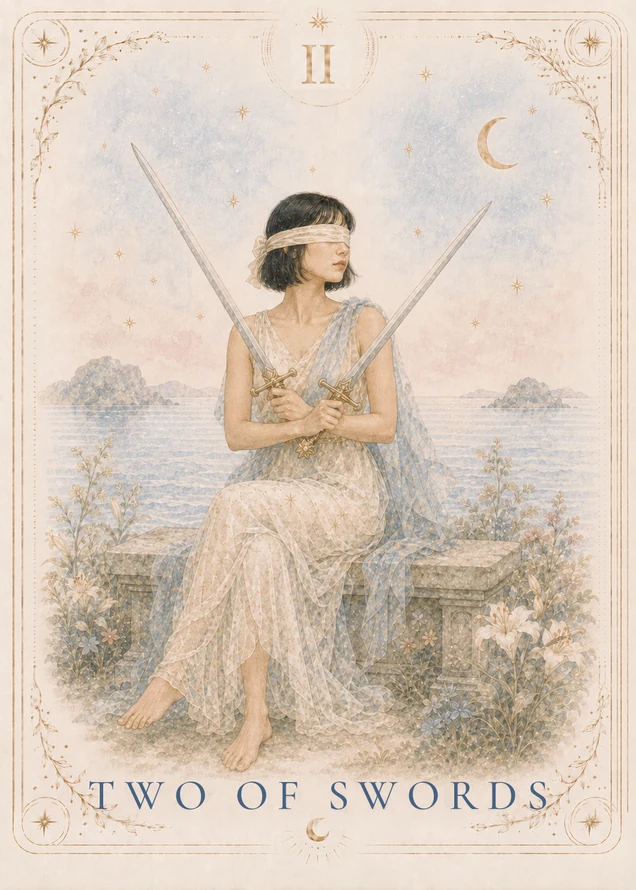
Blindfold
A pale cloth covers the seated figure’s eyes.
The covered eyes can suggest a limit on what is known or admitted; the image does not establish why the cloth is there.
Two held swords
The forearms cross in front of the body, holding two swords whose blades rise to either side.
Holding both blades gives the unresolved balance a visible form: neither position has yet been set aside.
Water and rocks
Water extends behind the bench, with rocks rising above its surface.
The scene continues beyond the seated figure, supporting attention to circumstances that a held position may leave out.
Similarities & differences
Related cards
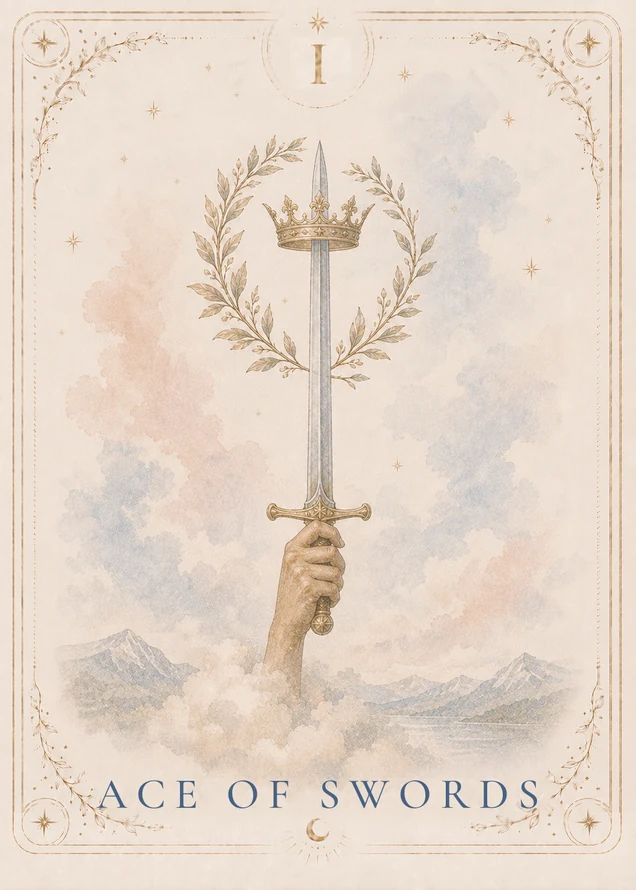
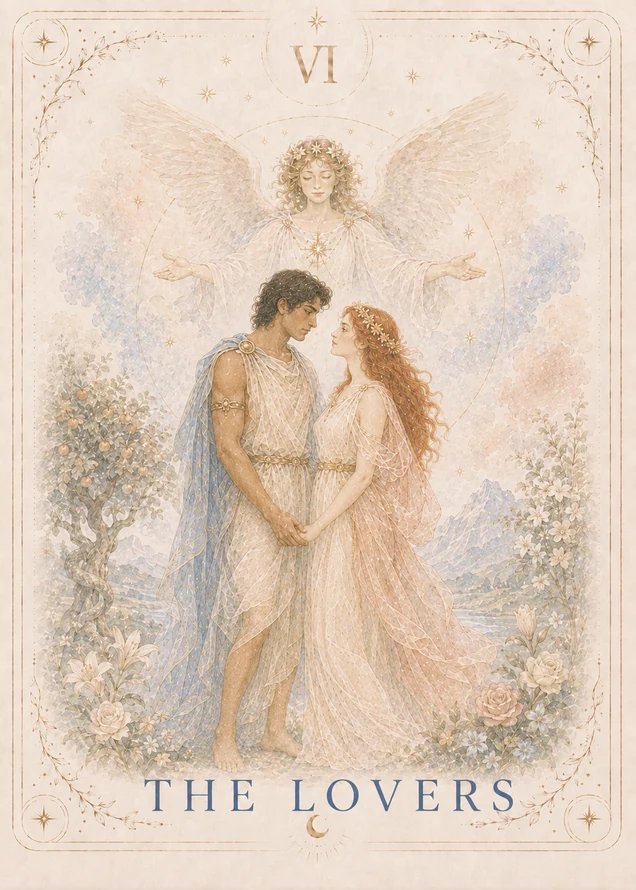
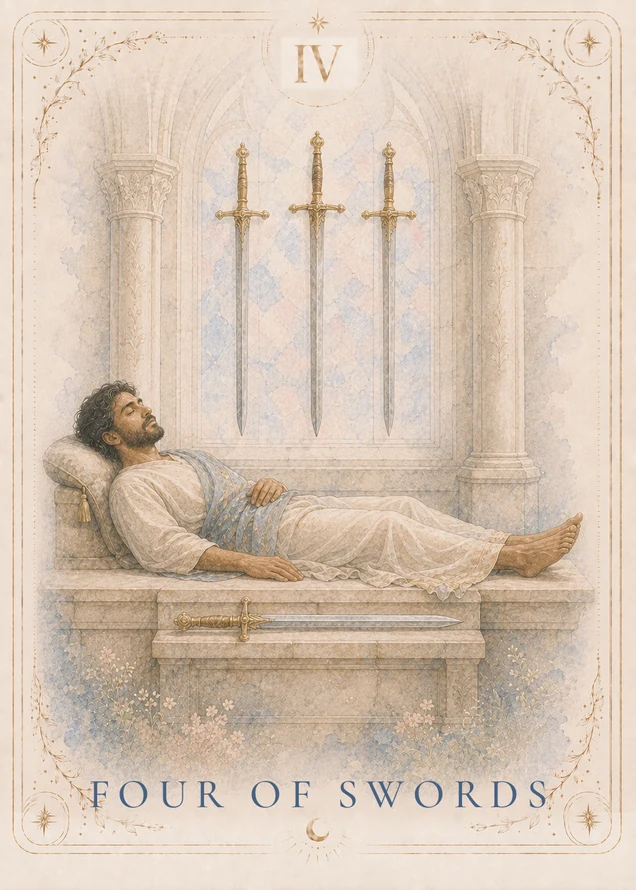
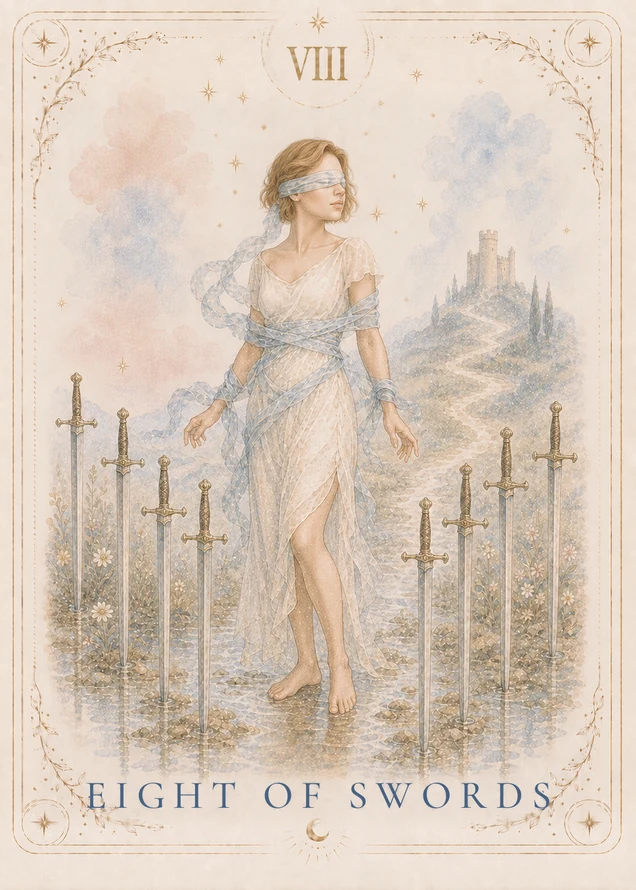
Tradition & Lunaire’s interpretation
The traditional foundation
Waite’s main upright entry includes balance, courage, friendship, guarded concord, and an alternative of tenderness or intimacy, while qualifying its harmony. His reversed list names falsehood, deception, and disloyalty. The additional upright entry assigns gifts or influential protection according to gender; the additional reversed entry concerns dealings with dishonest people.
Lunaire’s reading
Lunaire develops the contemporary RWS emphasis on difficult decisions and stalemate, found in Joan Bunning and Biddy Tarot, while retaining room for Waite’s guarded peace. The chosen reversal follows Biddy Tarot’s confusion and conflicting information rather than using Waite’s list to accuse anyone of deception. The gendered additional predictions are retained as history, not assigned to a reader.
Read the source in The Pictorial Key to the Tarot ↗
Waite: additional meanings for Two of Swords (Part III §4) ↗
Arthur Edward Waite. The Pictorial Key to the Tarot. W. Rider; [1911]. Illustrations by Pamela Colman Smith. Source edition details ↗