
Swords
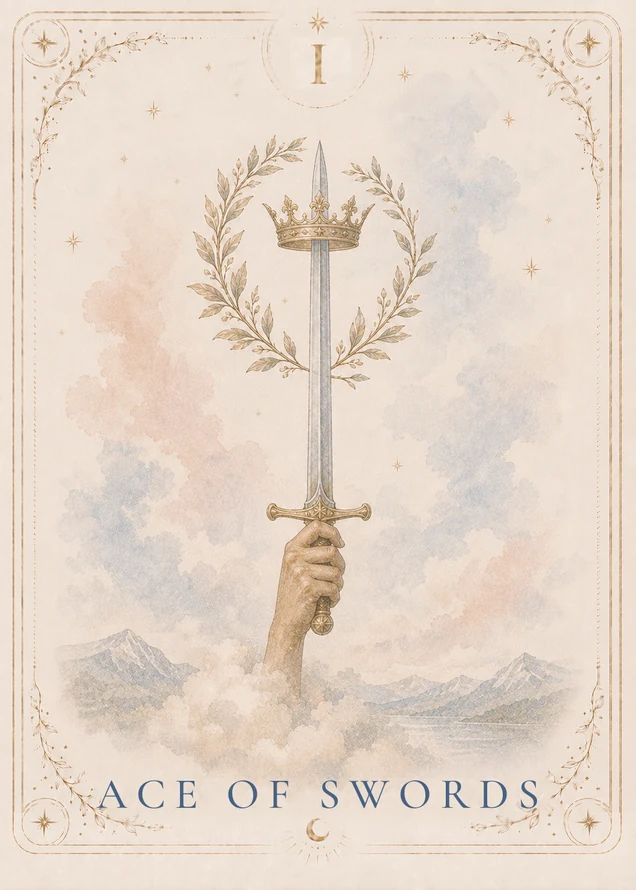
Ace of Swords
A clear thought gives a difficult question an edge you can work with.
- clarity
- precision
- insight
- decision
Read the card in its own right, then follow its meaning through the spread.
Two orientations
The card’s meaning
As an Ace in Swords, this is a beginning in thought or language, before the sustained inquiry and practiced judgment of the courts.
Upright
A clear thought gives a difficult question an edge you can work with.
A sentence can change the shape of a problem. The Ace of Swords brings the first clean distinction: what is known, what is being asked, or what you mean to say. Its blade passes through a crown, giving an idea the force to be taken seriously. A precise question or a plainly spoken decision can make room for action where everything previously seemed tangled.
- clarity
- precision
- insight
- decision
Reversed
The wish for a decisive answer can sharpen a claim beyond what it supports.
A clever sentence can foreclose an important question. Reversed, the Ace of Swords brings force to a thought before its meaning has been fully tested: a label stands in for an explanation, or the urge to be clear makes a complicated matter sound settled. The sword still has an edge. Precision comes from noticing where the claim reaches too far and making it exact enough to survive a second look.
- premature certainty
- overstatement
- exact wording
- revision
How the reversal changes the emphasis
The upright power to distinguish becomes an insistence on settling the matter; the reversal asks for precision without that added certainty.
The question changes the emphasis
Reading this card in context
Each spread gives its cards different roles. The examples below explore this card as an influence, a situation or challenge, and advice or support. Begin with the question your position asks, wherever it falls in the spread.
As an influence
Upright
A clarifying conversation, discovery, or decision may have opened the present question by making something possible to name for the first time.
Reversed
A quick explanation or forceful decision may have narrowed the question before all of its parts had a chance to become clear.
As a situation or challenge
Upright
Find the sentence that states the question plainly; notice which distinction makes the tangle easier to think about.
Reversed
Look closely at a claim that sounds final: which part is established, and which part is being carried by the confidence of the wording?
As advice or support
Upright
Put a clear thought into words, then use it to decide what can be asked, checked, or done next.
Reversed
Restate the point as precisely as the facts allow, leaving the unresolved part visible instead of forcing it into the same answer.
Read through a particular life focus
Open reading
A precise distinction may make an otherwise tangled question easier to approach.
Love & relationships
In questions of closeness, saying what a word such as commitment means could make a conversation more honest.
Work & direction
A plainly stated question could help distinguish the work worth doing from the activity surrounding it.
Home & family
In questions of home or belonging, a clear agreement could make an unspoken expectation discussable.
Self-growth
Naming a value precisely may reveal what it asks of an ordinary choice.
Look a little closer
The imagery
Sword through the crown
The upright blade passes through the open center of a gold crown.
A clear thought can earn authority through what it reveals; its force still needs a considered use.
Hand and hilt
A hand grips the gold hilt firmly beneath the long straight blade.
Understanding becomes useful when someone can hold it clearly enough to speak or act on it.
Curved branches
Two leafy branches curve around the upper blade and crown.
The framing gives the thought distinction, while leaving its consequences to the person who uses it.
Similarities & differences
Related cards
Tradition & Lunaire’s interpretation
The traditional foundation
Waite describes the crowned sword as great force, triumph and excess, with adverse results or alternative reproductive associations in reversal.
Lunaire’s reading
Lunaire translates the sword’s force into clear thought and language. The reversed overstatement is a reflective use of excess, not Waite’s predicted disaster; triumph, conception and childbirth are not outcomes inferred from a draw.
Read the source in The Pictorial Key to the Tarot ↗
Arthur Edward Waite. The Pictorial Key to the Tarot. W. Rider; [1911]. Illustrations by Pamela Colman Smith. Source edition details ↗