

Swords
Page of Swords
An alert, questioning mind learns by looking again and asking the next useful question.
- curiosity
- inquiry
- attention
- learning
Read the card in its own right, then follow its meaning through the spread.
Two orientations
The card’s meaning
The Page is a mode of beginning to use thought and language, available at any age or gender; the court title does not identify a person in the reader’s life.
Upright
An alert, questioning mind learns by looking again and asking the next useful question.
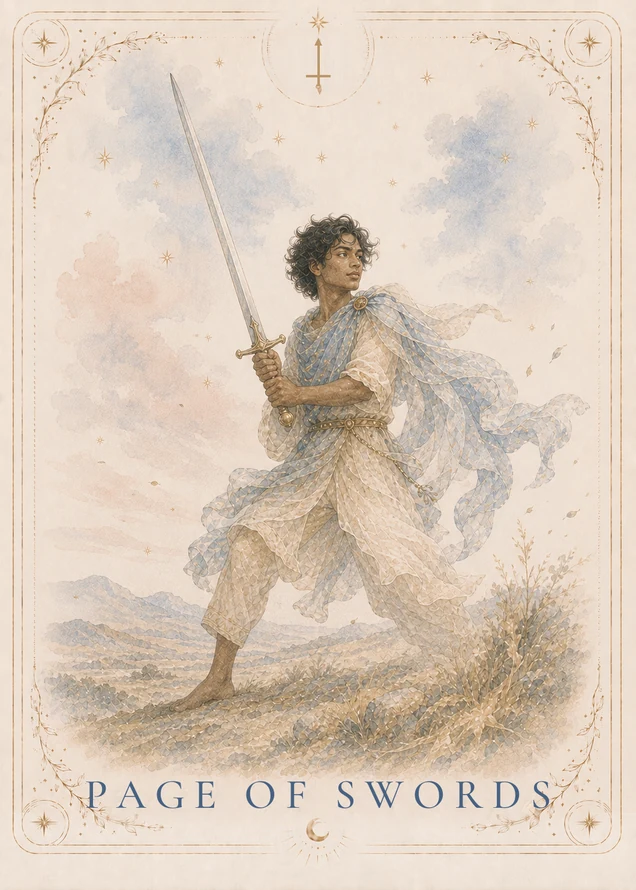
The Page of Swords is interested before being certain. Both hands hold the sword while the face turns toward something beyond its blade. This is the energy of asking how a thing works, checking a detail, or trying out words for an unfamiliar idea. A good question can keep a conversation alive. What comes back matters as much as the question: an answer may bring an overlooked detail or a reason to think again.
- curiosity
- inquiry
- attention
- learning
Reversed
Attention can become so quick to challenge that there is little room left to learn.
There is a kind of listening that is already preparing its reply. The Page of Swords reversed brings that restless edge: another question arrives before the answer has landed, or a small clue grows into a whole explanation. The mind stays busy while understanding stands still. Curiosity needs enough patience to be surprised. Read the full message, hear the rest of the sentence, or leave a detail undecided until there is more to learn.
- reactivity
- fragments
- restless scrutiny
- listening
How the reversal changes the emphasis
The Page’s useful vigilance becomes so restless that challenge replaces listening; the reversal restores the learning purpose of attention.
The question changes the emphasis
Reading this card in context
Each spread gives its cards different roles. The examples below explore this card as an influence, a situation or challenge, and advice or support. Begin with the question your position asks, wherever it falls in the spread.
As an influence
Upright
An unanswered question, a piece of study, or a detail noticed in passing may have given this matter its starting point.
Reversed
Quick replies or fragments gathered without their context may have helped the question grow more complicated than the available information supports.
As a situation or challenge
Upright
Follow the detail that invites a real question, then listen for an answer that could change the first impression.
Reversed
Notice whether the next question opens room for an answer or simply recruits another detail to support the first impression.
As advice or support
Upright
Ask something specific enough to learn from, check the answer, and let an unfamiliar idea remain unfinished while it takes shape.
Reversed
Read or hear the whole account before answering; choose the unresolved question that further information could actually help to settle.
Read through a particular life focus
Open reading
A useful question may offer more movement than an answer reached too quickly.
Love & relationships
Curiosity about what someone actually means may serve a conversation better than filling in the rest of an unfinished sentence.
Work & direction
An unfamiliar method or piece of information could be approached through a small, specific inquiry before a larger decision.
Home & family
In questions of family or private life, asking how an expectation began may reveal more than assuming everyone understands it alike.
Self-growth
Trying to explain a new idea in plain language may reveal the part still worth exploring.
Look a little closer
The imagery
Two-handed sword
The figure holds the sword’s hilt with both hands, its blade raised diagonally.
Attention and a developing skill are brought together in an alert, still-learning stance.
Sideways gaze
The face looks toward the side rather than along the blade.
Inquiry notices what lies beyond the first line of thought.
Windblown cloak and leaves
The blue cloak streams outward and loose leaves appear around the figure.
Changing information calls for responsiveness, without making every movement a threat.
Similarities & differences
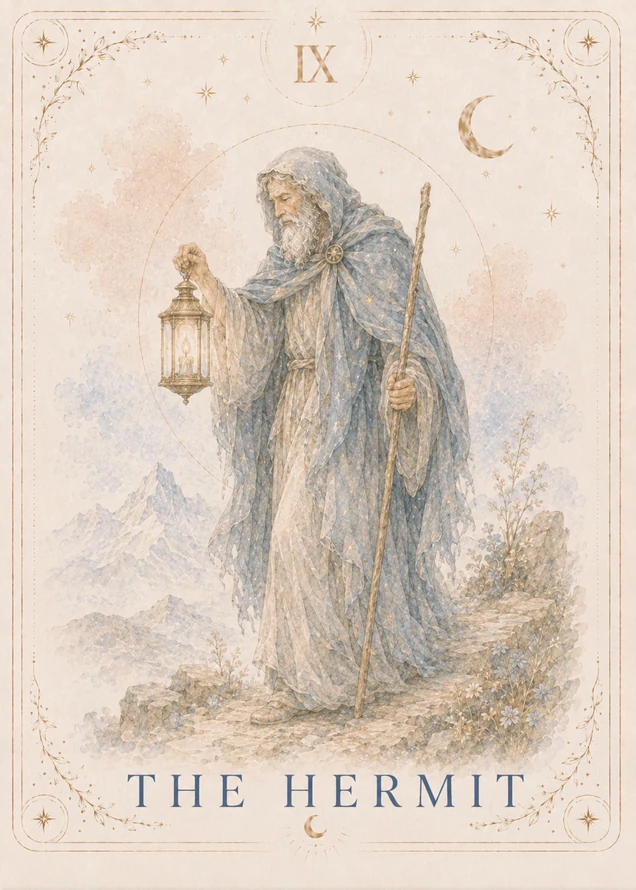
Related cards

Tradition & Lunaire’s interpretation
The traditional foundation
Waite describes an alert figure with a raised sword and associates the Page with vigilance, examination and overseeing; the reverse includes adverse vigilance and lack of preparation.
Lunaire’s reading
Lunaire recasts vigilance as curious inquiry, and its excess as reactive scrutiny. It does not carry over spying as advice, a hidden-enemy claim, or the historical health prediction; the court is a posture, not a demographic forecast. Waite explicitly describes swift walking; the native image presents a wide stance, with movement expressed in the cloak and scattered leaves.
Read the source in The Pictorial Key to the Tarot ↗
Arthur Edward Waite. The Pictorial Key to the Tarot. W. Rider; [1911]. Illustrations by Pamela Colman Smith. Source edition details ↗