
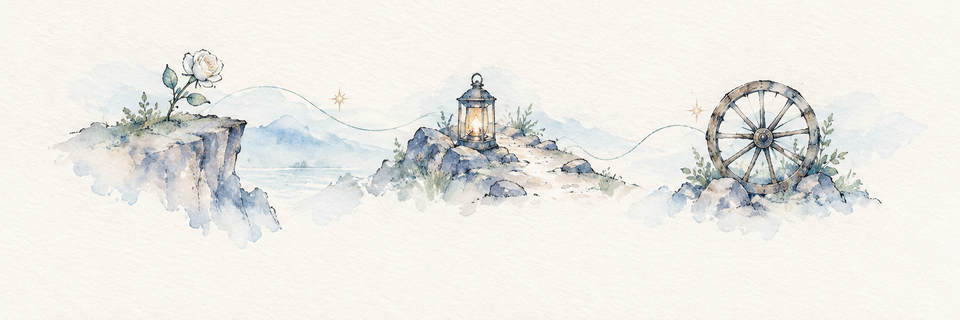
The Fool stands at the edge with a white rose in hand and a small dog at his feet. The picture does not tell us whether he will step. It makes the threshold impossible to ignore. That is the Major Arcana at its best: 22 cards with enough character to turn a familiar question slightly in the light.
In Lunaire’s three-card beta spread, these are the only cards in the deck. They are often called tarot’s larger archetypes, but they are not a fixed biography that every person must live through in order. Think of them as a cast of recurring concerns. If you know what the planets each bring to a chart, you know the pleasure of meeting distinct characters; tarot’s figures work through pictured choices and situations rather than measured positions in the sky.
Here are the first eleven, numbered 0 through 10. These descriptions draw on Lunaire’s own cards and the meanings we use for them.
0. The Fool — the beginning
The cliff edge puts possibility and risk in the same frame. The Fool asks what might begin if you did not require the whole road to be visible first. His openness is not a request to abandon care. Reversed, the threshold remains, but hesitation or a leap made too quickly may be part of the question.
1. The Magician — the means at hand
One hand rises, one lowers, and the tools of all four suits sit within reach. The Magician is about using ability rather than merely admiring it. Reversed, capacity may be scattered, withheld, or spent on the appearance of action. What can you actually make with what is already on the table?
2. The High Priestess — the pause that knows something
Between two columns, she holds a text with her eyes closed. Not every truth arrives ready to be announced. This card gives quiet recognition its due while asking us to distinguish intuition from assumption. Reversed, noise, secrecy, or too much certainty can complicate that distinction.
3. The Empress — conditions for growth
Wheat, flowers, and fruit surround her. The Empress does more than praise abundance; she asks what tending has made it possible. Where is care becoming material support? Reversed, care may be overextended or doled out unevenly. Even generous hands need something to draw from.
4. The Emperor — structure with a duty
A stone throne and a scepter make authority visible. At its best, the Emperor builds a structure that holds when the mood changes. Reversed, the same need for order can harden into rigid control, or the person holding authority may fail the responsibility that comes with it.
5. The Hierophant — what is handed down
Two attendants stand before him; crossed keys rest below. The Hierophant asks what a teaching, custom, or shared practice can open. Reversed, it may be time to examine a rule in your own words. Inherited does not mean empty, but familiar does not mean beyond question.
6. The Lovers — a choice made visible
Joined hands sit at the center of this card. The Lovers speaks to connection, but also to the choice that gives a bond its shape: what do you value enough to show in your conduct? Reversed, affection, choice, and action may be out of sync.
7. The Chariot — direction amid competing pulls
Black and white sphinxes face forward beneath a starry canopy. The Chariot needs more than speed; it needs a course that can hold competing forces. Reversed, movement may scatter or tighten into an exhausting grip. The question is not simply whether you can push harder.
8. Strength — the gentle hand
A hand rests near the lion. Strength is courage that does not have to dominate what it meets. Reversed, that courage may turn inward until composure becomes strain. The lion is still present; so is the possibility of meeting it without a fight.
9. The Hermit — a light carried apart
The lantern lights a rocky path, not the entire mountain. The Hermit gives solitude a purpose: enough quiet to hear what experience knows. Reversed, a useful retreat can become a long isolation, or reflection can keep circling after it has taught what it can.
10. Wheel of Fortune — the turning conditions
Figures gather around a wheel that keeps turning. This card recognizes timing, change, and circumstances no one commands alone. Reversed, a cycle may repeat or stall. Either way, the Wheel asks you to notice what has changed around you before assuming the old move will have the same result.
From Justice through the World, the second half of the Major Arcana asks what we do with consequences, endings, disruption, hope, and completion. These are not meanings Lunaire invents afresh with each draw. The cards have a recognized interpretive foundation, and the reading has its own method of joining them. A figure’s meaning becomes most interesting when you see which position it occupies and who has arrived beside it.