Where do tarot card meanings come from? Not from a single, fixed dictionary. The cards have passed through centuries of play, divination, art, and interpretation. Lunaire joins that conversation with its own style and a particular way of reading the deck. Here is the trail we can actually name, and where our own choices begin.
Before the cards became a reading
Long before anyone turned over a card to ask what might happen, tarot was something you played. In fifteenth-century northern Italy, four suits—Cups, Swords, Batons, and Coins—were joined by illustrated trumps and a Fool. The surviving Visconti-Sforza cards already include figures such as Love, Justice, Death, and the World. They carried the courtly, religious, and moral imagery of their time, but they did not come with the upright and reversed meanings you might find in a modern guide. The Met’s account of these early decks lets us see what was on the table before tarot became a way to answer questions.
That change took centuries. In late eighteenth-century France, the cartomancer Etteilla helped bring tarot into divination. Nineteenth-century writers such as Éliphas Lévi then placed the cards in conversation with occult systems, adding correspondences and new explanations for what the images could mean. Some claims from that period, including an ancient Egyptian origin for tarot, have not stood up as history. The V&A’s account of the transition tells a story of how tarot’s interpretive language accumulated over time: it was not waiting, complete, inside the first painted pack.
For the meanings and images most familiar to contemporary readers, our clearest historical reference is the Rider–Waite–Smith deck published in 1909. Artist Pamela Colman Smith gave it a visual language that still shapes how people read tarot (and informs Lunaire’s illustrations). Arthur Edward Waite’s Pictorial Key to the Tarot offers his account of its symbols, alongside a separate list of divinatory meanings. The pictures and the written lists are related, but they are not always saying the same thing. Smith’s work deserves to be named as a source of meaning, not merely as illustrations for Waite’s words.
Consider the Fool. The traveler, rose, companion, and cliff make a beginning visible before anyone supplies a keyword. Waite’s discussion of the image leaves room for a journey into experience; his short divinatory list is much harsher about folly and carelessness. Lunaire keeps curiosity and possibility in view while letting the risk remain real. That reading is our selection from a longer conversation, not a claim that Waite wrote our definition or that every tarot reader would choose the same emphasis.
A conversation still in motion
Waite was not the last person to find something in these cards. Joan Bunning describes a reading as a meeting among the card’s image, meanings built up around it, its place in a spread, and the reader’s question. Brigit Esselmont of Biddy Tarot gives intuition and personal agency a larger role than fixed prediction. Tina Gong of Labyrinthos asks what a court card can describe beyond someone’s age, appearance, or gender. Each voice changes what a reader notices, rather than merely updating a list of keywords.
We have also consulted contemporary interpretations like these in the work of expanding Lunaire’s deck. They help us test where a meaning is an inherited convention, where it is one author’s choice, and where our own choice needs an explanation. The 22 Major Arcana meanings available now are Lunaire’s reviewed selections, grounded in their historical illustrations. Our voice enters this conversation with particular attention to the image we show, the question a card can open, and the bounds of what a reading suggests versus what we know.
From inherited symbols to Lunaire’s cards
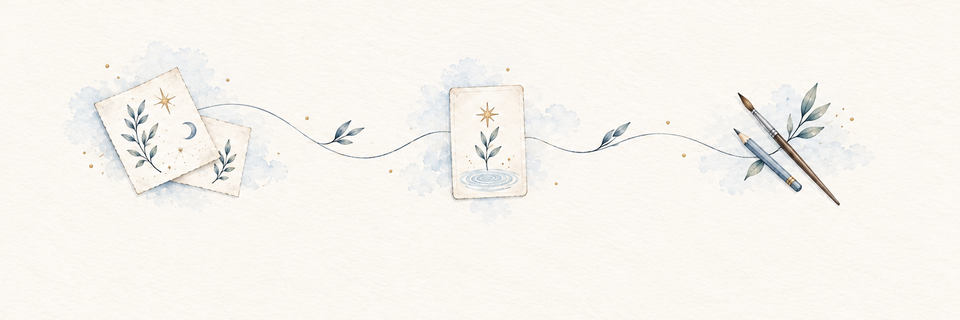
Smith’s scenes and the associations readers have built around them helped shape Lunaire’s Major Arcana. We made new watercolor illustrations rather than reproductions of her cards, but the family resemblance is deliberate. A rose at the Fool’s cliff edge, Justice’s scales, and the Star’s poured water. These images are familiar to visitors and help anchor the reading within tarot’s shared tradition. We also read the image we actually made: if a detail appears in the older deck but not in ours, we do not quietly treat it as though it were on the card in your hand.
Each of our 22 Major Arcana cards has human-reviewed upright and reversed meanings in Lunaire’s distinct voice. Those meanings draw on the recognizable symbols and themes, then make an editorial decision about which strand to follow and how to speak it. A reversal is not automatically the opposite of the upright card or a punishment. It may show a quality turned inward, held back, or taken too far. This is a deliberate reading lens, not a universal rule inherited intact from a historical source.
Where Lunaire’s lens changes the reading
Our reviewed meanings ask what these cards can say without assigning someone a role or a fate. The Empress keeps cultivation and care without treating motherhood as a woman’s required path. The Emperor can speak about structure and responsibility without making command a masculine virtue. The Lovers can speak about connection and choice without prescribing a heterosexual couple or a single kind of relationship. These are interpretive departures, not claims that older imagery never carried gendered assumptions. They give more people room to meet a card honestly.
Safety changes the wording as well as the welcome. Death can mark an ending without predicting a physical death. The Tower’s lightning can reveal a failing structure without promising catastrophe. We do not let a card claim knowledge of your health, another person’s motives, or an event that has not happened. This keeps the symbolic force of the card while leaving your circumstances where they belong: with you.
You can see the bridge between convention and this lens in our portraits of the Fool through the Wheel and Justice through the World. The figures are familiar. The questions they ask are shaped by the lives reading them now.
What happens when three cards meet
For this first version of Lunaire tarot, three different Major Arcana cards are drawn at random. Each takes a position—What shaped this, What is asking for attention, or What may help—and the focus you choose gives the reflection an area of life, not a new set of facts about you. Our guide to the three-card spread and its lenses explores how those parts work together.
Lunaire then writes from the cards actually drawn: their illustrations, approved meanings, orientations, positions, and the relationship among them. The historical references above helped us develop that foundation; they are not pages searched anew during your reading. The writing may notice a shared concern, a disagreement, or a third card that changes the question. It is checked against the approved card material before it appears, and the individual meanings remain available if the combined reading cannot be completed.
The old pictures give the cards a shared grammar. Lunaire is responsible for the sentences it writes with that grammar. You decide where, if anywhere, they meet your life.