


You know the moment when an idea makes you get up from the chair. There may be no sensible plan yet, only a sudden wish to see what happens if you try. The Ace of Wands knows that moment well. Across the suit, other figures are considering the journey: celebrating together, arguing, or discovering that ten branches are considerably harder to carry than one.
Wands belong to tarot’s Minor Arcana, the four suits concerned with ordinary life in its many forms. They bring desire, invention, courage, and effort into view. A creative project belongs here, but so does an outing, an invitation, or an opinion you’re willing to stand behind. Their fire is a way of describing appetite and initiative; they don't need you to be relentlessly perky.
As in the Major Arcana, these are distinct characters, with different questions to ask. Their numbers help us meet different manifestations of the same themes. They don’t prescribe a life in fourteen steps, and the court cards aren’t people destined to arrive. Each linked name opens the fuller upright and reversed meanings in Lunaire’s Tarot Library. But before going deeper, let's get a brief glimpse of who has picked up a wand, and what they intend to do with it.
Something worth trying
Ace of Wands — the first impulse
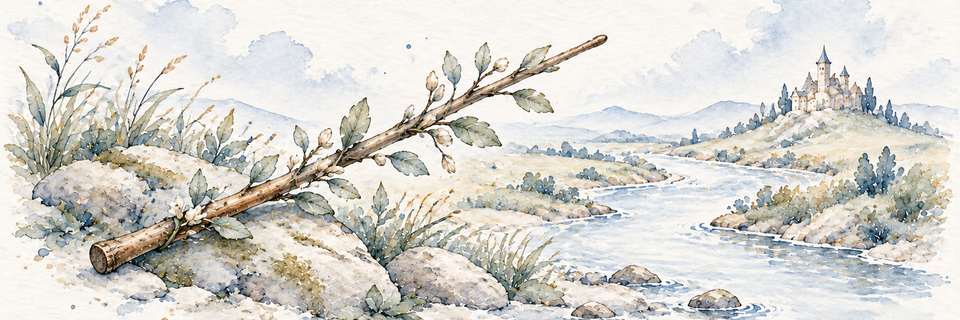
The Ace has an idea, and would rather test out a small version than explain it for another hour. A hand emerges from pale clouds holding a wand with leaves still growing from it; beyond lies a river valley and a distant castle. Desire and impulse have found something to grasp, even while its destination is far away.
Reversed, the first attempt may feel surprisingly flat. The Ace can make the beginning smaller, change its form, or discover that the imagination imbued in the idea was part of what it liked. Curiosity deserves a trial, but enthusiasm for the real thing can’t be argued into existence.
Two of Wands — the one considering the view
The Two holds a globe on a stone terrace, looking across water toward mountains. Here is someone who can appreciate the view and still ask what getting there would involve. Which direction is appealing enough to choose? How would your life today need to change to make room for it?
Reversed, the globe keeps turning in the mind while the feet stay put. More information might help; so might admitting that an impressive prospect isn’t especially desirable in practice. The Two wants a course it can actually follow, with a little foresight packed alongside the ambition.
Three of Wands — the outward-looking companion
The Three has launched an undertaking beyond its starting point. Three ships are visible beyond a flowering cliff, where a figure stands among three upright wands. A wider world has entered the picture: people to meet, responses to receive, possibilities that couldn’t develop in a room with only one opinion.
The Three has confidence, but the ships have conditions of their own. Reversed, the hoped-for outcome might be delayed or difficult to establish. It may call for waiting, a different connection, or a revised plan without telling the whole story of the effort’s worth.
Four of Wands — the welcoming host
The Four would like everyone to pause their work for long enough to notice what has convened. Two smiling figures gesture beneath a flower garland hung among four posts; a path leads toward a small house. A gathering has a place to happen; someone has made enjoyment possible.
There can still be things unfinished (the Four knows this and has invited you anyway). Reversed, the invitation becomes more personal or modest: a small circle, a quiet acknowledgment, an occasion that means something without needing to draw a crowd. Celebration can be meaningful even when small in size.
Other people have wands, too
Five of Wands — the spirited contestant
The Five brings five people into a clearing, each holding a staff at a different angle. Nobody is short on opinion. A lively contest can reveal an idea’s strengths (and weaknesses), or bring unfamiliar approaches into view. It can also become thoroughly unhelpful. The Five leaves the quality of the exchange open to interpretation.
Reversed, disagreement keeps producing more disagreement. Winning has acquired more importance than the point anyone came to discuss. A clear question, turns to speak, or some distance from the argument may make better use of everyone’s energy than another collision at the center.
Six of Wands — the one who accepts the applause
The Six carries a wreath-topped staff along a flower-lined path, with five companions nearby. Present company recognizes that there’s no horse carrying the leading figure. That effort has earned acknowledgment, and the Six lets that register. A contribution can be named and its result enjoyed.
Reversed, credit may be unevenly doled out, applause delayed, or the achievement still difficult to establish. The Six looks at what actually happened: what worked, what remains unfinished, and who helped. A missing hurrah can hurt without becoming the only measure that the work took place.
Seven of Wands — the defender of a chosen position
The Seven stands ready, with feet apart on a rocky rise, a wand held across the body. Six more rise from hands below. This figure has a position to defend, and some higher ground to stand on. Courage is useful when there’s something worth protecting, whether a view, an undertaking, a limit.
Reversed, defending against every challenge may become too difficult, or the position itself may need reconsidering. The Seven can accept help and hear a fair objection. A firm stance doesn’t have to do combat with every raised staff.
How the effort travels
Eight of Wands — the swift messenger
The Eight has dispensed with a portrait altogether. Eight leafy wands cross the sky in parallel diagonals above a winding river. The movement is the message: news traveling, arrangements coming together, one development making the next step possible.
Reversed, those movements lose their coordination. One person is waiting; another is rushing with different information. The Eight looks for where the course became tangled. Sometimes a clarification helps. Sometimes the missing part needs time, and another message won’t make it arrive sooner.
Nine of Wands — the experienced keeper
The Nine holds one staff, with eight standing behind and a cloth around the forehead. Effort has a history here. The sideways glance notices what a bright beginning can miss. Persistence might take the form of a careful next attempt, a useful limit, or support accepted before it’s urgently needed.
Reversed, the watchful role becomes difficult to separate from. Every pause swells with preparations for future challenges. The Nine asks what actually needs protecting, and what continuing on as is costs. Experience can help change the arrangement. It needn’t become an obligation to endure everything.
Ten of Wands — the overburdened carrier
The Ten leans forward on a stony path, both hands occupied by a fan of ten leafy staves. Buildings stand ahead, but the load blocks most of the view. An undertaking can be worthwhile and still generate more demands than one person can comfortably carry. Success has baggage, too.
Reversed, the Ten considers how that load could change: something shared, finished, declined, or set down. Duties don’t vanish because a card recommends relief. Practical help and a more realistic promise may be needed. The burden itself belongs in the conversation, alongside the reason for carrying it.
Four ways to carry the fire
The court’s titles name four approaches, available to any person, at any age or of any gender. These figures share initiative, but they put it to different uses.
Page of Wands — the interested beginner
The Page looks up toward the branches of a wand held in both hands. Sandy ground and low mountains leave plenty to explore. There’s something appealing about an interest without a claim to expertise: a question asked freely, a first attempt made without an impressive introduction.
Reversed, the Page may ponder several possibilities without giving any one a try. Curiosity hasn’t found a direction. One limited experiment could reveal what keeps the attention after the announcement is over. Discovery gets to be the point, even for someone who is experienced at other things.
Knight of Wands — the eager explorer
The Knight’s blue cloak streams behind a rider on a brown horse, one foreleg lifted. This character would like to find out by going. An outing, an unfamiliar experience, an idea put into motion: real engagement supplies details that imagining couldn’t.
Reversed, the speedy clip leaves too much unfinished. A new pursuit starts while a previous promise is still waiting for an answer. The Knight can pause long enough to notice those consequences and choose what deserves the next burst of energy. Movement teaches more when there’s time to take in the lesson.
Queen of Wands — the generous independent
The Queen holds a sunflower and a leafy wand; a dark cat sits beside her bare feet. Her confidence has warmth in it. She can offer an idea, act on an interest, and encourage someone else’s contribution without requiring it to resemble her own. Independence can still occupy a welcoming seat.
Reversed, comparison or a desired response may begin choosing the expression for her. The Queen wants to hear what still interests its owner. That confidence can return quietly. There’s no need to put on a performance merely to prove it has come back.
King of Wands — the keeper of a larger purpose
Lion faces sit on the arms of the King’s pale throne. A leafy wand remains upright beside the dark-haired, bearded figure. Here, enthusiasm has become a purpose that can survive more than its first exciting afternoon. The King makes decisions others can understand and contribute to; leadership includes knowing which parts don’t need his hands.
Reversed, the purpose becomes too attached to one plan. A question sounds like an interruption; someone else’s pace seems intolerably slow. The King’s vision may still be worthwhile. Letting experience and honest disagreement change its expression is part of carrying it responsibly.
A desire worth giving form
You don’t have to become the most energetic person in the room to embody the Wands. Their question can be quite small: an interest worth trying, a contribution worth making, an effort worth sustaining differently. The cards give that question more than one possible answer.
Choose the picture that catches your eye and open its Library entry. What does its particular way of acting help you notice? A useful reading leaves room for the company around the card, the orientation it takes, and the life you bring to the question.
Explore the rest of the deck
For our coverage of the rest of the deck: