

Wands
Seven of Wands
The Seven of Wands stands behind a chosen position when it meets a challenge.
- defense
- conviction
- challenge
- courage
Read the card in its own right, then follow its meaning through the spread.
Two orientations
The card’s meaning
Wands makes this Seven a question of holding an aim, claim, or undertaking amid active challenge. The higher ground suggests a possible advantage, not a guarantee of success or an instruction to fight every objection.
Upright
The Seven of Wands stands behind a chosen position when it meets a challenge.
The Seven of Wands concerns the courage to hold a position under pressure. A view, a limit on what is acceptable, an undertaking, or a place already gained may need to be explained or defended. The figure’s higher ground suggests that useful support or an advantage can be present even when a challenge feels demanding. Standing firm has a purpose when the position still deserves it. The card leaves room to answer a fair objection, choose which challenge matters, and protect what should remain intact.
- defense
- conviction
- challenge
- courage
Reversed
The Seven of Wands reversed struggles to hold a clear position under mounting pressure.
The Seven of Wands reversed describes difficulty deciding where to stand or how to answer a challenge. Too many objections, an uneven contest, or doubt about the position itself can make every response feel inadequate. The pressure may be real; needing help or reconsidering a stance does not make it a personal failure. This card asks which point still matters, what backing is available, and whether holding, revising, or leaving the position would best answer the actual situation.
- pressure
- indecision
- overwhelm
- reconsideration
How the reversal changes the emphasis
The courage to answer pressure is obstructed by confusion, doubt, or an unequal demand. This develops Waite’s perplexity, anxiety, and caution about indecision without treating every retreat as defeat or every challenge as a reason to persist.
The question changes the emphasis
Reading this card in context
Each spread gives its cards different roles. The examples below explore this card as an influence, a situation or challenge, and advice or support. Begin with the question your position asks, wherever it falls in the spread.
As an influence
Upright
A challenged decision, a position already gained, or pressure to justify a limit may have helped bring this question into focus.
Reversed
Sustained objections, uncertainty about a stance, or pressure greater than the available support may have helped shape the present question.
As a situation or challenge
Upright
Consider what is being challenged, why the position matters, and what evidence or support would make a response proportionate to the pressure.
Reversed
Look at whether the difficulty comes from the position itself, the conditions of the challenge, or trying to answer too much at once.
As advice or support
Upright
State the point worth defending, use the support available, and answer the relevant challenge without taking on every objection at once.
Reversed
Choose the one point that needs an answer, seek concrete backing, and allow revision or withdrawal if defending the position no longer serves its purpose.
Read through a particular life focus
Open reading
Consider the position being defended, the nature of the challenge, and whether available support makes a clear response possible.
Love & relationships
A preference, shared choice, or limit on what you will offer or accept may need explaining; standing by it can include hearing another view and deciding freely whether to continue the exchange.
Work & direction
An idea, application, or undertaking may need advocacy, evidence, or support when challenged, without assuming the challenge is unfair.
Home & family
Where a limit or decision about shared life is contested, consider what needs protecting and what can be discussed or revised.
Self-growth
Explore the difference between standing by a considered belief and feeling obliged to defend a position simply because it was taken earlier.
Look a little closer
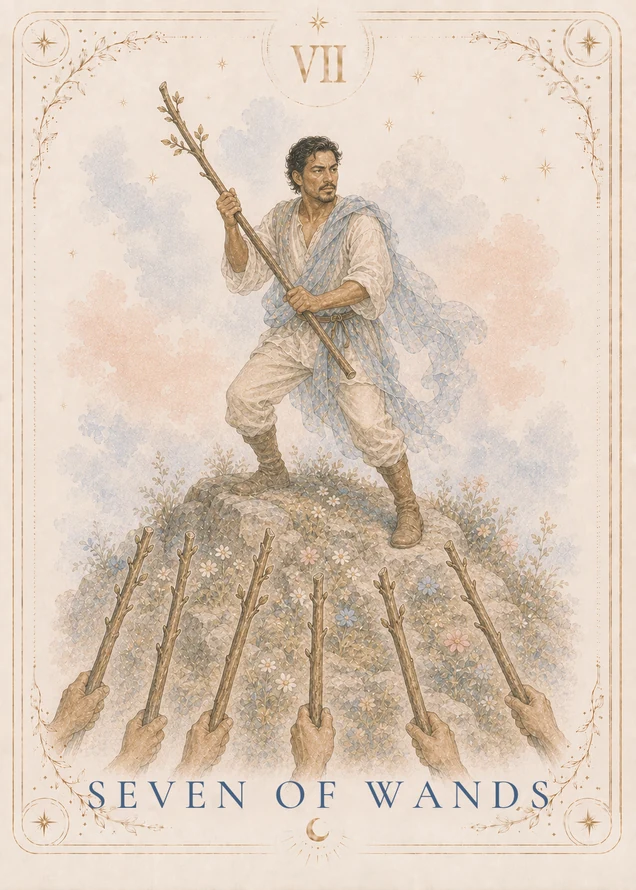
The imagery
Raised position
The figure stands on a rocky mound above the six raised staves.
An existing advantage can help someone meet a challenge; elevation does not establish moral correctness.
Staff held across the body
The figure grips one long leafy staff in both hands, angled across the body.
The stance gives a visible form to defending a position or answering pressure.
Six staves below
Six hands at the lower edge each raise a staff toward the figure.
Several challenges can call for a selective response; the image does not identify the people behind them or their motives.
Similarities & differences
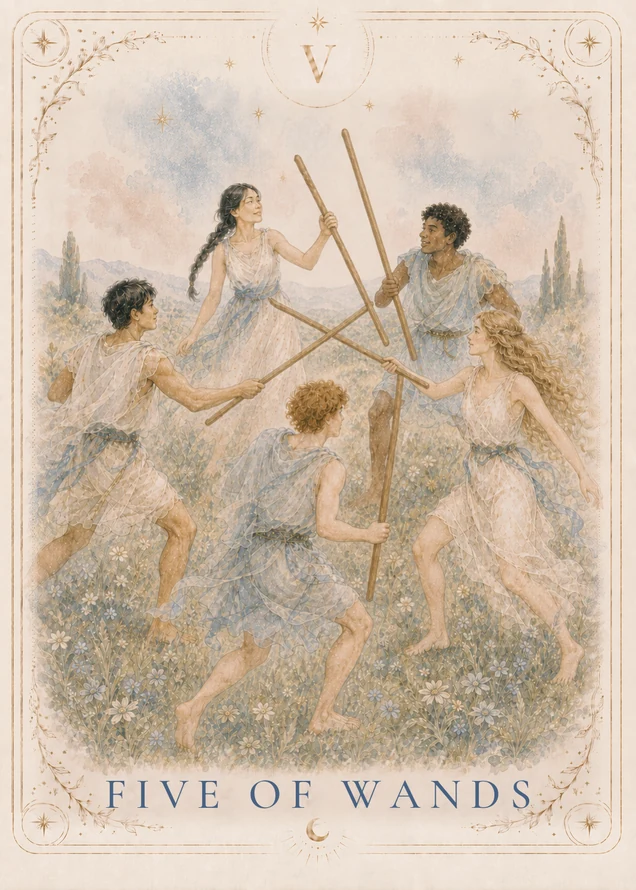
Related cards
Tradition & Lunaire’s interpretation
The traditional foundation
Waite’s main entry joins courage and a favorable position with debate, negotiation, trade, competition, and possible success. Its reversal lists perplexity, embarrassments, anxiety, and a warning about indecision. The additional list identifies a child by appearance, an unrelated fortune-telling attribution retained only as historical context.
Lunaire’s reading
Lunaire keeps a position meeting active challenge and selects blocked confidence or response for reversal. Success becomes a possibility supported by circumstances, not a prediction; high ground is practical advantage rather than proof of being right. The appearance-based child attribution is not carried into the meaning. Reconsideration, assistance, and withdrawal remain legitimate choices rather than failures of courage.
Read the source in The Pictorial Key to the Tarot ↗
Waite: additional divinatory meanings ↗
Arthur Edward Waite. The Pictorial Key to the Tarot. W. Rider; [1911]. Illustrations by Pamela Colman Smith. Source edition details ↗