



Wands
Five of Wands
The Five of Wands brings competing efforts into a lively, sometimes difficult encounter.
- competition
- friction
- challenge
- participation
Read the card in its own right, then follow its meaning through the spread.
Two orientations
The card’s meaning
Wands gives this Five the heat of active competition: different desires and efforts meet. Its disturbance can be playful or consequential, without establishing that disagreement is harmful or productive in advance.
Upright
The Five of Wands brings competing efforts into a lively, sometimes difficult encounter.
The Five of Wands gathers different aims, ideas, and ways of doing things into the same space. There can be rivalry, frustration, or the energy of a spirited contest. Each participant has something to put forward, and agreement is not yet established. Testing a view against another can sharpen it, though friction does not automatically become useful. The card concerns how differences are expressed and what, if anything, the contest helps people discover or achieve.
- competition
- friction
- challenge
- participation
Reversed
The Five of Wands reversed finds disagreement repeating after the useful contest has worn thin.
The Five of Wands reversed describes friction that keeps generating more friction. Positions harden, small differences become repeated arguments, or the wish to win takes attention away from what is being discussed. What began as a useful test may no longer leave enough room to listen or try anything different. The card asks what would make disagreement worth participating in again: a clear point to address, an agreed way to take turns, or distance from an exchange that is going nowhere.
- entanglement
- argument
- rivalry
- de-escalation
How the reversal changes the emphasis
The contest loses its usefulness as rivalry or contradiction becomes self-perpetuating. This selects excessive friction from the historical dispute meanings, while preserving resolution as a possible response rather than a promised reversed outcome.
The question changes the emphasis
Reading this card in context
Each spread gives its cards different roles. The examples below explore this card as an influence, a situation or challenge, and advice or support. Begin with the question your position asks, wherever it falls in the spread.
As an influence
Upright
Different priorities, a contest, or several attempts to influence the same outcome may have helped shape the present question.
Reversed
A recurring argument, unclear rules for a contest, or an effort to win every point may be part of this question’s background.
As a situation or challenge
Upright
Look at what the disagreement is actually about, whether people can take part fairly, and what the contest is revealing.
Reversed
Consider whether the exchange still permits listening, correction, and a useful outcome, or whether repeating it is adding to the difficulty.
As advice or support
Upright
Name the point being tested and agree how to explore it, making room for a real difference without requiring immediate agreement.
Reversed
Narrow the discussion to one specific difference, change how people take turns, or step back long enough to choose whether to continue.
Read through a particular life focus
Open reading
Consider what the competing efforts are trying to accomplish and whether the way they meet helps clarify the issue.
Love & relationships
Different preferences or strong opinions can be explored without making disagreement proof of incompatibility or evidence of someone’s hidden intent.
Work & direction
A debate, audition, application, or shared undertaking may involve competing ideas; consider who can take part, how contributions are judged, and what people hope to achieve.
Home & family
Where people share space or decisions, consider how differing preferences can be expressed and how a recurring disagreement could be made more specific.
Self-growth
Notice what is learned by testing an idea or ability against a challenge, including when comparison stops being useful.
Look a little closer
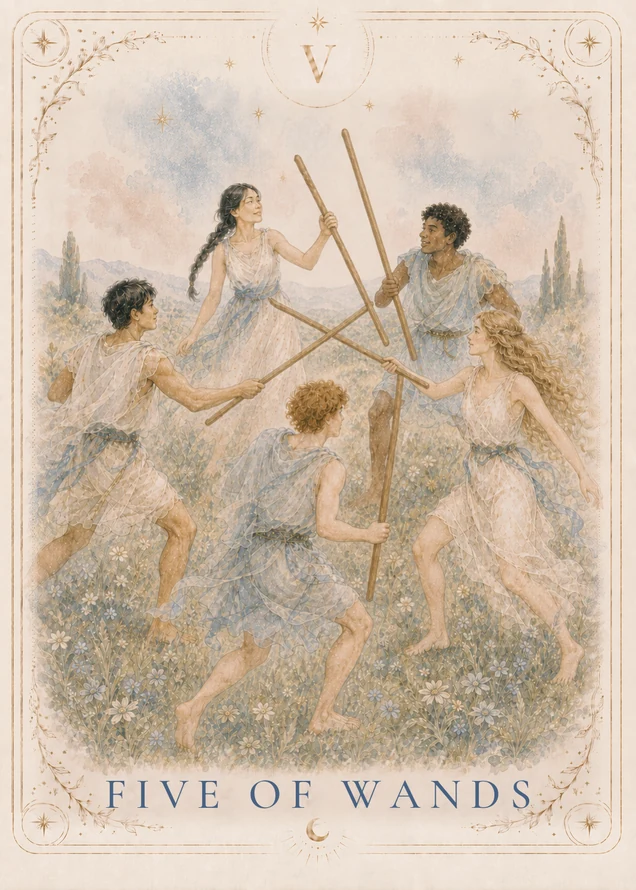
The imagery
Crossing staves
The five staves run across one another at different angles between the figures.
Several efforts meet in the same space; their contact can be a test, a contest, or a source of friction.
Five participants
Five figures face into the group, each holding a staff and taking a different stance.
No single figure directs the encounter, leaving differences of approach visible.
Flowered clearing
The figures stand among small pale flowers in an open landscape.
The setting leaves room for a spirited contest without making the scene proof of injury or hostility.
Similarities & differences
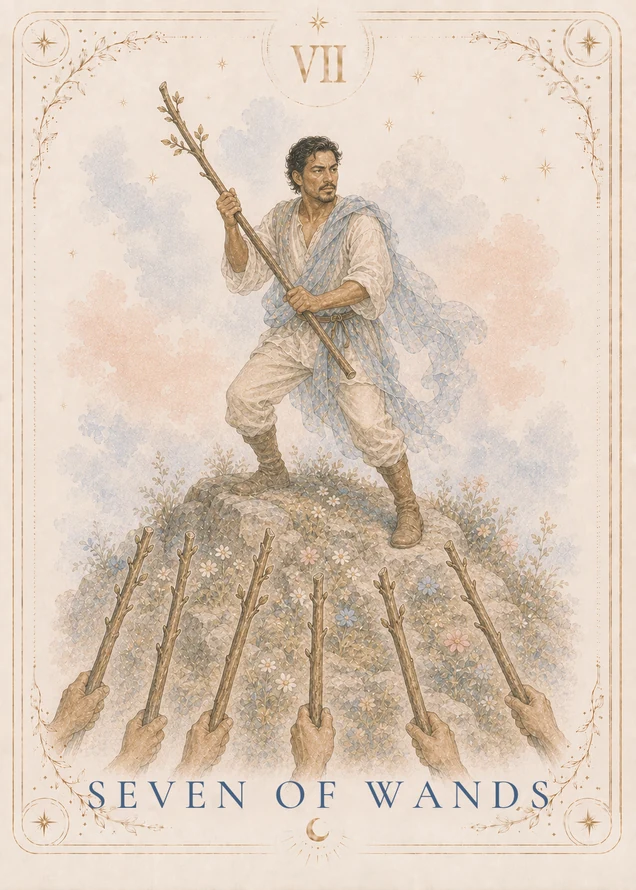
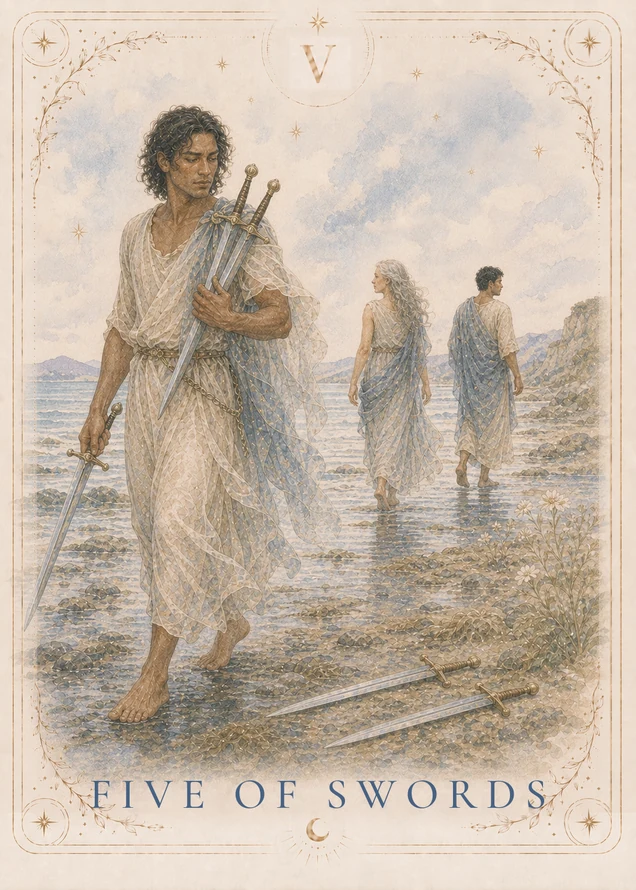
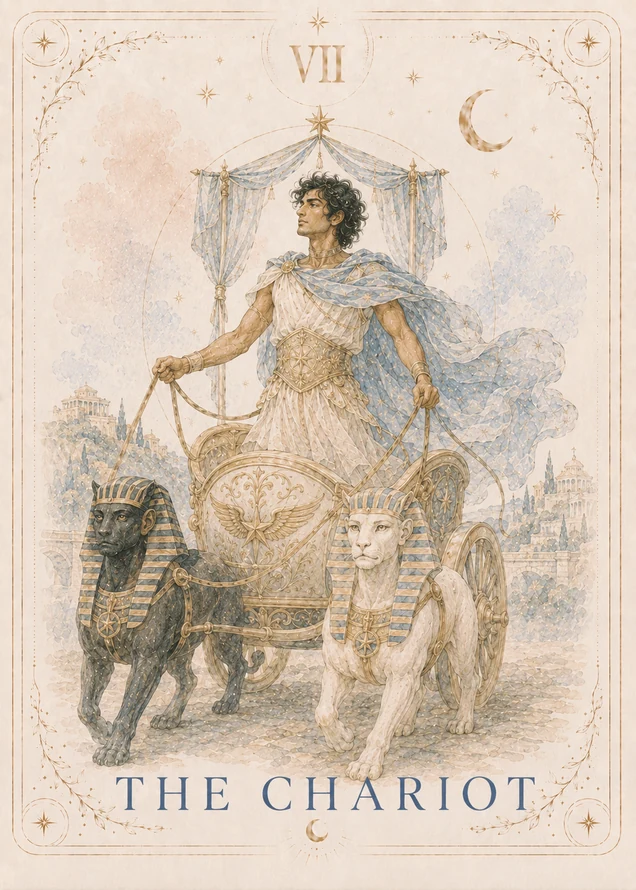
Related cards
Tradition & Lunaire’s interpretation
The traditional foundation
Waite’s main entry presents a mock fight and strenuous competition for material success; it also retains attributions of gain and wealth. Reversal names litigation, disputes, trickery, and contradiction. His additional list gives financial speculation upright and the possible advantage of quarrels reversed.
Lunaire’s reading
Lunaire keeps rivalry and friction alongside the possibility of a useful contest, without predicting wealth, litigation, or deceit. The selected excess reversal develops repeated, unproductive dispute; the historical possibility of turning a quarrel to advantage is retained as an alternative, not guaranteed. Neither orientation establishes anyone’s motives or requires the reader to remain in a hostile exchange.
Read the source in The Pictorial Key to the Tarot ↗
Waite: additional divinatory meanings ↗
Arthur Edward Waite. The Pictorial Key to the Tarot. W. Rider; [1911]. Illustrations by Pamela Colman Smith. Source edition details ↗