


There is the idea of a lovely evening, and then there is finding clean glasses, dietary restrictions, making room at the table, and remembering that someone needs to catch the last train. Pentacles notice the second part. They have opinions about the things a life is made of: time, tools, work, shelter, something good to eat. They want the idea of care to actually have somewhere to sit at the table.
Money belongs to their territory, but it also considers the value of time, the skill someone possesses, and the room that lets you concentrate. Meet them as fourteen characters with different ideas about what makes life workable. Some cultivate, some protect, some give; others ask who has been left on the outside. These are different ways to consider a question, rather than fourteen stages everyone must pass through. The Pentacles guide introduces the suit; each linked card below opens its fuller upright and reversed meanings.
Somewhere to begin
Ace of Pentacles — the first foothold
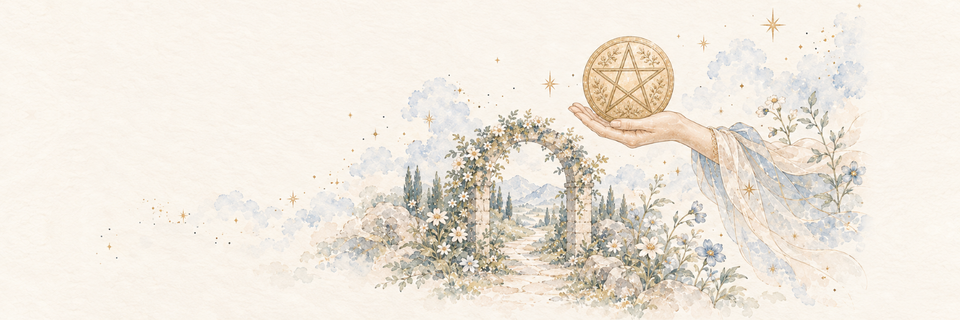
The Ace of Pentacles arrives with something in its outstretched palm. It has heard enough talk of the thing you might make; now it would like you to start from the beginning. A gold disk rests above a flowering arch, and a path runs through it toward the mountains. The Ace can benefit from a borrowed tool or an available afternoon.
Its gift is a foothold. What grows from it still needs tending. Reversed, it checks the conditions behind an attractive opening: the missing materials, the promised time, the upkeep nobody has mentioned yet.
Two of Pentacles — the nimble arranger
The Two of Pentacles is already adjusting the arrangement. On the waterfront, its figure steps between two raised palms while a ribbon loops overhead. It knows that the compartments that make up an ordinary life rarely stay neatly organized: this needs attention now, that can wait until tomorrow, and the timing has changed again. There is some pleasure in its dexterity.
It would like a rhythm with enough room for a breath. Reversed, the Two has been asked to accommodate too much. Its next question concerns the demands themselves. A more elaborate calendar cannot create time or resources that are genuinely missing.
Three of Pentacles — the practical collaborator
The Three of Pentacles brings the drawing over to the person with the tool. One figure works on a wooden platform; two others consult a plan below the carved arch. They want the conversation to improve the thing being made. One can appreciate a good idea and still ask whether the measurements work.
Skill deserves a hearing, and useful knowledge may come from more than one person. Reversed, it notices a gap between contributions: a detail rushed, an agreement unclear, experience passed over. The repair belongs to that particular gap; merely adding more voices does not settle it.
Four of Pentacles — the keeper of a reserve
The Four of Pentacles holds something back. Its seated figure holds one disk close, with others overhead and beneath the feet. It understands the comfort of knowing something will still be there when needed: protected time, a private corner, a useful reserve. The Four may decline an invitation without producing a dramatic explanation. It calls for a limit that serves a goal.
Reversed, guarding what's in reserve has become an occupation in itself. Nothing can be enjoyed because everything must remain untouched. It contemplates whether the thing protected might finally be allowed to do the job it was saved for.
What is missing, given or growing
Five of Pentacles — the companion in the cold
The Five of Pentacles asks us to look outside the lit window. Two cloaked figures walk through snow beside a stone building, one with a staff. It presents two contrasting visions of need. The Five names hardship without turning it into a lesson about character. It wants us to notice what's missing: support, security, something essential and difficult to reach.
Reversed, it considers an opening toward relief, including help that makes a difference while leaving other needs unresolved. A beginning of support matters. The card cannot promise its arrival or make it depend on an improved attitude.
Six of Pentacles — the thoughtful giver
The Six of Pentacles notices the open hand across the table. Its standing figure holds scales while offering a disk, and the scene brings giving into balance with receiving. The Six wants help offered to fit the present need. It can value an hour of someone’s knowledge as readily as a material gift; it knows that fairness does not always mean identical portions.
There should be room for the recipient’s choice and the giver’s limits. Reversed, it listens for the unspoken condition attached to generosity. Assistance that decides unrelated choices in return, or misses the need entirely, deserves closer consideration.
Seven of Pentacles — the watchful cultivator
The Seven of Pentacles leans on its wooden handle and looks at what has grown. It has given this undertaking its time; now it wants to see what that time is cultivating. It is patient enough to recognize that progress can be slow, but also questions where things are going. Those are compatible qualities. The Seven would rather look closely at what is needed than congratulate itself just for continuing on. Reversed, the results may be disappointing or the conditions for growth incomplete. Time already spent cannot answer whether more effort has a useful purpose. Continuing, changing the approach, or bringing something to an end are all options.
Eight of Pentacles — the attentive craftsperson
The Eight of Pentacles returns to the piece on the bench. Completed disks hang behind the seated craftsperson, but attention belongs to the unfinished one on the table. This character welcomes the difference between one attempt and the next: something learned about the tool, a new detail understood, a hand growing more familiar with its craft.
It relishes steady work, along with the time, materials and rest that sustain it. Reversed, one tiny flaw can keep the piece on the bench indefinitely. The Eight asks what quality the task actually needs, and whether the next refinement will still serve the ultimate goal.
Room to enjoy; room to endure
Nine of Pentacles — the one who enjoys the garden
The Nine of Pentacles has stepped into the garden to enjoy it. Its heroine stands among grapevines, a hooded bird on a gloved hand and a snail on the path below. The Nine appreciates accomplishment, but it also has preferences about the life that accomplishment should sustain. A pleasing afternoon is allowed to be a result in itself. Independence can still include help and gratitude toward others; needing someone does not erase what has been cultivated.
Reversed, maintaining an impressive life may leave very little room to inhabit it. The Nine asks what its version of success costs in time and freedom, within the circumstances actually available.
Ten of Pentacles — the keeper of continuity
The Ten of Pentacles welcomes more than one generation beneath its blossoming arch. Adults, a child and beloved pets gather in a place that celebrates continuity. It is interested in what can be received, shared and carried forward: practical knowledge, a home, an undertaking that supports people beyond its first maker.
It does not insist on a particular family shape or on owning the place. Reversed, it examines the arrangement behind the feeling of belonging. Something may last while its benefits remain uneven or its expectations no longer fit the present form. The Ten wants to know what must change for the support to remain useful to those involved.
Four ways to tend what matters
Page of Pentacles — the absorbed beginner
The Page of Pentacles holds the disk up for closer scrutiny. The curly-haired figure’s attention is undivided: there is something here worth learning about. The Page will turn an interest into study, a careful first attempt, a question that can be answered by doing.
It has no objection to an experienced person becoming a beginner again. Reversed, preparation may gather dust while the attempt waits on hold, or a practical obstacle may interrupt the learning process. The Page asks where the attention stopped and what would let it return. An unfinished beginning has not told the whole story of someone’s ability.
Knight of Pentacles — the steady companion
The Knight of Pentacles can be counted on to return. Its rider holds a disk against the chest on a dark horse, with furrowed fields in the backdrop. The Knight knows that the crux of a promise happens after the interesting first conversation: checking, planning, coming back to the task.
Quiet progress suits it, provided the pace can be maintained. Reversed, the method may continue long after it has stopped helping the purpose. Reliability can require a changed approach or a more honest commitment. This Knight’s useful question is whether the routine still carries the work well.
Queen of Pentacles — the resourceful host
The Queen of Pentacles is considering what would make this place more comfortable. Barefoot on a stone seat, with a disk across the lap and flowers, wheat and a rabbit nearby, it brings judgment and warmth to ordinary provision. It knows that something can be both useful and beautiful. Care and tenderness take a practical form: an arrangement that works, a need anticipated, available resources put to thoughtful use.
Reversed, the Queen brings that resourcefulness toward its own needs. The person providing comfort also belongs in the room (even before everyone else is completely settled). This manner of care can belong to anyone; it assigns no household role.
King of Pentacles — the seasoned steward
The King of Pentacles knows what the undertaking will need in its next season. Its gray-bearded figure sits among vines on a bull-carved throne, holding a leafy scepter and a disk on an open palm. Experience has become judgment about what can be built and sustained.
The King likes a promise with dependable backing and resources that give something else room to flourish. Reversed, it may keep adding to the tally while the purpose of the accumulation grows faint. Its question returns to what has been built: whom does it support, what does it sustain, and is there room to enjoy it?
What a life can use
Pentacles keep bringing the conversation back to what is tangible. The Two changes the rhythm; the Four protects a reserve. The Seven considers the cultivation; the Eight attends to the craft. The Nine enjoys a life with room to choose, while the Ten asks how support might continue beyond one person.
You don’t need to turn them into a verdict on how well you are managing. Their differences can make an ordinary question more precise. When something matters, what would give it a useful place in your life: an opening, a different arrangement, another person’s contribution, or the chance to enjoy what is already there?
Explore the rest of the deck
For our coverage of the rest of the deck: