



Pentacles
Seven of Pentacles
Patient cultivation includes taking stock of what the effort is becoming.
- cultivation
- patience
- assessment
- long view
Read the card in its own right, then follow its meaning through the spread.
Two orientations
The card’s meaning
This Seven considers material cultivation over time, bringing attention to progress, patience and the choice of further effort. Its meaning is not derived from a numerical rule, and the extra disk in the native art does not turn it into an Eight.
Upright
Patient cultivation includes taking stock of what the effort is becoming.
The Seven of Pentacles pauses beside something that has taken time to grow. It concerns cultivation, patience, and an honest look at the results so far. A practice, project, or source of support can deserve continued care while still needing adjustment. Looking closely helps distinguish slow development from effort that is no longer serving its purpose. The card values a longer view without promising that persistence alone will produce the hoped-for return.
- cultivation
- patience
- assessment
- long view
Reversed
Effort without the hoped-for return calls for a fresh look at what continuing requires.
The Seven of Pentacles reversed brings attention to effort whose benefit is uncertain or disappointing. Waiting may have become difficult, or the conditions needed for growth may be missing. Neither frustration nor the time already spent settles what should happen next. The question is whether further effort has a reasonable purpose, and what it would cost. More time, a changed approach, or ending an undertaking may each deserve consideration; the card does not choose on the reader’s behalf.
- disappointment
- impatience
- reassessment
- uncertain return
How the reversal changes the emphasis
The passage from care to meaningful benefit is blocked or doubtful. This selection includes impatience and disappointing results without treating either as proof of poor effort, inevitable failure, or a duty to continue.
The question changes the emphasis
Reading this card in context
Each spread gives its cards different roles. The examples below explore this card as an influence, a situation or challenge, and advice or support. Begin with the question your position asks, wherever it falls in the spread.
As an influence
Upright
Time, care, or resources already given to an undertaking may explain why its progress and future now matter.
Reversed
A slow or disappointing result, or uncertainty about what further effort would achieve, may have brought the question into focus.
As a situation or challenge
Upright
Consider what has developed, what is still uncertain, and whether the time expected for growth fits the conditions you can actually see.
Reversed
Examine what another period of effort would require and what gives reason to expect a different result, including conditions outside your control.
As advice or support
Upright
Pause to assess a concrete sign of progress, then decide what care or adjustment is worth giving before you look again.
Reversed
Separate what has already been spent from the next decision, then compare the realistic possibilities for continuing, changing the approach, or stopping.
Read through a particular life focus
Open reading
A developing undertaking may benefit from looking at its actual progress before deciding what to give it next.
Love & relationships
In a question about connection, consider what shared effort has made possible and whether further time would meet the needs of those involved.
Work & direction
A project or course of learning can be assessed through what is developing, what remains costly, and which conditions could realistically change.
Home & family
A practical arrangement may need time to settle, alongside an honest look at whether its upkeep is bringing the support intended.
Self-growth
Consider how a practice has affected daily life and what would help you judge its value beyond the wish for quick progress.
Look a little closer
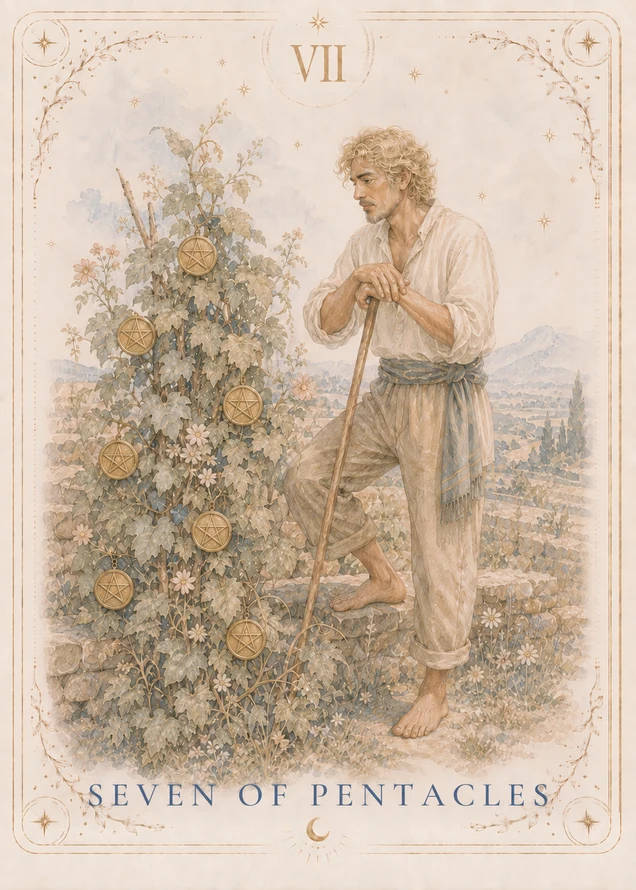
The imagery
Resting hands and attentive gaze
The figure rests both hands at the top of a long wooden handle and looks toward the plant.
A pause in effort can make room to assess what has developed and what further attention it needs.
Pentacles among the leaves
Eight gold disks hang at different heights in dense greenery; this exceeds the card’s intended count of seven.
The association of resources with a growing plant supports cultivation over time; the extra disk is an artwork mismatch, not an additional symbolic meaning.
Plant and surrounding ground
Flowers and leaves grow around the figure, with stones and terraced land beyond.
What develops depends on conditions as well as the attention given to it.
Similarities & differences
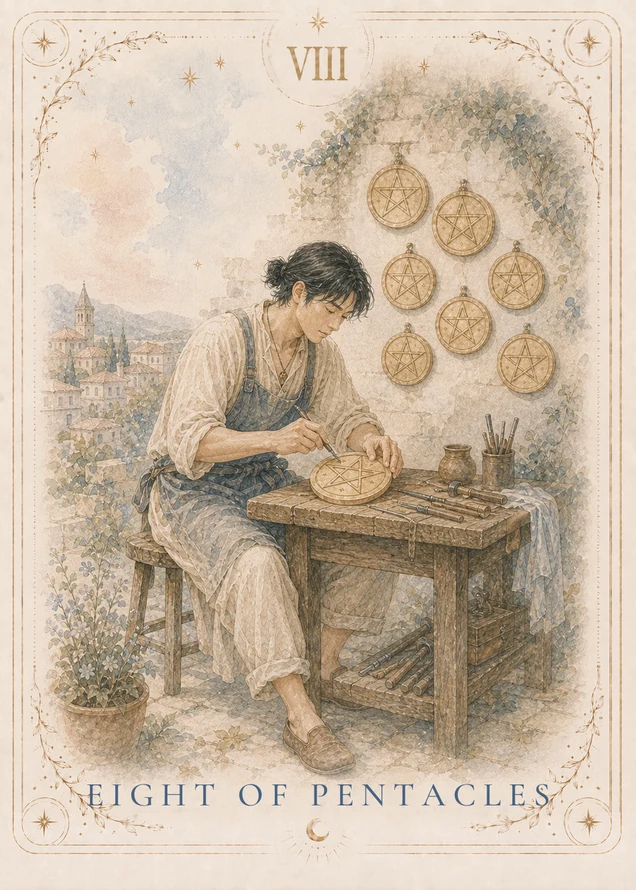
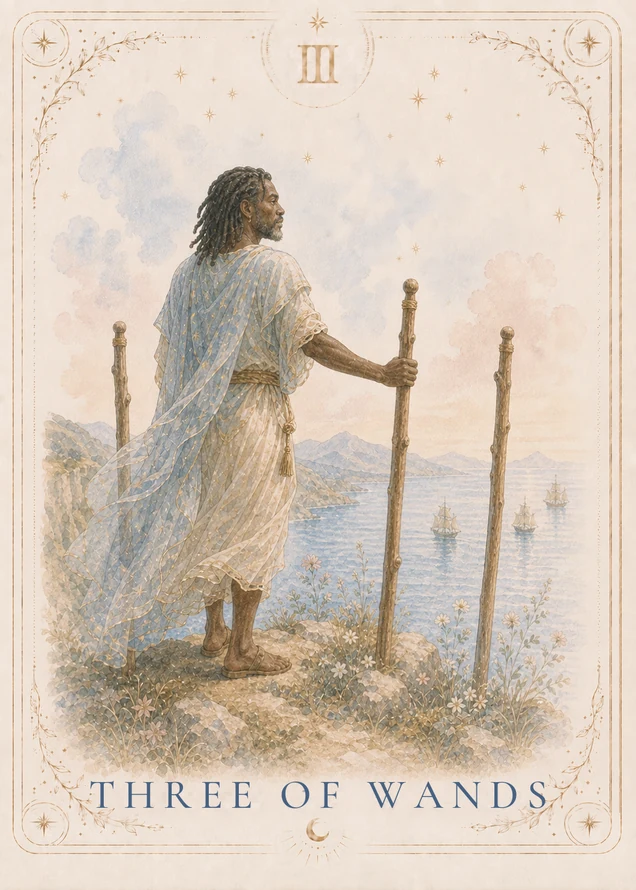
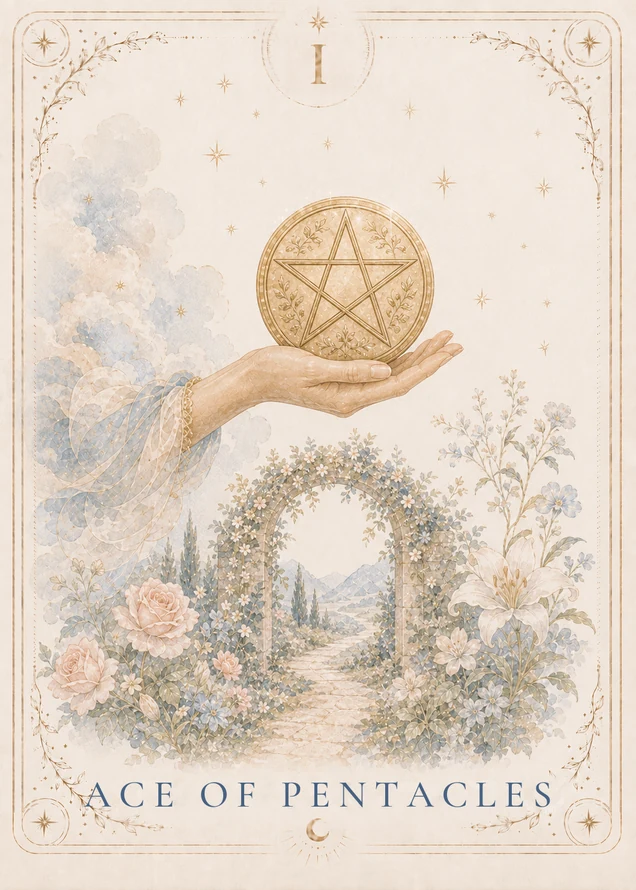
Related cards
Tradition & Lunaire’s interpretation
The traditional foundation
Waite describes attention fixed on pentacles in greenery. His main upright list explicitly contains conflicting readings: commerce alongside quarrels and innocence; the reversal concerns anxiety over a proposed loan. In Part III §4, the additional upright entry forecasts a future husband’s improved position, while the reversed entry names impatience, apprehension and suspicion.
Lunaire’s reading
Lunaire adopts the modern cultivation-and-assessment emphasis found in Biddy Tarot’s account, grounded in the pictured pause, while retaining Waite’s conflicting alternatives as history. The blocked-benefit reversal develops disappointment and reconsideration without promising returns, judging scarcity or prescribing either persistence or departure. The gendered forecast and lending prediction are not applied to the reader; the native eight-disk mismatch remains a separate artwork issue.
Read the source in The Pictorial Key to the Tarot ↗
Biddy Tarot: Seven of Pentacles ↗
Waite: additional meanings for Seven of Pentacles (Part III §4) ↗
Arthur Edward Waite. The Pictorial Key to the Tarot. W. Rider; [1911]. Illustrations by Pamela Colman Smith. Source edition details ↗