



Pentacles
Eight of Pentacles
Skill develops through repeated practice that stays attentive to the work itself.
- practice
- craftsmanship
- learning
- attention
Read the card in its own right, then follow its meaning through the spread.
Two orientations
The card’s meaning
The Eight expresses Pentacles through making and learning: ability develops in contact with a task and its materials. Craft can be paid or unpaid, creative or ordinary, and neither endless hours nor flawless output establishes a person’s worth.
Upright
Skill develops through repeated practice that stays attentive to the work itself.
The Eight of Pentacles gives attention to the work in hand. Skill develops through doing, noticing, and trying again with a little more understanding. Repetition matters because it offers another chance to learn, whether someone is beginning or refining years of experience. There can be satisfaction in making something carefully and seeing the difference that care makes. Time, suitable tools, and rest support this practice; devotion need not mean working without limits.
- practice
- craftsmanship
- learning
- attention
Reversed
Care for the details can become refinement that never lets the work be finished.
The Eight of Pentacles reversed can keep a piece on the bench after further adjustments have stopped improving it. Care becomes perfectionism: a small flaw outweighs the work’s purpose, or every attempt must prove complete mastery. Effort continues, but learning and satisfaction have less room. This card asks what quality the task actually needs and when further refinement stops serving it. A useful result can carry the marks of practice without making the whole effort inadequate.
- perfectionism
- overworking
- repetition
- completion
How the reversal changes the emphasis
The useful attention of craftsmanship grows beyond what the task needs. Perfectionism is the selected modern excess lens; interrupted practice, careless work or misused skill are other possible reversals, rather than conditions this record assumes.
The question changes the emphasis
Reading this card in context
Each spread gives its cards different roles. The examples below explore this card as an influence, a situation or challenge, and advice or support. Begin with the question your position asks, wherever it falls in the spread.
As an influence
Upright
Practice, an opportunity to learn, or attention given to a particular craft may have developed the skill available in this question.
Reversed
Repeated correction, a demand for faultless work, or pressure to prove mastery may have shaped how much attention the task now receives.
As a situation or challenge
Upright
Look closely at how the work is being done, what the latest attempt teaches, and which conditions would help you practice well.
Reversed
Consider which refinements improve the result and which keep it from being used, shared, or allowed to stand as finished.
As advice or support
Upright
Choose a manageable part to practice, notice what changes, and make one useful adjustment while leaving enough time to rest.
Reversed
Define what this particular task needs to do, then test whether one remaining change serves that purpose before continuing to refine it.
Read through a particular life focus
Open reading
A question may benefit from attending to the method, the practice it allows, and what each attempt can teach.
Love & relationships
Consider a way of listening or offering care that can improve through attention to the other person’s response, without treating closeness as a task to perfect.
Work & direction
A skill may develop through focused practice, helpful feedback, and a pace that leaves enough room to notice what is being learned.
Home & family
A repair, practical routine, or shared task can become easier through learning its details and deciding what care it actually needs.
Self-growth
Practice can deepen an ability while leaving room for unfinished learning and results that are useful before they are flawless.
Look a little closer
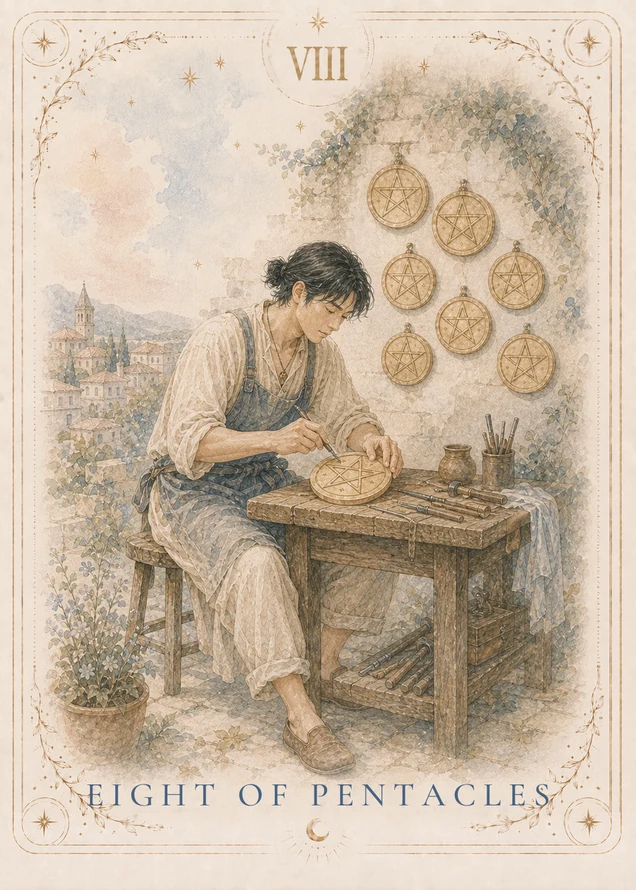
The imagery
Work beneath the hands
One hand steadies a gold disk while the other holds a fine tool against its star pattern.
Skill grows through attention to what a particular attempt is doing, including the small adjustment it needs.
Seven mounted disks
Seven completed-looking pentacles hang on the wall above the eighth at the bench.
Repeated attempts can accumulate into experience, with each piece giving the next something to build on.
Tools on and beneath the bench
Several handled tools lie on the work surface and lower shelf; others stand in a container.
Careful work has practical means and methods, as well as the willingness to keep learning.
Similarities & differences
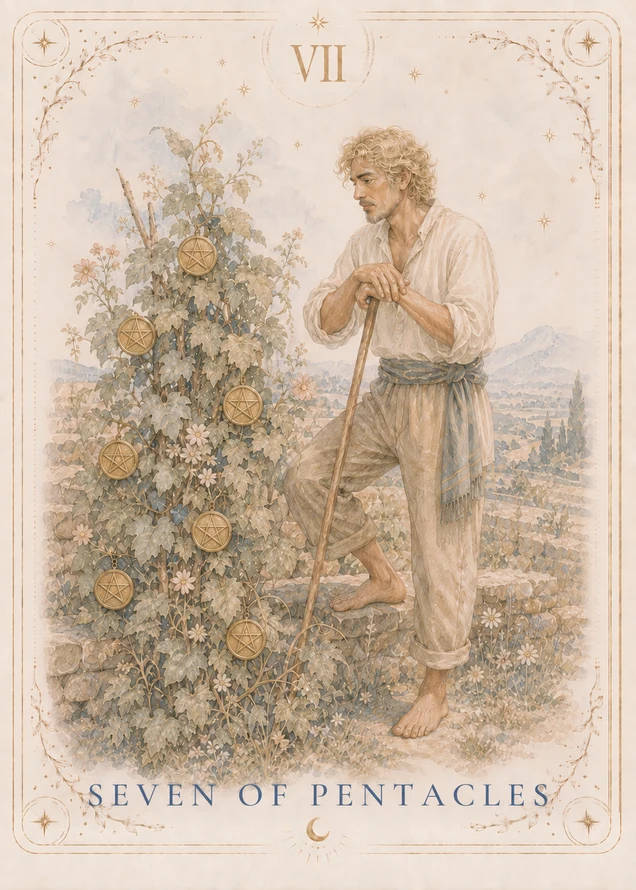
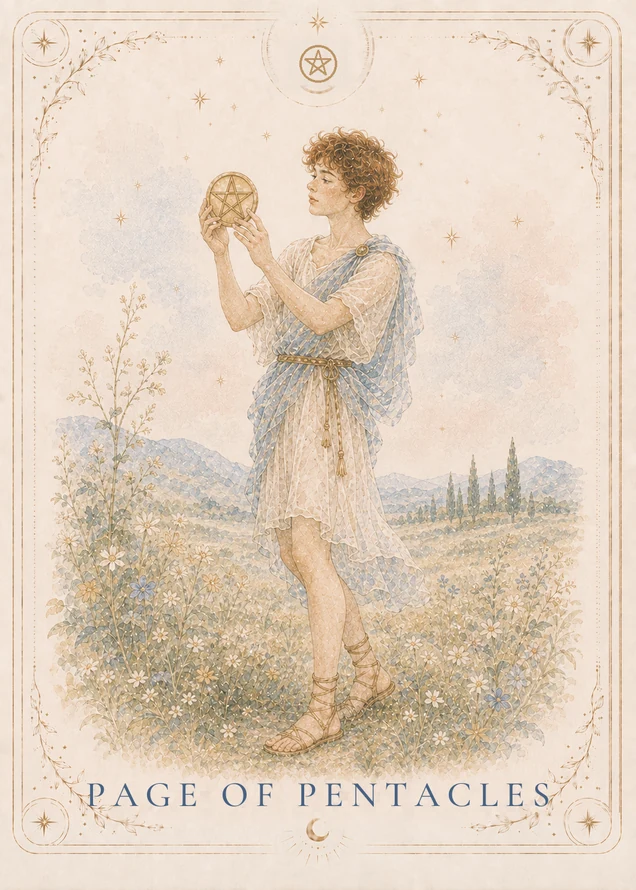
Related cards


Tradition & Lunaire’s interpretation
The traditional foundation
Waite’s stoneworker supports upright meanings of work, commissions and craftsmanship, possibly still in preparation. His reversed list includes frustrated ambition, vanity, greed, exploitative demands, usury and skill used for intrigue. Part III §4 adds gendered and appearance-based person descriptions upright, and a compromising money-lending matter reversed.
Lunaire’s reading
Lunaire develops craftsmanship into attentive practice across paid and unpaid life. The reversed perfectionism lens is a modern selection also presented by Biddy Tarot; it does not claim to reproduce Waite’s varied condemnatory list. The native image shows a fine tool working a gold-colored disk rather than clearly depicting stone carving; that material distinction is retained without changing the card’s center.
Read the source in The Pictorial Key to the Tarot ↗
Biddy Tarot: Eight of Pentacles ↗
Arthur Edward Waite. The Pictorial Key to the Tarot. W. Rider; [1911]. Illustrations by Pamela Colman Smith. Source edition details ↗