


Pentacles
Knight of Pentacles
Patient, dependable effort carries a practical commitment through the work it requires.
- reliability
- patience
- method
- follow-through
Read the card in its own right, then follow its meaning through the spread.
Two orientations
The card’s meaning
This Knight pursues the suit’s practical concerns through patient, reliable action. It describes an approach available across age, gender and role; a slow pace alone does not define it, and adapting a method can be part of keeping faith with a task.
Upright
Patient, dependable effort carries a practical commitment through the work it requires.
The Knight of Pentacles attends to the work that makes a promise dependable. Planning, care with details and repeated effort give a chosen task continuity beyond the first burst of interest. This is the value of returning, checking and doing what is needed, even when the progress is quiet. Steadiness can include adjusting a method when conditions change. The commitment is to carrying the work well, with a pace and approach that can actually be maintained.
- reliability
- patience
- method
- follow-through
Reversed
A familiar routine can keep repeating after it has stopped helping the work.
The Knight of Pentacles reversed can keep the method intact while the purpose goes unattended. A routine repeats because it is familiar, or preparation grows so exacting that the next step is always postponed. Effort may be considerable even when little changes. This reading examines where persistence has become rigid. Keeping a commitment can sometimes require a different pace, a simpler method or an honest revision of what can be done. Reliability leaves room to respond to the work itself.
- rigidity
- routine
- perfectionism
- reassessment
How the reversal changes the emphasis
This excess lens selects steadiness becoming rigidity: preserving a method matters more than whether it still helps. It does not treat rest, a slow pace or an external obstacle as proof of stagnation.
The question changes the emphasis
Reading this card in context
Each spread gives its cards different roles. The examples below explore this card as an influence, a situation or challenge, and advice or support. Begin with the question your position asks, wherever it falls in the spread.
As an influence
Upright
Repeated effort, a dependable routine, or a commitment carried through ordinary tasks may have given the present matter continuity.
Reversed
A method kept long after conditions changed, or preparation that continually postpones action, may be one influence on this question.
As a situation or challenge
Upright
Consider the practical work still required and whether its pace, method and promises fit the time and support available.
Reversed
Notice what the routine actually accomplishes, and distinguish a necessary slow pace from repetition that no longer serves the task.
As advice or support
Upright
Choose a next step you can return to reliably, check what it accomplishes, and adjust the method when the work asks for it.
Reversed
Revisit one repeated step, simplify what can be simplified, and revise a promise if fulfilling it now requires a different approach.
Read through a particular life focus
Open reading
Consider what steady practical follow-through would involve and which method can continue responding to the task as it develops.
Love & relationships
In questions of connection, dependable follow-through can make an offer of care meaningful while leaving promises open to honest discussion.
Work & direction
A chosen direction may need a repeatable next step and attention to details, with room to change a method that no longer helps.
Home & family
Regular upkeep can support daily life when its tasks and pace fit the people, time and resources actually involved.
Self-growth
A practice may become more dependable through patient return, including the ability to adjust it when circumstances or understanding change.
Look a little closer
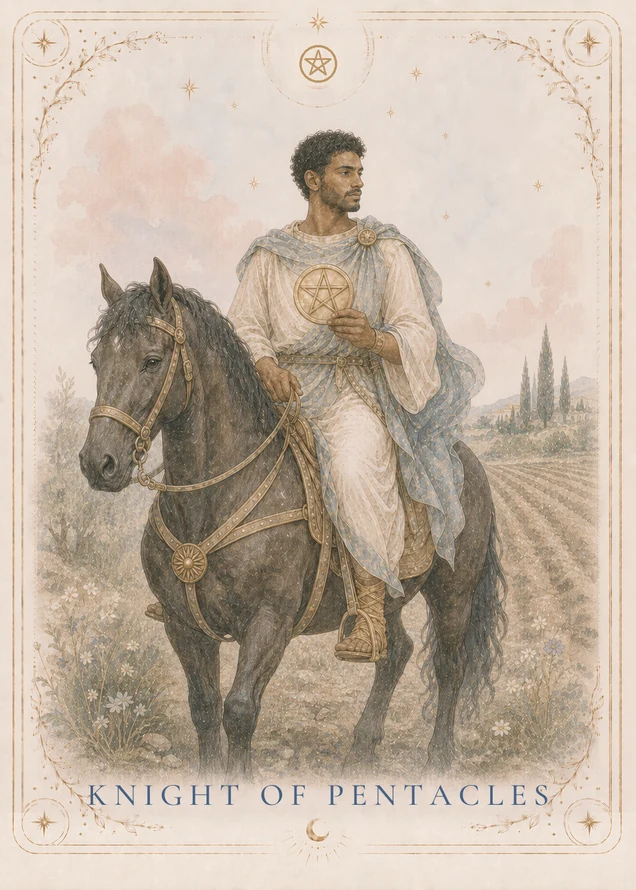
The imagery
Pentacle carried by the rider
The rider holds a gold disk upright near the chest while turning the face away from it.
A practical purpose can be carried into the wider situation, with attention to the ground on which it must be pursued.
Dark horse and reins
The broad-bodied dark horse stands beneath the rider, whose free hand holds the reins.
Deliberate action can be strong without being fast.
Furrowed field
Parallel curved rows cross the field to the right behind the horse.
Repeated work gives an intention a continuing practical form, with each return contributing to the larger task.
Similarities & differences
Related cards
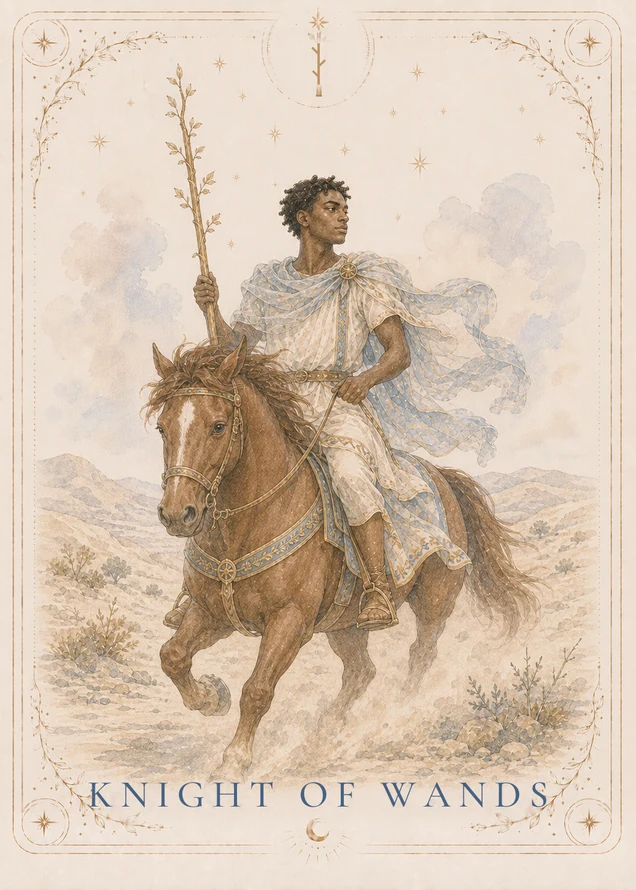
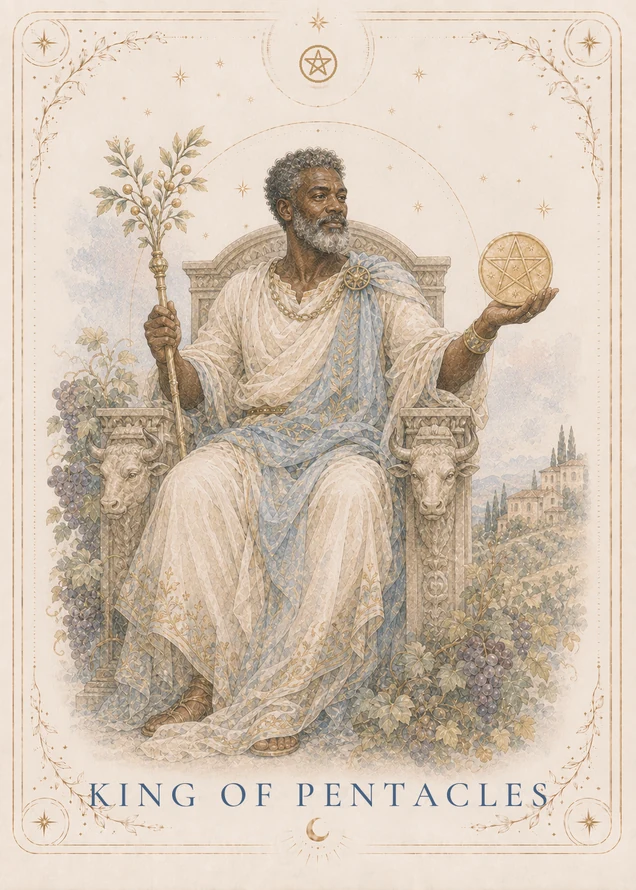
Tradition & Lunaire’s interpretation
The traditional foundation
Waite’s Part III §2 describes an enduring horse and a rider displaying the pentacle without looking into it. Upright meanings emphasize usefulness, service, responsibility and rectitude; reversal includes inertia, stagnation, placidity, discouragement and carelessness. His §4 adds a useful man and useful discoveries upright, and a brave man out of employment reversed.
Lunaire’s reading
Lunaire develops practical service and steadiness into dependable follow-through, without equating worth with productivity or promising success. The selected excess reversal draws on modern readings of inflexible routine and perfectionism, including Brigit Esselmont’s; it is one route into the historical concern with stagnation, not Waite’s complete reversed list. Slow progress and necessary rest are not failures. The native rider’s outward gaze agrees with Waite’s description; modern descriptions of a rider studying the coin are not used as evidence for this image.
Read the source in The Pictorial Key to the Tarot ↗
Biddy Tarot: Knight of Pentacles ↗
Arthur Edward Waite. The Pictorial Key to the Tarot. W. Rider; [1911]. Illustrations by Pamela Colman Smith. Source edition details ↗