



Pentacles
Page of Pentacles
An attentive learner turns a practical possibility into something that can be explored.
- study
- curiosity
- application
- developing skill
Read the card in its own right, then follow its meaning through the spread.
Two orientations
The card’s meaning
This Page brings an attentive learner’s approach to resources, practical possibilities and developing skill. The court is available at any age or level of experience; curiosity does not imply incompetence, and no gender or occupation is assigned.
Upright
An attentive learner turns a practical possibility into something that can be explored.
The Page of Pentacles takes an interest seriously enough to learn about it. A possibility becomes something to examine, study or try with care. The figure holds the coin close, giving an ordinary object undivided attention. This card brings patience, curiosity and a willingness to develop useful skill. That approach is available to an experienced person meeting unfamiliar work as well as a beginner. A first attempt can offer knowledge that the idea alone could not.
- study
- curiosity
- application
- developing skill
Reversed
An interest has not yet found the attention or practice it needs to develop.
The Page of Pentacles reversed concerns a promising interest that has not become sustained learning. Preparation may keep accumulating while an attempt waits, or attention may move on before experience has much to teach. Practical obstacles can also interrupt study; an unfinished beginning is not a verdict on ability. The useful distinction is where learning has stopped: before trying, while attending to the work, or when considering what the result reveals. A smaller step or different support may reopen it.
- interrupted learning
- preparation
- distraction
- first attempts
How the reversal changes the emphasis
This reading selects the delayed development of an interest into learning through practice; it allows for distraction, preparation without application, and real obstacles without treating them as the same cause.
The question changes the emphasis
Reading this card in context
Each spread gives its cards different roles. The examples below explore this card as an influence, a situation or challenge, and advice or support. Begin with the question your position asks, wherever it falls in the spread.
As an influence
Upright
An interest taken seriously, a period of study, or an early practical attempt may have opened the present question.
Reversed
An interrupted attempt, scattered attention, or missing support for study may have left an interest less developed than expected.
As a situation or challenge
Upright
Look at what this possibility asks you to learn, and which detail becomes clearer when you examine it directly.
Reversed
Locate the gap between interest and learning: whether an attempt is waiting, attention is divided, or practical help is missing.
As advice or support
Upright
Try a small piece of the work, consult a useful source, and give the result enough attention to teach you something.
Reversed
Choose one manageable thing to learn, notice what support it requires, and let an imperfect attempt provide information rather than a verdict.
Read through a particular life focus
Open reading
Consider which practical possibility merits closer study and what an actual attempt could teach about it.
Love & relationships
In questions of connection, curiosity about how care is offered and received can lead to a small, thoughtful action to learn from.
Work & direction
A useful course, example or trial task may make an unfamiliar direction easier to understand before a larger commitment.
Home & family
Learning a practical task or trying a modest change to a space can reveal what helps daily life and what still needs attention.
Self-growth
Taking a personal interest seriously can include being a learner again, with room to practice without proving immediate mastery.
Look a little closer
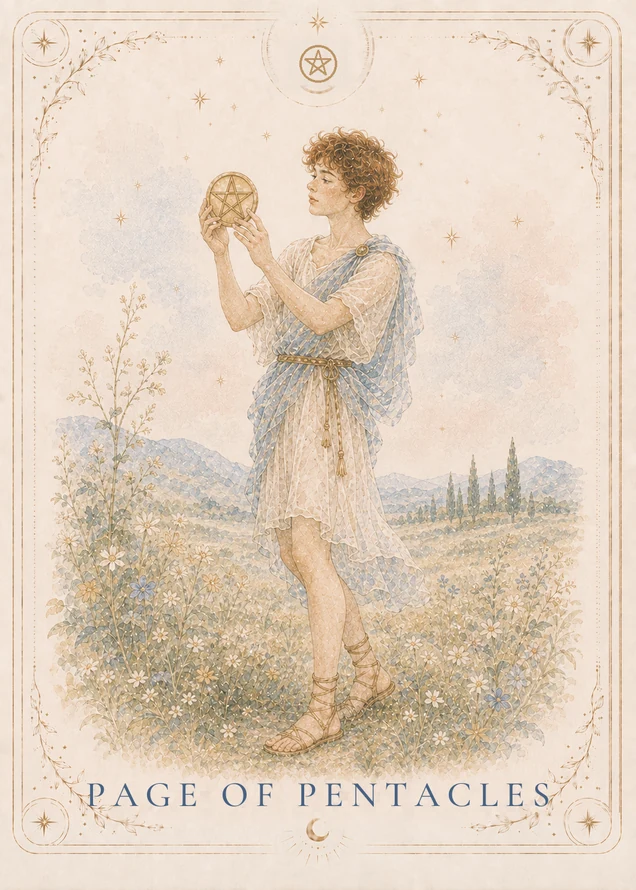
The imagery
Pentacle held for examination
The gold disk is held between both hands near the figure’s face, with the gaze directed toward it.
Close attention makes an ordinary object a source of learning; practical understanding can begin with what is actually in hand.
Feet among the flowers
The figure’s sandaled feet are planted at different angles on flower-covered ground.
Interest has a place in material life, where observation can lead to an experiment or a first attempt.
Distant hills
Pale blue hills and a group of slender trees appear behind the figure.
There is more to discover beyond the immediate subject, without making distant terrain a prediction of difficulty.
Similarities & differences
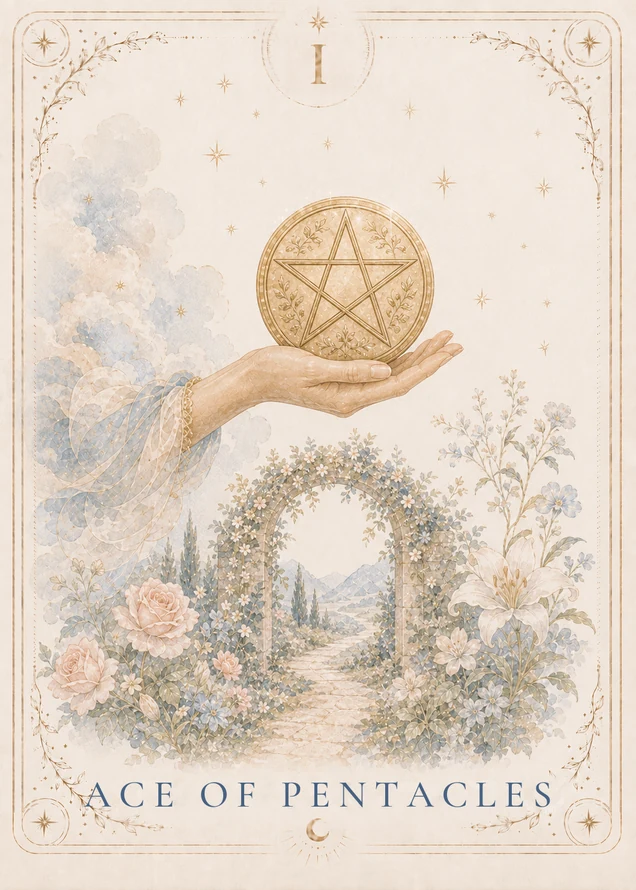
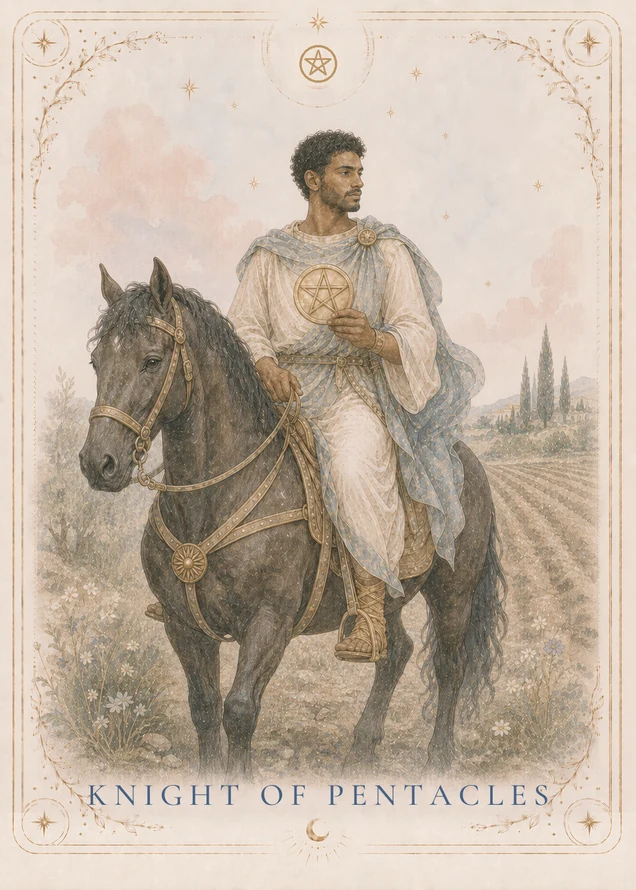
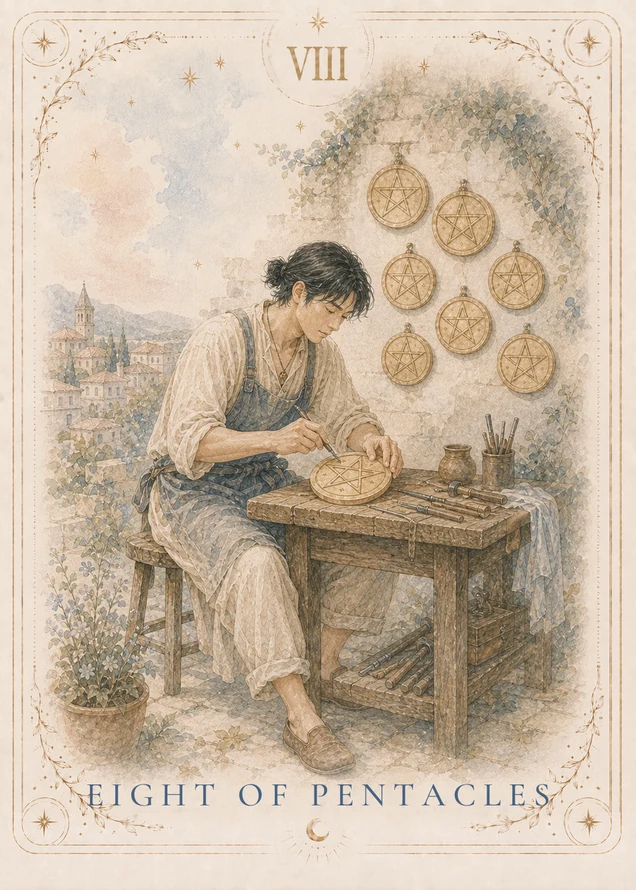
Related cards

Tradition & Lunaire’s interpretation
The traditional foundation
Waite’s Part III §2 Page emphasizes application, study, scholarship and reflection, alongside messages and management; reversal includes prodigality, dissipation, luxury and unfavourable news. His §4 additional list assigns age, appearance and military roles upright, with degradation and pillage reversed.
Lunaire’s reading
Lunaire retains serious practical learning without assigning age, appearance or a profession. The selected modern delay reversal follows an interest that has not developed into attentive practice; Brigit Esselmont’s contemporary account supports delayed progress and learning from attempts. It is not Waite’s original reversal or a prediction of bad news. Waite describes a hovering pentacle and slow movement; this native image visibly holds the disk in both hands, with no motion asserted.
Read the source in The Pictorial Key to the Tarot ↗
Biddy Tarot: Page of Pentacles ↗
Waite: additional meanings for Page of Pentacles (Part III §4) ↗
Arthur Edward Waite. The Pictorial Key to the Tarot. W. Rider; [1911]. Illustrations by Pamela Colman Smith. Source edition details ↗