


Pentacles
Three of Pentacles
Skilled contributions take shape through shared work, careful planning, and respect for what each brings.
- craftsmanship
- collaboration
- planning
- recognition
Read the card in its own right, then follow its meaning through the spread.
Two orientations
The card’s meaning
This Three brings material skill into relation with planning, feedback, and other contributions. Its common task can be a craft, a repair, or an undertaking outside paid work; the card does not require an employer, formal qualification, or a team of exactly three.
Upright
Skilled contributions take shape through shared work, careful planning, and respect for what each brings.
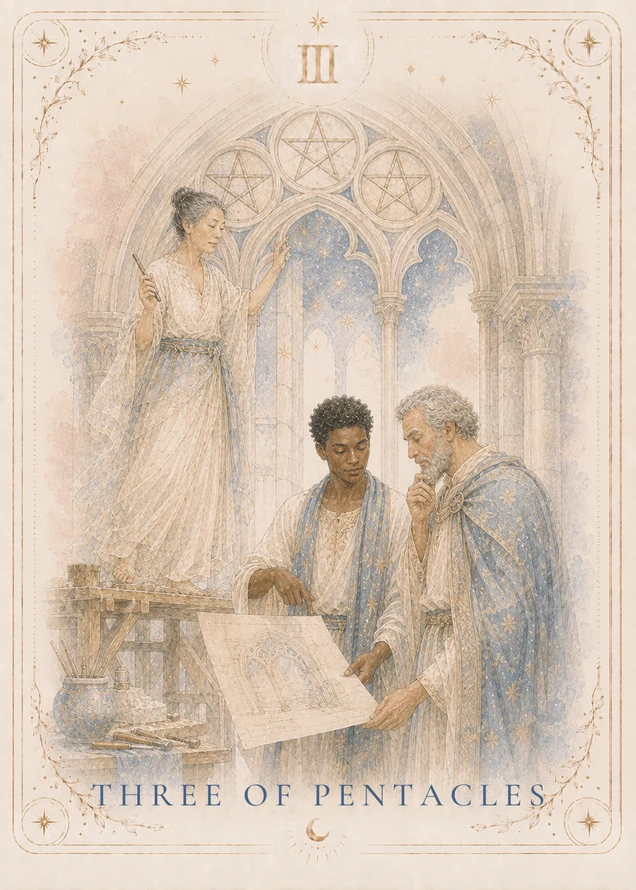
The Three of Pentacles brings skilled work into a setting where it can be used, discussed, and recognized. A plan matters because people can make something from it; experience matters because it improves the result. The craftsperson and the figures with the drawing suggest different kinds of knowledge meeting around a common task. This card values care in the making, practical cooperation, and the willingness to learn from another person’s contribution.
- craftsmanship
- collaboration
- planning
- recognition
Reversed
Good work becomes harder when practical care or cooperation breaks down.
The Three of Pentacles reversed concerns work whose quality suffers because useful contributions are not coming together. Details may be rushed, a plan may leave important questions unanswered, or experience may be overlooked. The result can fall short even when individual ability is present. Attention belongs on the particular gap: what needs learning, clearer agreement, or more care in execution. Working alone is not itself a failure, and cooperation need not mean accepting every suggestion.
- unclear agreements
- overlooked skill
- uneven work
- repair
How the reversal changes the emphasis
The upright connection between skill, shared understanding, and a well-made result is interrupted. This blocked lens includes poor execution and neglected expertise without turning either into a verdict on someone’s worth.
The question changes the emphasis
Reading this card in context
Each spread gives its cards different roles. The examples below explore this card as an influence, a situation or challenge, and advice or support. Begin with the question your position asks, wherever it falls in the spread.
As an influence
Upright
A learned skill, useful feedback, or an earlier collaboration may have given the present undertaking a practical foundation.
Reversed
An incomplete plan, uneven attention to detail, or a contribution that went unheard may have affected the result now being considered.
As a situation or challenge
Upright
Consider what the work needs from each contribution, and whether the people making it have a clear understanding of the intended result.
Reversed
Identify where the work falls short and what explains it; missing knowledge, an unclear agreement, and ignored advice call for different repairs.
As advice or support
Upright
Bring a concrete example or plan into discussion, invite relevant expertise, and give useful contributions a clear place in what happens next.
Reversed
Choose a specific gap to address through learning, a clearer plan, or relevant feedback, while preserving the parts of the work that already succeed.
Read through a particular life focus
Open reading
An idea may become clearer through the skills, preparation, and different contributions needed to make it real.
Love & relationships
In questions of connection, practical cooperation may reveal how each person’s knowledge and effort are heard and valued.
Work & direction
Consider the quality of the work itself, the preparation it needs, and whether useful expertise can influence the result.
Home & family
A repair or shared task may benefit from a clear plan and respect for the different kinds of work involved.
Self-growth
Developing a skill can include learning to recognize useful feedback while keeping your own judgment about how to apply it.
Look a little closer
The imagery
Craftsperson at the arch
A figure stands on a wooden platform, holding a slender tool and raising the other hand toward the decorated arch.
Skill becomes visible through the attention and practical work needed to give a design form.
Shared drawing
Two figures below the platform look toward a large drawing that repeats the arch’s shape and three disks.
A common plan gives different contributions something concrete to discuss, test, and improve.
Three pentacles within the stonework
Three gold pentacles form a triangular grouping in the upper part of the carved arch.
Distinct parts can belong to one accomplished piece of work without becoming identical.
Similarities & differences
Related cards
Tradition & Lunaire’s interpretation
The traditional foundation
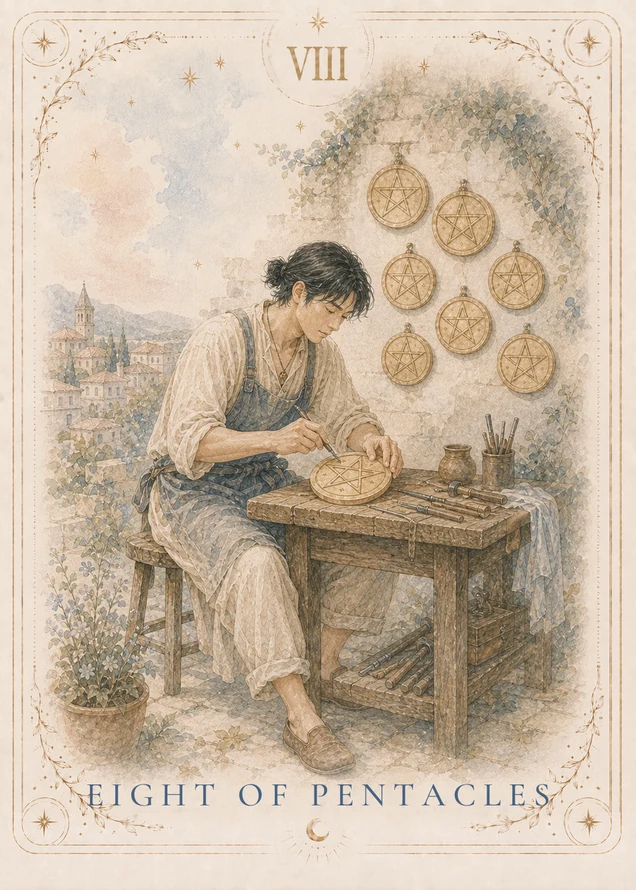
Waite describes a sculptor working in a monastery and explicitly compares the Eight’s earlier stage of craft. The main upright entry joins skilled labour with rank and renown; reversed, it gives poor quality and belittling character judgments. The additional upright forecast concerns a man’s eldest son becoming famous, while its reversal depends on neighboring cards.
Lunaire’s reading
Lunaire keeps skilled work and recognition while developing the collaborative emphasis documented by Joan Bunning and Biddy Tarot. The selected blocked reversal concerns the work’s preparation and execution, not a person’s social rank or moral quality. Modern interpretations can also emphasize working alone; this source does not treat solitude itself as defective.
Read the source in The Pictorial Key to the Tarot ↗
Waite: additional divinatory meanings ↗
Biddy Tarot: Three of Pentacles ↗
Joan Bunning: Learning the Tarot ↗
Arthur Edward Waite. The Pictorial Key to the Tarot. W. Rider; [1911]. Illustrations by Pamela Colman Smith. Source edition details ↗