
Pentacles
Two of Pentacles
Changing demands can be met through practical balance, flexibility, and a little ease.
- flexibility
- priorities
- practical balance
- rhythm
Read the card in its own right, then follow its meaning through the spread.
Two orientations
The card’s meaning
Pentacles gives this Two a practical field: time, tasks, resources, and the changing needs of daily life. Its two disks suggest concurrent concerns, without requiring exactly two choices or making endless multitasking a virtue.
Upright
Changing demands can be met through practical balance, flexibility, and a little ease.
The Two of Pentacles concerns the changing balance of ordinary life: making room for one need without losing sight of another. Timing, resources, and priorities rarely hold still, so steadiness may come from adjusting the order or amount of attention each receives. There can be pleasure in this dexterity, in finding a rhythm that leaves room to breathe. Flexibility includes recognizing limits; keeping things moving does not require keeping every commitment.
- flexibility
- priorities
- practical balance
- rhythm
Reversed
Constant adjustment becomes strain when the demands exceed what can reasonably be managed.
The Two of Pentacles reversed describes a balance maintained at too great a cost. An overloaded schedule, competing needs, or a shortage of resources can turn each adjustment into another thing to manage. Something important may receive only the time left over. More organization can help in some situations, but it cannot supply everything that is missing. The question is what needs reducing, changing, or supporting, rather than how to keep the same demands moving faster.
- overload
- competing needs
- neglected priorities
- simplification
How the reversal changes the emphasis
The useful ability to adapt is stretched into continual juggling. This selects a modern overload reading without assuming that the demands were freely chosen or that better organization alone can resolve them.
The question changes the emphasis
Reading this card in context
Each spread gives its cards different roles. The examples below explore this card as an influence, a situation or challenge, and advice or support. Begin with the question your position asks, wherever it falls in the spread.
As an influence
Upright
Changing demands on time or resources may have made adjustment more useful than a plan that expected every day to stay the same.
Reversed
Several needs competing for limited time or support may have left little room to absorb a change or attend to something important.
As a situation or challenge
Upright
Notice which needs compete for the same time or resources, and whether their order can change without neglecting something essential.
Reversed
Consider what the present arrangement asks of you, what it leaves unattended, and which demands are genuinely open to change.
As advice or support
Upright
Try an adjustment in timing, sequence, or how much you take on, leaving enough room to respond when conditions change.
Reversed
Where possible, reduce one demand, change a deadline, or seek practical support; distinguish an organizational problem from a genuine shortage.
Read through a particular life focus
Open reading
Consider whether a changing situation calls for a different rhythm, a reordered priority, or fewer demands at once.
Love & relationships
In questions of connection, the time available for each person’s needs may matter as much as the wish to meet them.
Work & direction
An undertaking may benefit from a more realistic order of tasks, especially when several things require the same time or materials.
Home & family
The ordinary work of a living arrangement can be considered through changing needs, available help, and what can reasonably fit into a day.
Self-growth
Flexibility may include revising a commitment when keeping it would leave no room for something equally important.
Look a little closer
The imagery
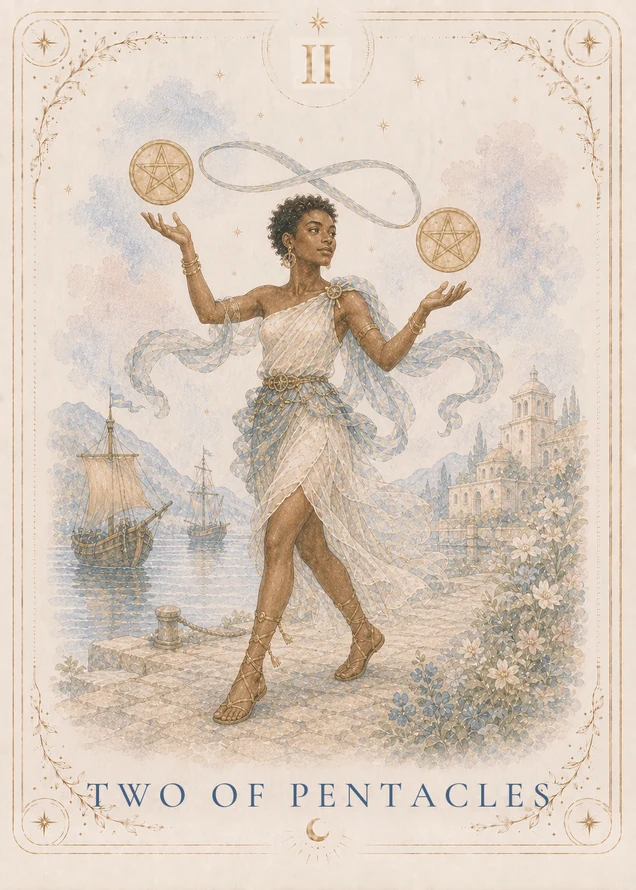
Two raised hands and pentacles
Two separate gold disks float above open palms held at different heights.
Several practical concerns can need attention at once, with their demands changing relative to one another.
Looping ribbon and moving pose
A blue and gold ribbon makes a sideways figure eight above the figure, whose legs are set in a wide step.
The image suggests balance maintained through movement and adjustment; an endless shape does not establish endless energy.
Ships by the waterfront
Two sailing ships sit on the water behind the figure, beside a stone quay and distant buildings.
Practical activity takes place within a wider setting whose timing and conditions are not entirely one person’s to decide.
Similarities & differences
Related cards
Tradition & Lunaire’s interpretation
The traditional foundation
Waite describes a dancing figure and an endless cord, with main upright meanings ranging from recreation to written messages, obstacles, and agitation. His reversal includes forced enjoyment and writing. The additional upright entry minimizes troubles as imagined; the additional reversal lists an ill omen, ignorance, and injustice.
Lunaire’s reading
Lunaire develops the modern practical-balance interpretation, preserving room for ease while selecting overload as an excess reversal. This is not Waite’s exact divinatory scheme: actual shortages remain real. Joan Bunning’s flexibility reading and Biddy Tarot’s discussion of competing priorities inform this modern interpretation, with their predictive assurances left aside.
Read the source in The Pictorial Key to the Tarot ↗
Waite: additional divinatory meanings ↗
Biddy Tarot: Two of Pentacles ↗
Joan Bunning: Learning the Tarot ↗
Arthur Edward Waite. The Pictorial Key to the Tarot. W. Rider; [1911]. Illustrations by Pamela Colman Smith. Source edition details ↗