
Major Arcana
Temperance
Temperance combines different elements through patient adjustment, finding what they can create together.
- moderation
- blending
- patience
- calibration
- synthesis
Read the card in its own right, then follow its meaning through the spread.
Two orientations
The card’s meaning
Temperance describes the patient work of allowing different contributions to affect one another usefully. Its center is the quality of their interaction; a mixture can be equitable without equal quantities, and incompatibility need not be hidden behind the ideal of harmony.
Upright
Temperance combines different elements through patient adjustment, finding what they can create together.
Temperance pours continuously between two vessels; its steadiness comes from constant adjustment, not stillness. The card describes the patience required to combine different needs, methods, or tempos without erasing what distinguishes them. Moderation here is not bland compromise or a command to make every share equal. It is an exacting search for the proportion that lets the mixture work. Temperance asks what each element changes in the other, where the exchange needs time, and which small correction would improve the whole.
- moderation
- blending
- patience
- calibration
- synthesis
Reversed
Temperance reversed finds the mixture out of proportion, with its elements competing instead of transforming one another.
Temperance reversed describes a combination whose parts are not working well together. One contribution may overwhelm another, the pace may be too fast, or the elements may need more time to respond. Incompatibility can also be real: a useful adjustment is more specific than simply asking for more compromise. This orientation brings attention to excess, absence and timing: what needs less, what needs more, and whether changing the pace or point of contact would help.
- excess
- competing elements
- poor proportion
- readjustment
How the reversal changes the emphasis
The reversal does not require perfect balance. It asks what needs adjusting and whether the elements can respond to each other.
The question changes the emphasis
Reading this card in context
Each spread gives its cards different roles. The examples below explore this card as an influence, a situation or challenge, and advice or support. Begin with the question your position asks, wherever it falls in the spread.
As an influence
Upright
An earlier compromise, gradual adjustment, or effort to combine differing needs may have shaped the arrangement now under consideration.
Reversed
A rushed combination, competing priorities, or long-standing excess may still explain why the present arrangement feels difficult to sustain.
As a situation or challenge
Upright
Watch the exchange itself: what each element contributes, what it dilutes, and which proportion allows both to remain useful.
Reversed
Look at what each part contributes or receives, and whether excess, absence, or pace is making the exchange difficult.
As advice or support
Upright
Adjust one part of the mixture at a time, then notice what the whole can yield before changing it again.
Reversed
Change one proportion, pace, or point of contact, then let the result show whether the parts can begin responding again.
Read through a particular life focus
Open reading
Consider what needs to work together and how its parts affect one another. Reversal draws attention to where the combination loses responsiveness or becomes difficult to sustain.
Love & relationships
Look at how needs, habits and tempos meet between people. Consider what an adjustment would ask of each person and whether their responses show that it helps, with room to recognize incompatibility.
Work & direction
Explore how methods, workloads or collaborators interact. A small change can be observed before another is made, rather than assuming more effort will improve the combination.
Home & family
Consider the proportions of time, care, privacy or shared activity within the household. Different needs can be taken seriously without prescribing identical shares.
Self-growth
Look at how different needs or practices fit into one life, and whether a change in pace or emphasis would help you sustain what each contributes.
Look a little closer
The imagery
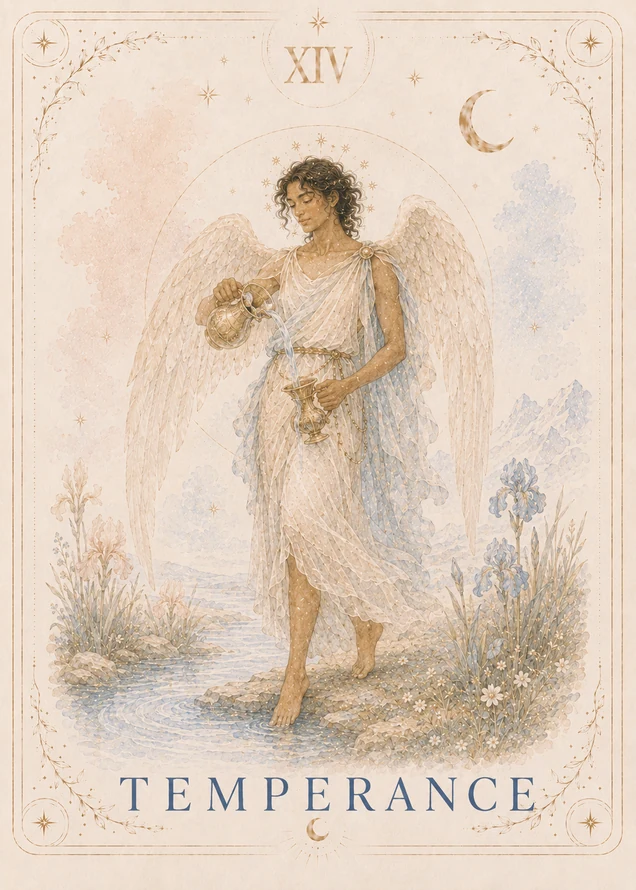
Water poured between two vessels
The winged figure tips one gold vessel so a narrow stream of water falls into the second.
Temperance is active mixture: the task is to preserve each element’s contribution while discovering a proportion they could not make alone.
One foot in water and one on land
One bare foot rests in the blue stream while the other touches the stony bank.
Adaptation needs contact with changing conditions and enough stable ground to notice what the change is doing.
Ring of stars and wide wings
A loose ring of small gold stars surrounds the figure’s head between two broad white wings.
The composed posture contains continuous adjustment; steadiness comes through practice, not an absence of movement.
Similarities & differences
Related cards
Tradition & Lunaire’s interpretation
The traditional foundation
Waite describes a winged figure transferring the essences of life between chalices, with one foot on land and one in water. His symbolic account concerns harmonizing psychic and material natures; the picture provides a clear anchor for an active process of combination.
Lunaire’s reading
Lunaire carries this combining movement into patient adjustment among different needs, methods or tempos. A working proportion can preserve meaningful difference. The selected reversal develops blocked exchange through excess, haste or incompatibility, with the possibility of adjustment but no requirement to force a mixture that cannot work.
Read the source in The Pictorial Key to the Tarot ↗
Arthur Edward Waite. The Pictorial Key to the Tarot. W. Rider; [1911]. Illustrations by Pamela Colman Smith. Source edition details ↗