


Pentacles
Six of Pentacles
Giving and receiving can bring practical support where it is needed.
- generosity
- receiving
- fair exchange
- practical help
Read the card in its own right, then follow its meaning through the spread.
Two orientations
The card’s meaning
This Six brings resources into an exchange between people. Its concern includes generosity, need, and the influence that accompanies distribution; neither the giver nor the recipient is assigned to the reader, and neither role establishes moral worth.
Upright
Giving and receiving can bring practical support where it is needed.
The Six of Pentacles concerns generosity, assistance, and the movement of resources between people. Time, knowledge, money, or practical help can answer a need that is difficult to meet alone. Giving and receiving need not be equal in amount to be fair, and a gift need not create a debt. The scales bring attention to how support is offered and distributed: whether it fits the need, respects choice, and can be given without exhausting what the giver needs too.
- generosity
- receiving
- fair exchange
- practical help
Reversed
Support becomes uneven when its conditions narrow choice or ignore someone’s needs.
The Six of Pentacles reversed examines an exchange that is not supporting the people involved. Help may come with unspoken demands, be distributed unfairly, or ask more from someone than they can give. A generous gesture can also leave the actual need unanswered. The issue is not that everyone must give the same amount. It is whether the arrangement leaves room to decline, explain a limit, or receive help without having unrelated choices decided in return.
- conditional help
- unspoken demands
- uneven exchange
- limits
How the reversal changes the emphasis
The upright movement of helpful giving and receiving is obstructed by unfair distribution, unspoken demands, or ignored limits. This selects a modern blocked-exchange reading, without assuming deliberate manipulation or treating unequal resources as proof of unfairness.
The question changes the emphasis
Reading this card in context
Each spread gives its cards different roles. The examples below explore this card as an influence, a situation or challenge, and advice or support. Begin with the question your position asks, wherever it falls in the spread.
As an influence
Upright
An offer, shared resource, or experience of giving or receiving help may have influenced what is possible in the present situation.
Reversed
An unclear expectation, uneven distribution, or offer that missed the actual need may have shaped how help is understood here.
As a situation or challenge
Upright
Look at what is offered, what is needed, and what each person understands about the gift, commitment, or exchange.
Reversed
Compare what is given with what is expected in return, including whether each person can describe a limit or decline an unrelated demand.
As advice or support
Upright
Make an offer or request specific enough to answer a real need, with clear limits and room for an honest response.
Reversed
Where possible, clarify an expectation or limit and look for support that addresses the need without giving someone else unnecessary say over your choices.
Read through a particular life focus
Open reading
Consider the help available or needed, together with the expectations and freedom to choose that accompany it.
Love & relationships
Practical care can be considered through whether support fits the need and leaves each person free to speak honestly about what they can offer.
Work & direction
An exchange of time, knowledge, tools, or other resources may benefit from clear expectations about what is offered and what is required.
Home & family
Sharing a resource or providing practical help may call for attention to differing needs, available means, and each person’s say in the arrangement.
Self-growth
Giving and receiving can be examined without making either self-sufficiency or constant generosity a test of personal worth.
Look a little closer
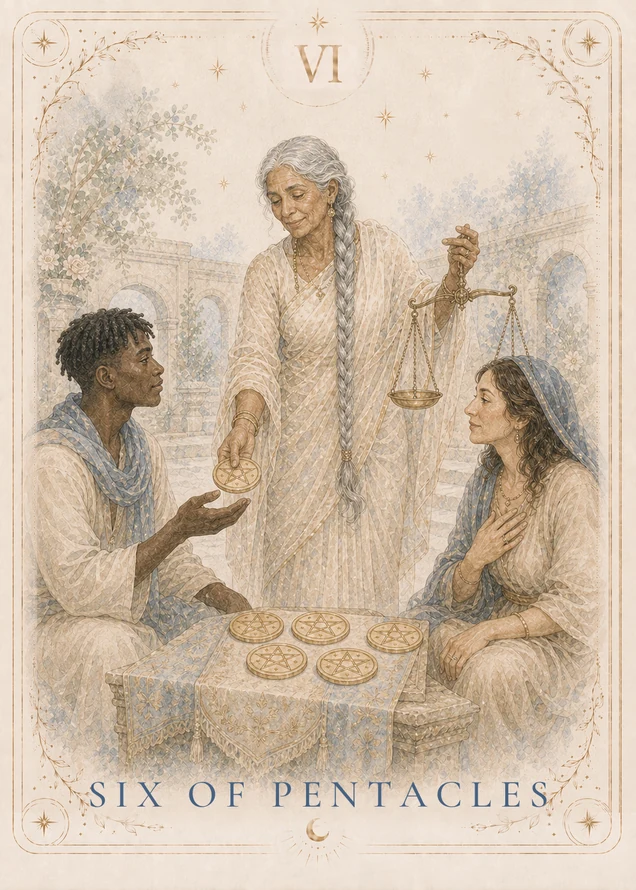
The imagery
Offered pentacle and open hand
The standing figure lowers a single gold disk toward the raised, open hand of the seated figure on the left.
Resources can pass between people, making both the offer and the experience of receiving important to the exchange.
Handheld scales
The standing figure holds a set of scales; one pan is clearly visible, while the other is partly obscured by the figure on the right.
A decision about distribution invites attention to need, fairness, and who decides what is offered or asked in return. The image alone does not prove a fair result.
Pentacles on the shared table
Five gold disks rest on the cloth-covered table between the seated figures.
The resource is concrete and finite; generosity takes shape through what is actually available and how it reaches people.
Similarities & differences
Related cards
Tradition & Lunaire’s interpretation
The traditional foundation
Waite describes a merchant distributing money with scales and treats the gesture as evidence of success and goodness. His main upright list includes gifts, gratification, present prosperity, and an alternative emphasis on attention and vigilance; reversed, it includes desire, greed, envy, jealousy, and illusion. The additional upright cautions against relying on the present, while its reversal checks ambition.
Lunaire’s reading
Lunaire retains giving and receiving while examining how assistance meets a need. Joan Bunning’s account of resources and power and Biddy Tarot’s discussion of uneven giving support this modern context. The selected reversal concerns obstructed or unfair support; it does not infer greed, require repayment of gifts, or treat wealth as proof of virtue.
Read the source in The Pictorial Key to the Tarot ↗
Waite: additional divinatory meanings ↗
Biddy Tarot: Six of Pentacles ↗
Joan Bunning: Learning the Tarot ↗
Arthur Edward Waite. The Pictorial Key to the Tarot. W. Rider; [1911]. Illustrations by Pamela Colman Smith. Source edition details ↗