



Swords
Queen of Swords
Independent judgment can hear another view and still speak plainly for itself.
- independence
- discernment
- direct speech
- clear limits
Read the card in its own right, then follow its meaning through the spread.
Two orientations
The card’s meaning
The Queen expresses Swords through independent, experienced discernment and direct communication. Leadership, advocacy, thoughtful refusal, and clear counsel are all available expressions; the title does not identify a gender, age, marital status, or history of suffering.
Upright
Independent judgment can hear another view and still speak plainly for itself.
The Queen of Swords brings clear perception, independent judgment, and direct speech. Experience can sharpen the ability to recognize what matters, question an explanation, and decide what is acceptable. The upright sword and open hand hold firmness and receptivity together: another view can be heard without giving away the right to choose. This clarity can lead, protect, or offer useful counsel. It need not become harsh, and it does not require feeling to be absent before a decision can be sound.
- independence
- discernment
- direct speech
- clear limits
Reversed
A sharp judgment can close the conversation before the whole matter is understood.
The Queen of Swords reversed describes judgment becoming so fixed that it stops distinguishing. One mistake may become a verdict on a whole person, or a familiar disappointment may make a new explanation seem settled before it is heard. Directness can then wound where it meant to clarify. The question is whether the words describe the specific problem without reducing a person to it. A firm refusal can stand without contempt, and hearing more does not require excusing what is unacceptable.
- fixed judgment
- dismissal
- cutting words
How the reversal changes the emphasis
The Queen’s incisive judgment becomes excessive when a distinction hardens into a total verdict. Lunaire selects this strand of harsh or closed judgment rather than treating independence, strong feeling, or a firm refusal as a defect.
The question changes the emphasis
Reading this card in context
Each spread gives its cards different roles. The examples below explore this card as an influence, a situation or challenge, and advice or support. Begin with the question your position asks, wherever it falls in the spread.
As an influence
Upright
An honest conversation, an independent decision, or knowledge gained through experience may have clarified what matters in the present question.
Reversed
A fixed impression, a cutting exchange, or an earlier disappointment carried into a new situation may have narrowed the discussion.
As a situation or challenge
Upright
Distinguish what is actually known from what is being assumed, then consider the choice or limit that follows from that distinction.
Reversed
Check whether a judgment names a particular action accurately or has expanded into a conclusion about everything a person is.
As advice or support
Upright
State what you mean plainly, hear the relevant reply, and keep the freedom to decide without making agreement a condition of being heard.
Reversed
Keep any necessary refusal clear, while removing the contempt or assumption that adds hurt without making the point more precise.
Read through a particular life focus
Open reading
A matter may become clearer when observation, assumption, and the decision to be made are named separately.
Love & relationships
An honest statement of a preference or limit can leave room for another response without giving up the right to decide what is acceptable.
Work & direction
Clear feedback, a careful distinction, or an independent decision may help an undertaking move beyond vague expectations.
Home & family
In questions of private life, a direct conversation can distinguish what has actually been asked from what has been silently expected.
Self-growth
An established impression can be examined without requiring either self-doubt on every point or certainty about every conclusion.
Look a little closer
The imagery
Upright sword
The seated figure holds a long sword vertically beside the body.
The clearly held blade can support direct judgment and the willingness to state a distinction plainly.
Open hand
The other arm extends outward with the palm open.
Receptivity can coexist with a decision: hearing another view need not mean surrendering independent judgment.
Seated figure facing to the side
The figure sits steadily on a carved stone seat and looks toward the side of the image.
A settled position can leave attention available to what is being encountered; it does not establish a particular history of grief or hardship.
Similarities & differences
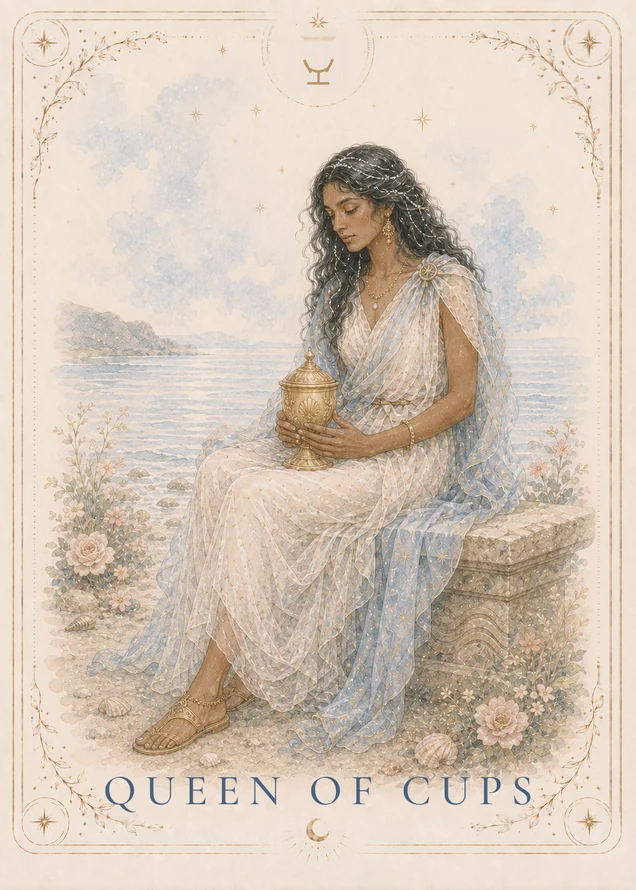
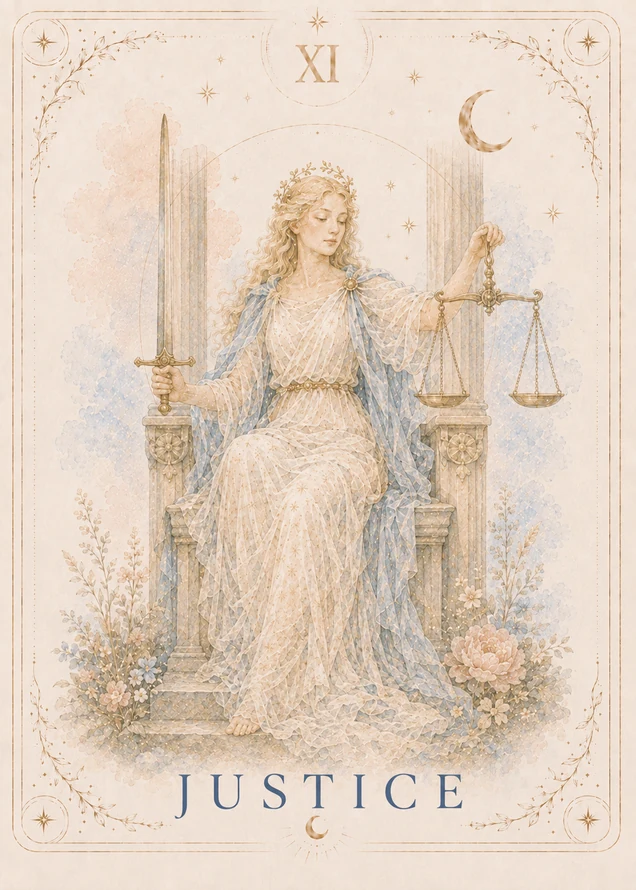
Related cards


Tradition & Lunaire’s interpretation
The traditional foundation
Waite describes an upright sword, an extended hand, and a face familiar with sorrow, while explicitly denying that the figure chiefly represents mercy or power. His upright meanings concern widowhood, gendered sadness, absence, sterility, mourning, deprivation, and separation; reversed, he lists malice, bigotry, artifice, prudery, harm, and deceit. The additional upright entry repeats widowhood; the reversed entry assigns a woman ill will toward the reader.
Lunaire’s reading
Lunaire’s independent, perceptive Queen follows a modern RWS development, represented in Biddy Tarot’s emphasis on clear judgment, direct communication, and receptivity; these are not Waite’s own upright divinatory list. The reversal selects harsh or closed judgment without preserving gendered insults or a claim that emotion itself undermines intelligence. The card neither diagnoses grief or infertility nor assigns a hostile woman to the reader’s life.
Read the source in The Pictorial Key to the Tarot ↗
Biddy Tarot: Queen of Swords ↗
Waite: additional meanings for Queen of Swords (Part III §4) ↗
Arthur Edward Waite. The Pictorial Key to the Tarot. W. Rider; [1911]. Illustrations by Pamela Colman Smith. Source edition details ↗