
Swords
King of Swords
Clear reasoning guides decisions that can be explained, questioned, and applied fairly.
- reasoned judgment
- expertise
- fair decisions
- intellectual authority
Read the card in its own right, then follow its meaning through the spread.
Two orientations
The card’s meaning
The King brings the knowledge and language of Swords into practiced judgment, counsel, and answerable authority. It can serve any reader without assigning gender, a profession, or superiority over another court; receptive attention remains part of sound judgment.
Upright
Clear reasoning guides decisions that can be explained, questioned, and applied fairly.
The King of Swords brings practiced judgment to a decision. Facts are examined, relevant knowledge is sought, and the reasons for choosing one course over another can be stated plainly. This is intellectual authority at its most useful: able to decide, yet willing to hear evidence that changes the conclusion. Fairness includes the people affected, not only the neatness of the reasoning. The approach can guide a personal choice, careful counsel, or a shared decision without requiring a formal position.
- reasoned judgment
- expertise
- fair decisions
- intellectual authority
Reversed
Authority loses fairness when reasoning becomes a way to overrule rather than understand.
The King of Swords reversed concerns reasoning used to make a decision unchallengeable. Expertise, a rule, or a polished explanation may be treated as sufficient reason to dismiss objections or overlook harm. The conclusion is protected while the people affected have little room to question it. This can appear in an exchange or a private decision; it does not identify a malicious person. The issue is how judgment is exercised and whether evidence, disagreement, and consequences can still change what is done.
- overbearing judgment
- rigidity
- misused authority
- fair scrutiny
How the reversal changes the emphasis
The King’s decisive authority becomes excessive when its reasoning is treated as beyond challenge. Lunaire retains the historical concern with harmful uses of power while locating it in observable choices and effects rather than diagnosing another person’s motives.
The question changes the emphasis
Reading this card in context
Each spread gives its cards different roles. The examples below explore this card as an influence, a situation or challenge, and advice or support. Begin with the question your position asks, wherever it falls in the spread.
As an influence
Upright
A considered decision, expert guidance, or an earlier agreement about how to choose may have shaped how this matter is now understood and approached.
Reversed
A decision defended as beyond question, or an explanation that left objections unanswered, may still shape what can be discussed.
As a situation or challenge
Upright
Identify the evidence and relevant knowledge behind the proposed decision, including any facts that would justify revising it.
Reversed
Examine whether the stated reasons genuinely support the decision and whether the people affected can challenge a mistake or describe its effects.
As advice or support
Upright
Explain the reasons for the choice, seek informed challenge where useful, and consider what following through will ask of those affected.
Reversed
Check what the decision rests on and what may have been overlooked, with independent help where needed and room for a different conclusion.
Read through a particular life focus
Open reading
A decision may benefit from stating its reasons clearly enough that both the conclusion and its consequences can be examined.
Love & relationships
Clear reasoning can help a conversation when each person can question an assumption or describe an effect without having to outargue the other.
Work & direction
Relevant expertise can strengthen a choice when its reasoning, limits, and practical consequences remain open to examination.
Home & family
A household or private arrangement may benefit from a reasoned decision that considers the people affected and allows mistaken assumptions to be corrected.
Self-growth
A useful standard can guide a choice while remaining open to what experience reveals about its limits.
Look a little closer
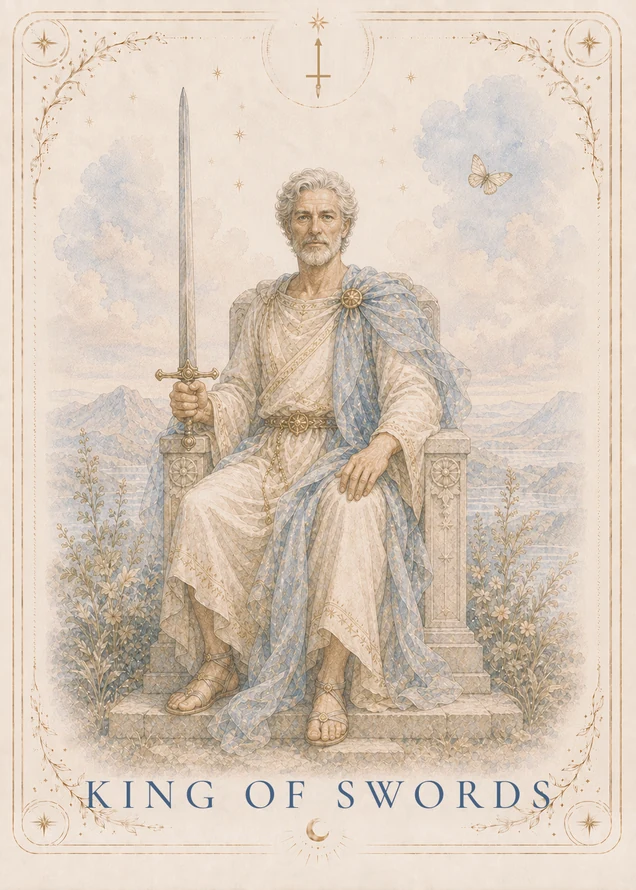
The imagery
Upright sword
The figure holds an unsheathed sword vertically beside the throne.
The blade can express a judgment that is stated clearly and carried into a decision.
Frontal seated posture
The figure faces forward, with the free hand resting on the knee and both feet visible below the robes.
The composed posture supports considered judgment without proving infallibility or emotional distance.
Carved stone throne
Floral shapes decorate the front of the throne’s arms.
The seat can suggest a stable basis for decisions; the flowers do not establish a special legal, astrological, or hierarchical meaning.
Similarities & differences
Related cards
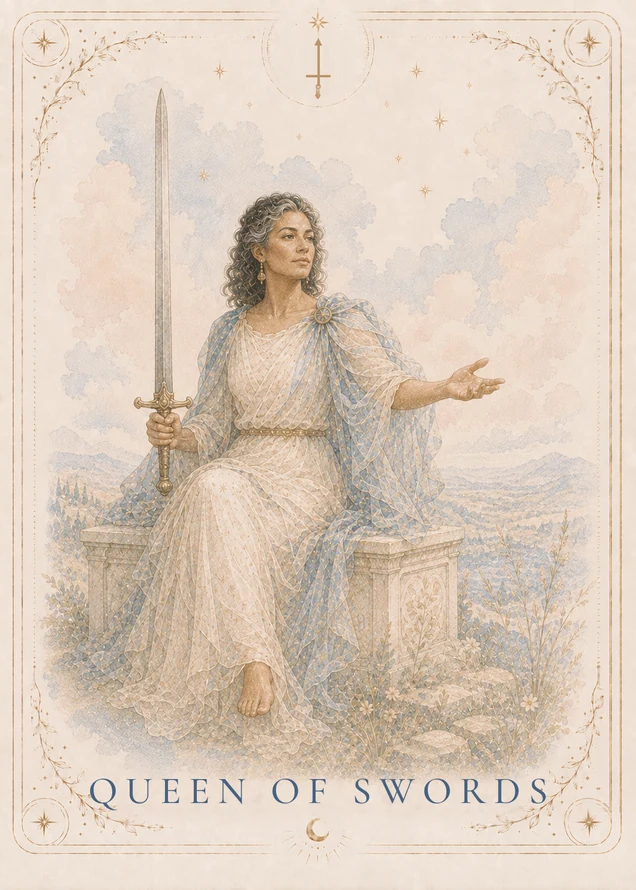
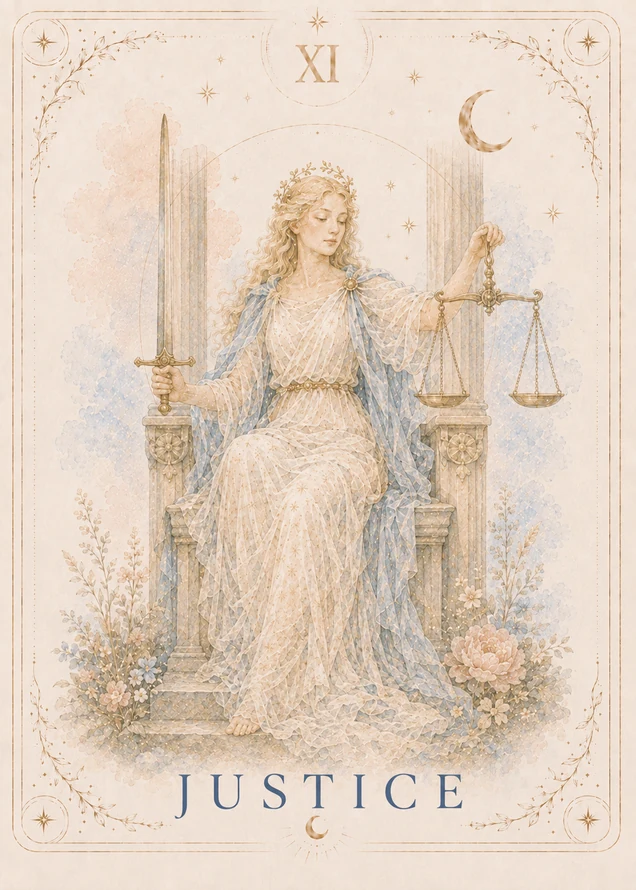
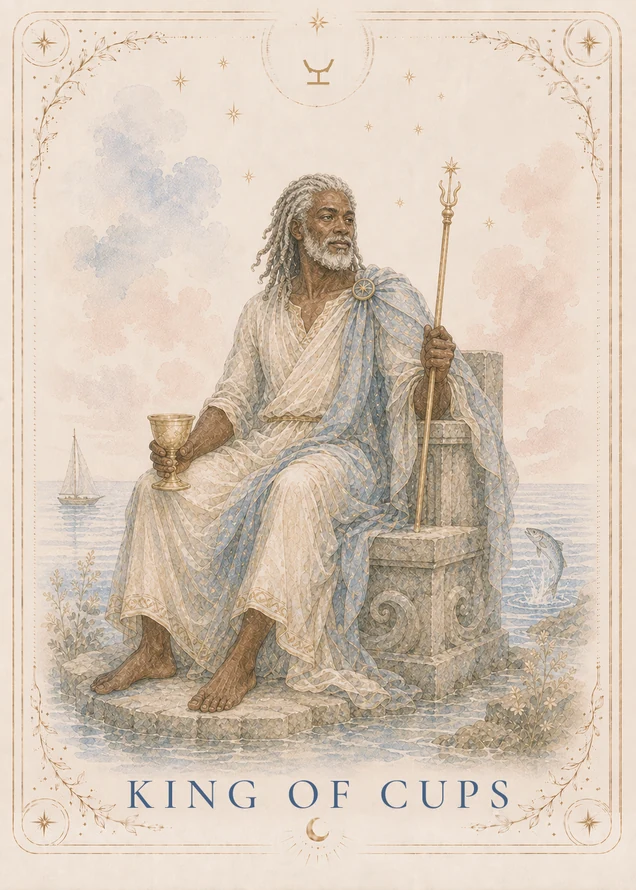
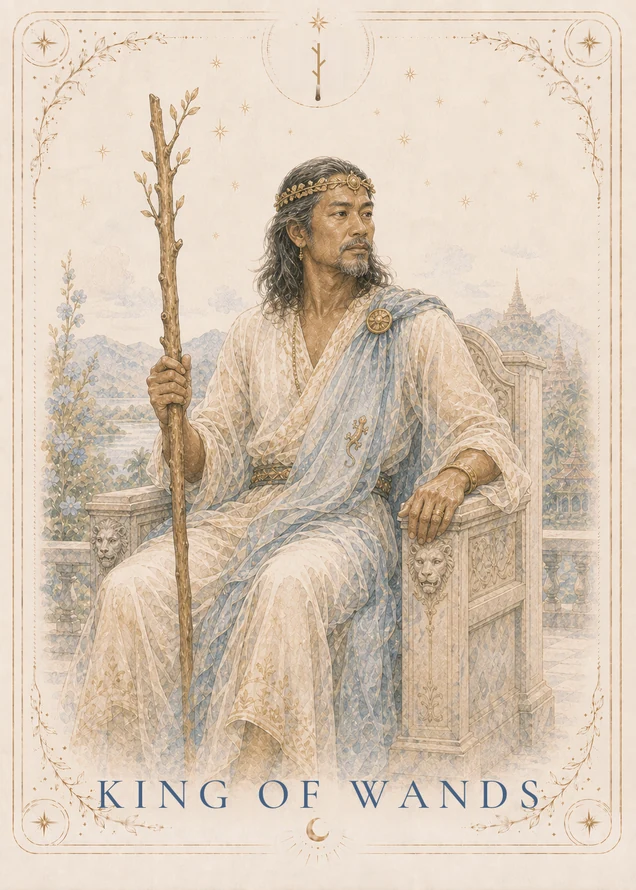
Tradition & Lunaire’s interpretation
The traditional foundation
Waite associates the King with judgment, command, authority, law, official office, and forceful intelligence; his description distinguishes the office’s power of life and death from Justice as a virtue. Reversed, his list includes cruelty, the dated condemnations “perversity” and “barbarity,” treachery, and harmful intention. The additional upright entry names a lawyer, senator, or doctor; reversed, it identifies a bad man and warns against continuing a ruinous lawsuit.
Lunaire’s reading
Lunaire retains reasoned authority and the possibility of its harmful use while making the court an approach rather than a demographic or professional forecast. Biddy Tarot’s modern emphasis on informed, impartial judgment supports the upright selection; misuse of power is the selected reversed strand, rather than its alternatives of quiet inward authority or indecision. No legal outcome or hidden motive is inferred, and intellectual clarity does not require indifference to feeling.
Read the source in The Pictorial Key to the Tarot ↗
Waite: additional meanings for King of Swords (Part III §4) ↗
Arthur Edward Waite. The Pictorial Key to the Tarot. W. Rider; [1911]. Illustrations by Pamela Colman Smith. Source edition details ↗