

Swords
Six of Swords
The Six of Swords makes a passage away from difficulty, with room for sadness and support.
- passage
- transition
- assistance
- gradual relief
Read the card in its own right, then follow its meaning through the spread.
Two orientations
The card’s meaning
This Six brings Swords’ difficulties into a scene of passage. Thought, conflict, or painful experience can travel into a new setting; the number does not guarantee harmony or a successful arrival.
Upright
The Six of Swords makes a passage away from difficulty, with room for sadness and support.
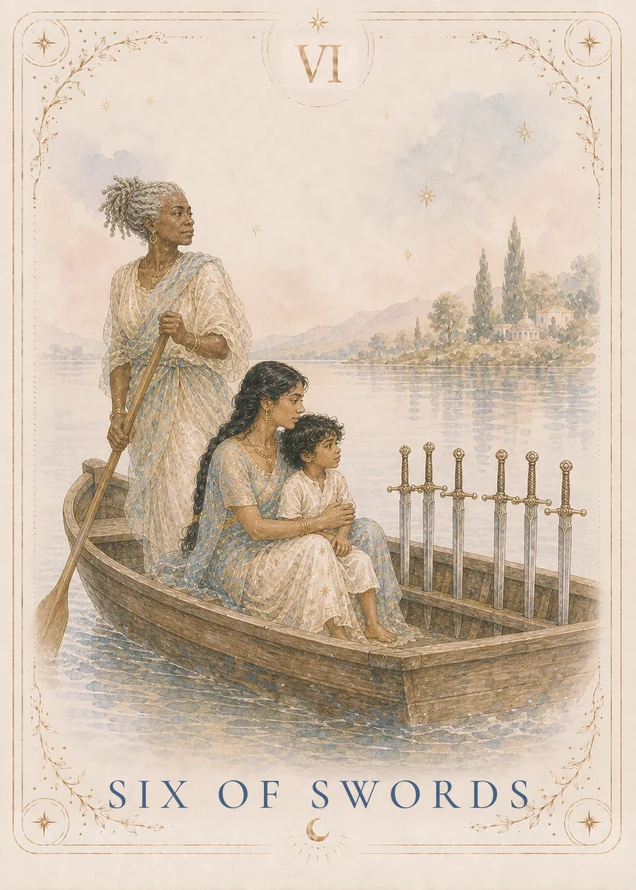
The Six of Swords describes a passage away from troubled conditions toward something more manageable. The move may be chosen or necessary, and sadness can travel with it. In the boat, one person guides the crossing while a seated passenger holds a child beside the swords: help can carry part of the journey, while old concerns remain present. This is movement through a transition, with room for gradual relief; neither an effortless crossing nor a better destination is guaranteed.
- passage
- transition
- assistance
- gradual relief
Reversed
The Six of Swords reversed finds a passage stalled or unfinished, with its difficulties still present.
The Six of Swords reversed describes a passage that has stalled, doubled back, or left something unresolved. A change in place or circumstances may have begun while conflict, loss, or practical obligations still travel with it. There may be a reason to pause, another route to find, or support that has not yet become available. The card asks what prevents the transition from proceeding; it does not decide that returning is failure or that continuing must happen immediately.
- unfinished passage
- delay
- return
- unresolved concerns
How the reversal changes the emphasis
The upright crossing remains incomplete, whether because practical conditions interrupt it or unresolved difficulty continues into a new setting. This modern selection differs from Waite’s reversed declaration, confession, publicity, and proposal-of-love alternative.
The question changes the emphasis
Reading this card in context
Each spread gives its cards different roles. The examples below explore this card as an influence, a situation or challenge, and advice or support. Begin with the question your position asks, wherever it falls in the spread.
As an influence
Upright
A departure, a change of approach, or help through a difficult period may have altered the circumstances from which this question is being asked.
Reversed
A change interrupted, a return to an earlier situation, or an obligation carried forward may have kept a past difficulty active in the present.
As a situation or challenge
Upright
Consider what a change could ease, what difficulties it might leave unresolved, and what support the next part of the passage would need.
Reversed
If a transition is not proceeding, identify what remains unresolved and distinguish a practical obstacle from a wish to pause or reconsider.
As advice or support
Upright
Look for a practical step or offered help that could ease a transition, while allowing any sadness about what is left behind.
Reversed
Find the next condition that could make movement possible, or clarify why a pause is needed before asking more of the transition.
Read through a particular life focus
Open reading
Consider whether a change of setting, approach, or distance could make a difficulty more manageable, and what the passage would require.
Love & relationships
Distance, a changed way of relating, or help through a difficult exchange may deserve consideration, without deciding that a connection must end.
Work & direction
A handover, change of role, or different approach can be examined for what it eases and what still needs to be carried forward.
Home & family
Changing living arrangements or moving between places may involve practical help and mixed feelings; the card does not predict a relocation or identify a family structure.
Self-growth
Notice how a changed perspective can coexist with lingering sadness, and what would support the next step without demanding a complete emotional departure.
Look a little closer
The imagery
Boat in passage
A wooden boat carries three people across the water, with a wooded shore and buildings visible beyond.
The crossing gives transition a practical form: leaving one setting and making a way toward another.
Oar and passengers
One figure stands holding a long oar while an adult and child sit close together.
Movement can depend on help and shared care, rather than everyone having to make the same effort.
Six carried swords
Six swords stand upright inside the boat beside the seated figures.
A change of circumstances can carry unresolved thoughts or concerns with it; movement need not erase what came before.
Similarities & differences
Related cards

Tradition & Lunaire’s interpretation
The traditional foundation
Waite describes a ferryman taking passengers toward another shore on a smooth course. His main upright list includes a water journey, a route, an envoy, and an expedient; his reversal gives declaration, confession, publicity, and a reported proposal of love. The additional upright entry predicts a pleasant voyage, while the additional reversal predicts an unfavorable lawsuit outcome.
Lunaire’s reading
Lunaire develops passage and assistance into a reflective account of transition, preserving the contemporary Six’s room for sadness and gradual relief without promising improvement. The unfinished-passage reversal is a documented modern selection, not Waite’s reversed list. Biddy Tarot’s modern account supports transition and unfinished business; its assurances of a better future are not carried over. The native passengers’ relationship and destination remain unspecified.
Read the source in The Pictorial Key to the Tarot ↗
Waite: additional divinatory meanings ↗
Arthur Edward Waite. The Pictorial Key to the Tarot. W. Rider; [1911]. Illustrations by Pamela Colman Smith. Source edition details ↗