


The Devil rarely arrives in a story empty-handed. There is a promotion, an irresistible invitation, a way to become the person you have been dressing for. The proposition looks excellent. The terms become clearer only after the montage.
That is useful territory for the Devil tarot card, number fifteen in the Major Arcana. In Lunaire’s reading, it concerns desire, attachment, and the bargain beneath a repeated pattern: what something gives you, what it asks of you, and how much room remains to choose.
The name has enough drama for a grand entrance (just in time for Halloween). The question underneath it is often waiting in your unread messages.
What does the Devil card mean?
Upright, the Devil brings an attachment and its cost into view. A relationship, ambition, habit, or arrangement may offer pleasure, relief, familiarity, or belonging while narrowing your choices.
The benefit matters. A bargain would be much easier to understand if it offered nothing you wanted. The job has prestige. They make you feel chosen. The routine is comforting after a difficult day. The card asks for an honest account of the whole exchange. Ask yourself what lurks behind the pleasure.
Lunaire’s Major Arcana introduction places the Devil among the larger figures of change and recognition. Here we can stay with the moment when a compelling offer starts setting the rules.
The bargain gets a soundtrack
In Little Shop of Horrors (perhaps one of the best musicals of all time), a remarkable plant offers Seymour a route toward success while demanding an increasingly terrible price. The desire is comprehensible; the arrangement keeps growing teeth, both literal and figurative. Read beside the Devil, the story makes escalation visible: yesterday’s prize becomes today’s price.
The Devil Wears Prada gives us a less supernatural version of the motif: an alluring career world whose demands take over the rest of a life. The comparison is about the bargain, not assigning a tarot card to a person or claiming the story was written as a reading.
Your own version may be less cinematic. You check work messages during dinner because being indispensable still scratches an itch. You accept terms you dislike because the invitation itself is something you wanted. There is rarely a horned figure lurking to make the paperwork obvious.
What the image is showing
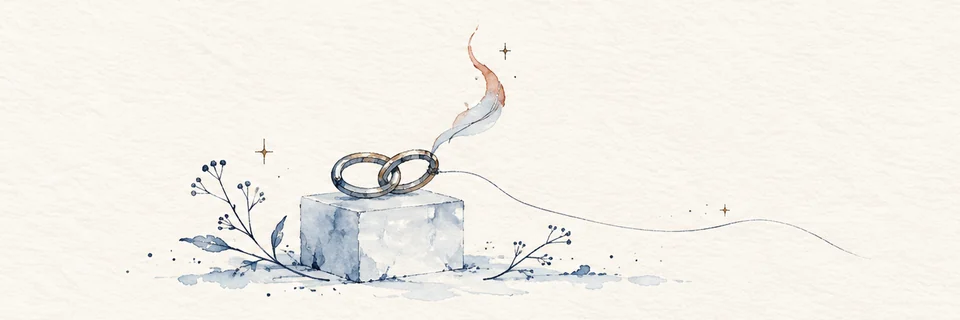
In the Rider–Waite–Smith image, a horned, winged figure stands above two chained figures. A downward torch and an inverted pentagram contribute to its unsettling arrangement. Waite’s description gives the imagery an explicitly moral and religious register. Lunaire keeps the visible bond, the pedestal, the horned presence, and the flame, while its illustration holds the torch upright. Our reading makes desire something to examine without treating wanting as a moral failure. The attachment has structure: a repeated act, an agreement, a role that has gradually acquired terms.
Modern readers bring their own emphasis. Joan Bunning reads the card through bondage and the loss of freedom; Little Red Tarot emphasizes examining difficult patterns without judgment. Lunaire joins that conversation with attention to what the attachment provides as well as what it costs. (Our account of tarot’s sources and our own lens further explains how inherited meanings become part of the reading.)
What changes when the Devil is reversed?
The Devil reversed brings the bargain into question. Its cost may be becoming clearer, or an old arrangement harder to defend. That does not mean the pull has disappeared.
Recognition and practical change are different moments. You can understand why you keep checking the message thread and still reach for it. The reversal asks what would make your new understanding visible: a changed expectation, a boundary, one repeated action approached differently.
In Lunaire’s three-card spread, position also matters. As What shaped this, the Devil can direct attention to the attachment beneath the question. As What is asking for attention, it asks you to examine the terms. As What may help, it can invite one manageable change to the arrangement.
Desire deserves an honest conversation
In love, the question concerns the relationship you can actually observe: what is exchanged, what is expected, whether there’s still room to choose. The card does not reveal another person’s secret intentions. At work, it may bring status, obligation, and availability into the same frame.
Some constraints are real, imposed, or difficult to leave. A chain in a picture does not make someone responsible for being harmed, and recognizing a cost does not instantly create an exit. A useful reading leaves room for support and circumstances as well as choice.
Try two sentences: I keep returning because this gives me ____. Keeping it on these terms costs me ____.
Both are true. Then ask which term could change.