

Major Arcana
The Fool
The Fool marks a beginning carried by curiosity, trust, and room for the unexpected.
- beginning
- curiosity
- trust
- possibility
Read the card in its own right, then follow its meaning through the spread.
Two orientations
The card’s meaning
The Fool concerns the openness that makes an unfamiliar beginning possible. It describes a stance toward experience rather than a guarantee that a particular opportunity is safe or destined. Its place at the threshold allows both the appeal and the exposure of starting.
Upright
The Fool marks a beginning carried by curiosity, trust, and room for the unexpected.
The Fool arrives before certainty does. It describes the openness that lets a first step become possible: curiosity, trust, and a willingness to learn by meeting the road rather than mastering it in advance. This is not praise for carelessness. The card keeps risk visible while asking whether experience must be guaranteed before it can be entered honestly.
- beginning
- curiosity
- trust
- possibility
Reversed
The Fool reversed holds a beginning at the edge between hesitation and unmeasured risk.
The Fool reversed concerns a beginning whose pace is unsettled. Hesitation may keep the first step waiting for certainty, while haste may ask instinct to replace preparation. Both bring attention to the relationship between trust and risk. Some unknowns can only be met through experience; others can be reduced by finding out what the action requires. Readiness involves judging the difference.
- hesitation
- risk
- readiness
- restraint
How the reversal changes the emphasis
This reversal does not cancel possibility; it asks whether fear or haste is deciding the pace.
The question changes the emphasis
Reading this card in context
Each spread gives its cards different roles. The examples below explore this card as an influence, a situation or challenge, and advice or support. Begin with the question your position asks, wherever it falls in the spread.
As an influence
Upright
Openness, a leap into uncertainty, or the permission to begin may still be shaping the question from underneath.
Reversed
An earlier hesitation or an unmeasured leap may still influence how safe, urgent, or possible the question feels.
As a situation or challenge
Upright
The center of the question may be the difference between staying receptive and moving without enough care.
Reversed
Risk itself is asking for a clearer look: what is genuinely unknown, and what could be prepared for now.
As advice or support
Upright
Approach the next step as something to learn from, without expecting it to settle the whole course in advance.
Reversed
Pause long enough to distinguish useful caution from avoidance, and check what preparation would make the next step possible.
Read through a particular life focus
Open reading
Consider what beginning is available to you, what it would let you learn, and what care its actual risks require.
Love & relationships
Give a new connection or a different way of relating room to develop while noticing what each person is ready and willing to offer.
Work & direction
Consider an unfamiliar direction or first attempt, including what you can learn by trying and what needs preparation beforehand.
Home & family
Look at whether a new routine or arrangement could be tried with curiosity, and what would make that experiment manageable for the people involved.
Self-growth
Notice where being a beginner might make learning possible and where a little preparation would help you begin with more care.
Look a little closer
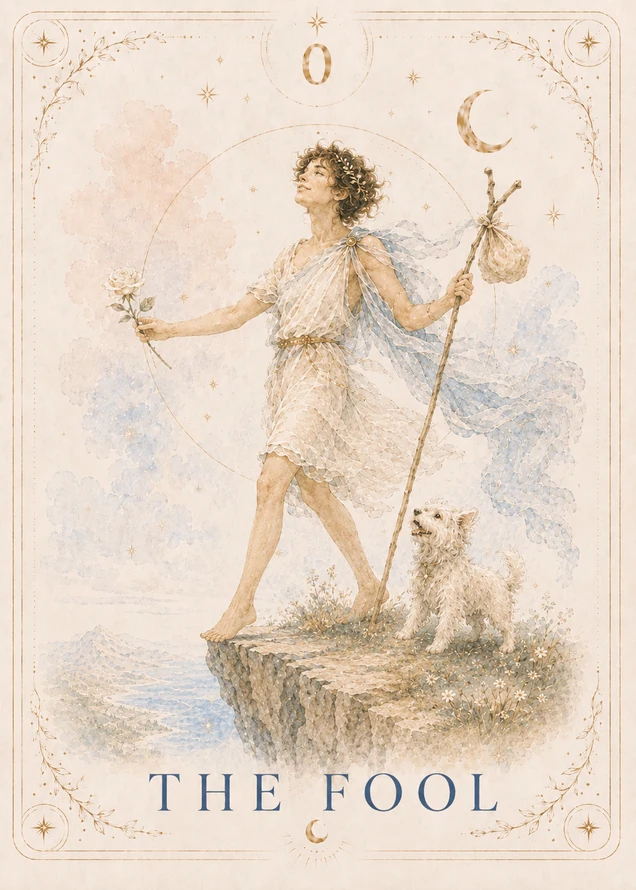
The imagery
Cliff edge
The traveler stands at the lip of a high cliff.
The edge makes the unknown immediate: the next step matters even when the road is not visible.
White rose
A white rose is held lightly in the traveler’s raised hand.
The rose keeps openness and sincerity beside the risk of beginning.
Small white dog
A small white dog looks upward beside the traveler.
The companion can suggest instinct, warning, or encouragement alongside the traveler’s curiosity.
Similarities & differences
Related cards
Tradition & Lunaire’s interpretation
The traditional foundation
A. E. Waite, The Pictorial Key to the Tarot, Part II §2, The Fool: the spirit encountering experience, an expectant traveler at a precipice, and openness to the journey; his Part III §3 fortune-telling entry has a markedly harsher emphasis.
Lunaire’s reading
Lunaire’s upright emphasis on curiosity, trust, and beginning draws more closely on Waite’s symbolic account than on his divinatory list. The reversal brings that beginning into question through hesitation or unmeasured risk. It keeps both branches while asking what readiness requires, rather than diagnosing a person or forecasting failure.
Read the source in The Pictorial Key to the Tarot ↗
Arthur Edward Waite. The Pictorial Key to the Tarot. W. Rider; [1911]. Illustrations by Pamela Colman Smith. Source edition details ↗