
Saturn arrives in an astrology reading with a measuring tape. Mars has already decided it is time to do something. Venus would like to know whether you actually love the thing you keep saying you want.
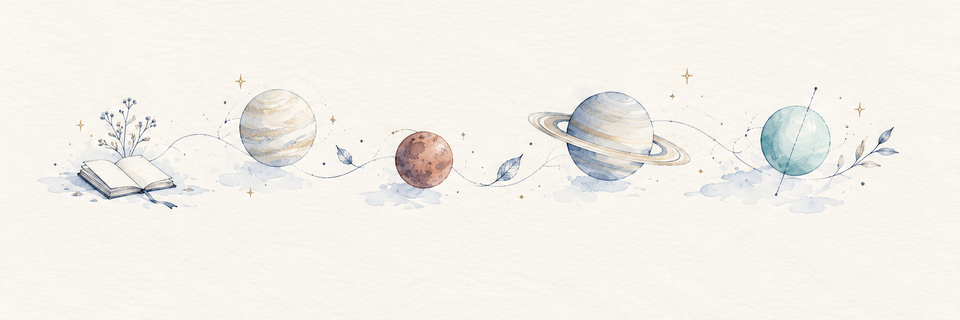
These are familiar characters around Lunaire. But they are also worlds: light reflected from clouds, iron turning to rust, rings made from innumerable pieces of ice. The astronomy does not drain the personality out of them. Sometimes it gives us a more interesting way in.
For World Space Week, celebrated October 4–10, we are looking at how the physical planets meet their astrological meanings. The history of astronomy’s relationship with astrology explains how the wish to interpret the sky helped people measure it. Here, we move a little closer to what they were measuring.
Where planetary meanings come from
Why does Mars signify action, or Saturn limits?
The answer has several layers. Planetary meanings developed through traditions of observation, myth, philosophy, and interpretation. Ancient observers could see differences in brightness, colour, movement, and the time a planet took to cross the sky. Those differences became part of how the planets were understood.
In the second century, Ptolemy’s Tetrabiblos described planetary qualities through the period’s ideas of heat, cold, moisture, and dryness. Mars’s fiery appearance figured in its burning character; distant Saturn was associated with cold. This was ancient natural philosophy, using an understanding of the cosmos very different from modern planetary science.
Later discoveries add another layer. Saturn’s rings and Uranus’s extraordinary tilt offer compelling images for contemporary interpretation, but they did not supply the original meanings of planets that ancient observers saw without telescopes.
That distinction lets us keep both kinds of wonder. Some associations grow from the sky people could see. Others gain fresh resonance from what we have since learned.
Venus: what catches the light
Venus can be astonishingly bright in the morning or evening sky. Its thick clouds reflect sunlight, helping make it the brightest planet as seen from Earth.
That visible splendor offers a natural doorway into Venus’s astrological concerns: beauty, attraction, pleasure, and value. Venus knows how to catch your eye. The more interesting question is what happens after it has your attention.
An attractive possibility is not always a satisfying one. You can love the dress in the shop and never feel quite yourself wearing it. You can want to be chosen by someone without enjoying the life that being chosen would give you.
The physical Venus also has a demanding interior behind that shining appearance: dense atmosphere, extreme heat. We need not turn that into a warning about love to let it complicate the picture. Beauty deserves attention; but, so does what it feels like to actually live inside the thing you are drawn to.
Venus asks for a closer look at what you value, beyond what photographs well.
Mars: the red we could see
Mars’s colour was available to the naked eye long before anyone knew what made it red. Modern astronomy supplies the material explanation: iron minerals oxidise—rust—in its surface dust and rocks.
The red appearance belongs to the older web of associations around heat, blood, conflict, and the planet named for the Roman god of war. Astrology gives Mars the work of action, assertion, desire, and the courage to begin.
We do not have to reduce that character to an argument. Mars is also the energy required to say “I want this” before you know whether wanting it will be convenient.
Think of the application you finally send, the boundary you finally say aloud, the first ten minutes of doing something you have spent three weeks considering. Mars gives an intention legs.
Knowing that its red is rust does not erase the color people took splendor in. It lets the symbol have a material history as well as a human one.
Saturn: structure that keeps moving
Saturn takes about 29.4 Earth years to orbit the Sun. Its slow rhythm was part of the sky available to ancient observers; its detailed rings belong to a later, closer view.
That long orbit makes a fitting companion to Saturn’s astrological work: time, responsibility, limits, and the structures that can hold a life. Saturn is interested in what survives repeated use. It wants the lovely plan to have somewhere to stand.
The rings offer a newer image. They are not a single solid wall. They consist largely of ice particles, with rock and dust, moving around the planet.
Here is a structure made from motion. A useful thought if you tend to imagine commitment as something you establish once and then never touch again.
A friendship lasts because people keep making time. A home stays a home because someone tends it. A practice becomes yours through returning. Saturn’s boundaries can give that work a shape; the rings remind us that a shape can endure while its pieces keep moving.
Uranus: another angle entirely
Uranus rotates almost on its side, with an axial tilt of about 98 degrees. It is a memorable physical oddity: a planet doing a familiar thing from a startling angle.
Modern astrology associates Uranus with disruption, invention, freedom, and departures from the expected. Its tilt makes an especially vivid contemporary image for that character. The image is a resonance we can draw now, rather than an explanation for how all of its meanings originated.
Uranus asks what happens if the arrangement you inherited is not the only possible arrangement.
Sometimes that means a large change. Sometimes it is smaller: working differently, dressing differently, admitting that the version of success you have been pursuing belongs to someone else. A changed angle can reveal how much of the old picture depended on where you were standing.
Let the worlds keep their complexity
As our guide to astronomy and astrology explains, a measured physical fact and its symbolic interpretation do different work. We can use the discoveries as images for reflection without treating ice, rust, or a tilted axis as a mechanism that determines our choices. The planetary characters are useful partly because they can hold more than one possibility. Venus can attract and reassess. Mars can protect as well as confront. Saturn can support a life as well as restrict it.
World Space Week invites us to notice that the worlds themselves are more complicated than a little circle on a diagram. Letting them keep that complexity makes the astrology more generous, too.
The sky has always given us something to look at. Looking closer gives us something else to think with.