
You can know exactly what day it is and still have no idea what kind of day you are having.
The date is settled. The question underneath it is less cooperative: is something beginning, ending, or asking for another look? Astrology gives that sort of question somewhere to go. But before a planet could acquire a meaning in a chart, someone had to work out where it was—and where it would be next.
That wish to read the sky helped people get better at measuring it. In several important early traditions, astrology was among the reasons astronomy became so precise. Meaning supplied a question; observation had to do the work.
World Space Week, held October 4–10, gives us an occasion to look back along that line. Our guide to astronomy and astrology delineates their different work today. The history brings them closer: the table of planetary positions and the question about a human life were often open on the same desk.
If the sky matters, you keep looking
In ancient Mesopotamia, the questions were often larger than one person’s afternoon. An eclipse or a planet’s appearance might be read as an omen concerning a ruler, a harvest, or the fortunes of a country. Knowing when it would happen mattered.
So people watched, recorded, compared, calculated. Late Babylonian mathematical astronomy could predict lunar and planetary phenomena; calculated positions also found their way into horoscopes. Historian Francesca Rochberg describes how astronomical calculation and astrological interpretation developed together.
There is a familiar human impulse inside all that careful work. When something seems meaningful, you pay attention to it. You remember the date. You begin noticing what repeats.
The difference is what you do with the attention. Here, it became a discipline: a record someone else could consult, a calculation that could be improved, a sky that could be anticipated more accurately next time.
Calendars and religious life also called for astronomical knowledge, and this history takes different forms in different cultures. Still, astrology’s demand was substantial. To interpret an event in the heavens, you first needed to know when the heavens would oblige.
Wonder could be quite demanding about the arithmetic.
A question can build an instrument
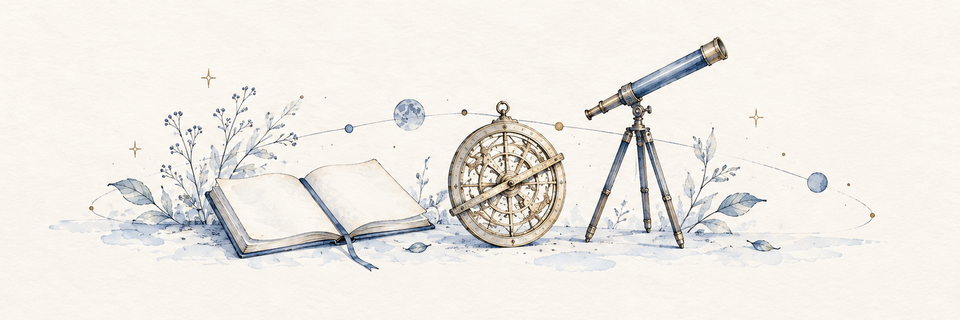
An astrolabe makes that relationship tangible. A map of the sky held in the hand, it could help tell the time, establish prayer times, measure angles, and serve astrological purposes in the Islamic world.
A single brass instrument could accompany several kinds of looking. You could want to know the hour, how to orient a day, or what a celestial arrangement signified. There was room for those questions to share a tool.
Johannes Kepler likewise worked across boundaries that now feel much more firmly drawn. Alongside the laws of planetary motion that helped transform astronomy, he worked with astrology and patrons who wanted astrological advice. His Rudolphine Tables, published in 1627, gave users much more accurate planetary positions than earlier tables.
Kepler’s work drew on mathematics, physics, theology, observation, and the practical business of earning a living (the sky itself has never paid everyone). An accurately calculated planet could serve more than one purpose.
That is a useful inheritance for Lunaire. An interest in meaning can make us more attentive to the thing we are interpreting. If we are going to give Mars a line in the reading, we owe him the courtesy of consulting with him, from where he currently stands.
The sky had more characters than we knew
Then astronomy began finding worlds beyond the familiar cast.
Uranus was identified in 1781 and Neptune in 1846; Pluto followed in 1930. They had been there all along. The ancient framework of the Sun, Moon, and five visible planets had been reading a sky with more characters in it than anyone knew.
For modern Western astrology, those discoveries opened new interpretive territory. Meanings took time to develop, through observation, mythology, cultural context, and exchanges among practitioners.
At Lunaire, their slower rhythms let the reading reach beyond the immediate business of the day. Uranus has questions about the arrangement you have stopped questioning. Neptune notices how easily longing can soften the outline of what is actually there. Pluto would like to know who has the power, including the power nobody has named.
These are useful characters for changes that take years to recognise: the ambition you quietly outgrow, the relationship whose terms you finally see, the life that gradually stops fitting.
A life has weather. It also has a climate. A larger sky gives us a language for both.
Looking closer changes the picture
Modern astronomy lends astrology precision on a scale those early observers could scarcely have imagined. Ephemerides—tables or calculations of celestial positions over time—and tools such as NASA JPL’s Horizons make detailed astronomical predictions accessible.
Lunaire’s own calculation-to-reading process begins with the actual arrangement of the sky. The interpretation follows: this angle, this apparent reversal, this Moon approaching its next phase. The details give the prose something real to attend to. Mercury does not get to walk backward just because we would like another chance at the conversation.
Space exploration changes the picture in another way. When New Horizons reached Pluto in 2015, a distant point became a world with mountains, glaciers, and a complicated surface.
There is something tender in that change of scale. From far away, a thing can look simple enough to name and move on from. Closer up, it has terrain. A person, a relationship, an old version of yourself can be like that, too.
The planets as physical worlds offer further images to think with: Saturn’s rings made from countless moving pieces, Uranus turning almost on its side. These discoveries bring fresh texture to the characters we already know. Sometimes a closer look makes the familiar more interesting.
What we bring back to the room
The wish for meaning did useful work. It gave people reasons to return to the sky, make another observation, improve a table. Those observations kept revealing more than anyone had first imagined.
World Space Week celebrates what exploring space makes possible. At Lunaire, some of what we bring back is perspective. You can come to the sky with a question about your own life. You may leave with a better question, or a little more room around the one you brought.