
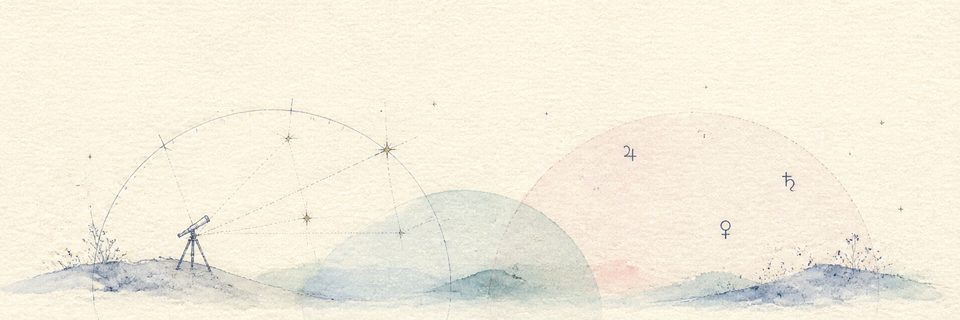
The planets keep moving whether anyone is reading them or not. They cross the zodiac, appear to slow and turn, and keep their appointments with the Moon. Astronomy measures that motion. Astrology begins with the pattern and asks a different kind of question: what might it mean to us?
One measures. One interprets.
Astronomy is a science. It uses observation, mathematics, and physical models to describe celestial bodies and their motion. An ephemeris can tell us where Mars appears along the zodiac at a particular moment, how the Sun and Moon are angled, or whether Mercury’s apparent movement is direct or retrograde from Earth.
Astrology is an interpretive tradition. It takes positions and relationships in the sky and reads them as symbols. A square may describe friction. A waxing Moon may suggest something gathering. Saturn tends to arrive with a measuring tape and little patience for a beautiful plan that cannot stand up.
Those interpretations are not scientific findings. Real astronomical inputs do not turn astrology into a branch of astronomy, and Lunaire does not ask them to. The value of a reading is closer to recognition: a pattern that helps you notice your own situation more clearly, not a physical explanation of why it happened.
The fact beneath each passage is calculated. The interpretation is Lunaire’s.
How Lunaire joins them
Lunaire works in a deliberate order:
- First, it captures one moment and calculates the current Earth-centered positions of the Sun, Moon, and planets.
- Then it checks what is actually present: the bodies’ signs and degrees, the Moon’s phase, apparent direction, and selected angles or transitions.
- Only after that does the astrology begin. The measured pattern becomes a reading through the traditional characters of planets, signs, phases, and aspects.
This order is why Mercury does not wander into a retrograde paragraph simply because the day feels inconvenient. If the reading says Mercury is retrograde, Lunaire has calculated that apparent motion. If the passage then suggests revisiting an unfinished conversation, that is the interpretive layer: a possibility to consider, not a prediction.
Why the distinction matters
Keeping the seam visible protects both sides of the work. The astronomy does not become decoration for a story that was written in advance. The astrology does not pretend that a precise longitude can prove an interpretation.
It also makes honesty easier. A position near a sign boundary deserves care. Pluto’s exact degree is treated as approximate because Lunaire calculates it with a different, less complete model than the other planets. Houses and the Ascendant stay out of the reading until the product can calculate them from the birth time and a properly located birthplace.
None of this requires the prose to sound like a lab report. The calculation is the pencil work beneath the watercolor. It keeps the outline true; the reading is still allowed to breathe.
What a reading can do
A Lunaire reading does not promise that a relationship will begin, a job will appear, or a difficult week will resolve on schedule. It describes the symbolic pattern of the sky and offers a human way into it. Recognition, not prediction.
That is how astronomy and astrology fit together here. One tells us what the sky is doing. The other gives us a language for sitting with it.