
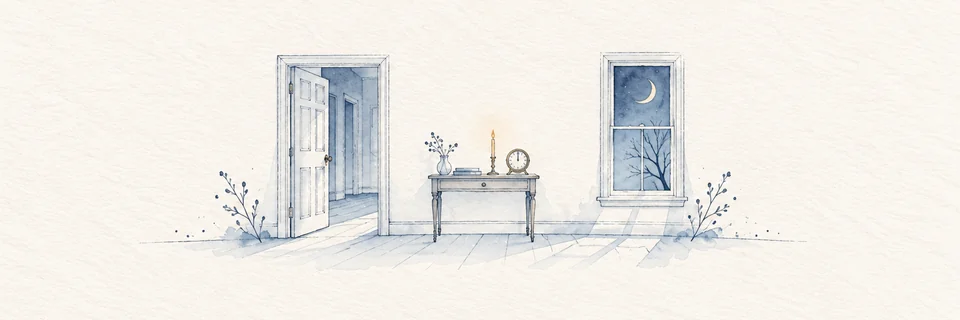
At midnight, the same small sound in the hallway acquires a much better agent. In daylight it was the house settling. Now it has timing.
The witching hour names the part of the night when folklore gives witches, ghosts, and other supernatural presences greater freedom. Its clock is less settled than the phrase suggests: midnight is one familiar answer; 3 a.m. is another. What stays consistent is the sense that ordinary hours have given way to a different kind of time.
Why is it called the witching hour?
The name belongs to the idea of a night especially suited to witchcraft and supernatural activity. In Washington Irving’s The Legend of Sleepy Hollow, Ichabod Crane rides home at “the very witching time of night.” He has traveled the same road cheerfully that afternoon. By midnight, the ghost stories he heard earlier have come along for the ride.
The familiar landscape has acquired a second cast: a tree, a bridge, the places where a story is said to have happened. The hour gives those stories room to move. It is a literary expression of the tradition, not where it began; what Irving captures is how the same road can feel like another place after dark.
The name gives that possibility a boundary. Something is permitted now that was less available a little earlier. The calendar has crossed into tomorrow; the room still belongs to tonight.
Is the witching hour midnight or 3 a.m.?
Dictionary.com’s entry identifies midnight. In that version, the attraction is easy to follow: midnight marks the change of date. It belongs to the end of one day and the opening of another, a threshold with a number attached.
Contemporary ghost lore and horror also often place the hour around 3 a.m., sometimes calling it the devil’s hour. One circulating explanation makes this an inversion of the traditional Christian association of 3 p.m. with Christ’s death. It is better understood as an explanation people attach to the hour than as a securely established account of where the phrase began.
There is no single timetable shared by every version. Folklore gives the time window a character; different tellers book different appointments.
The clock on the wall and the night outside
Here is where the story brushes against calculation. Civil midnight is the boundary our clocks assign to a date. It is not necessarily the exact midpoint between your local sunset and sunrise, and 3 a.m. does not correspond to one universal arrangement of the sky.
Time zones and daylight-saving rules organize the clock. Longitude, latitude, season, and the Sun’s motion determine the local relationship between light and darkness. Two places showing the same clock time can be standing in quite different nights.
A clock can be exact about an agreed convention. A sky calculation can be exact about a particular celestial relationship. The two deserve their own labels. That distinction runs through how Lunaire calculates its readings: a time stamp anchors the measured sky, while interpretation gives the moment its character. Today’s Sky does not calculate a supernatural hour.
Like astrology, the witching hour lives in the interpretive register. Its force comes from what people have gathered around that time: solitude, secrecy, a pause in ordinary activity, the possibility that something usually hidden might make itself known.
An hour for what stays out of daylight
In a ghost story, night lets what remains unresolved walk through the door. In your own evening, it may simply be the hour when a thought finally finishes its sentence. There are fewer people to interrupt it (your phone remains willing).
The dark Moon offers another kind of threshold, measured through a cycle rather than a clock. Both motifs give the unseen a turn: something can matter before it is clearly visible.
You need not wait for a particular minute to listen. But there is something persuasive about a world with the lights lowered, when the day has stopped asking for an answer and a quieter question finally gets the room.