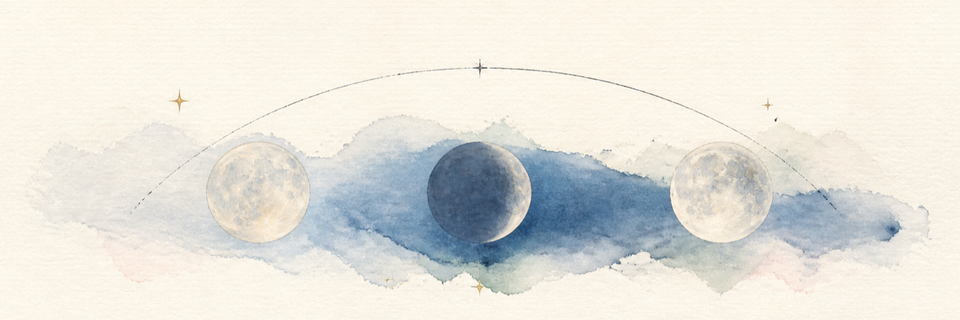
Lunaire arrives on August 28 with Earth’s shadow drawn across the Full Moon. During a deep partial lunar eclipse, the Moon slips almost entirely into the umbra. Familiar light is interrupted; the sky makes one of its hidden arrangements visible in shadow.
The eclipse did not choose our opening day (our launch calendar remains stubbornly terrestrial). Still, it gives Lunaire the right first image.
The lines beneath the light
An eclipse is geometry before it is metaphor. The Sun, Earth, and Moon align. At the deepest point, more than 96 percent of the lunar disk lies inside Earth’s central shadow. The measurement tells us where the darkness is. It does not tell us what the darkness means.
Lunaire works at that seam. It begins with real planetary positions, apparent motion, the Moon’s phase, and the angles between the bodies (the pencil drawing beneath the page). Then astrology adds watercolor—tradition, character, and the possibility of recognition. Mars wants something. Saturn asks what it will cost. The Moon changes the lights as the scene progresses.
We leave enough of the pencil showing that you can see what holds the image together. The line between measurement and meaning is part of the picture, not something hidden behind it.
The first page
In astrology, an eclipse is often read as a disruption of ordinary light: a strange pause to catch our attention anew. We take it as image, not instruction. No eclipse can order you to quit a job, reopen an old door, or send the text before breakfast. But it can offer a shape for noticing what appears when the usual illumination breaks.
The Moon gives Lunaire its name and its quickest visible rhythm. Her phases turn changing light into a readable cycle: beginning, gathering, fullness, release, return. An eclipse briefly casts something else across that cycle—Earth’s own shadow passing over the page.
So Lunaire opens its notebook there. Come read the current sky, find your daily horoscope, or learn the language one piece at a time. Then leave a note in the margin as the project grows and the Moon returns to light our way.