
Cups
Page of Cups
Curiosity welcomes a fresh feeling, an imaginative idea, or a message worth exploring.
- curiosity
- receptivity
- imagination
- expression
Read the card in its own right, then follow its meaning through the spread.
Two orientations
The card’s meaning
The Page meets the emotional and imaginative possibilities of Cups with curiosity and a readiness to learn. The role can appear in a message, an exploratory gesture, or an attitude to experience; it does not identify a child, an age, a gender, or a fixed personality.
Upright
Curiosity welcomes a fresh feeling, an imaginative idea, or a message worth exploring.
A fresh feeling, an odd image, or an unexpected message can deserve attention before its importance is clear. The Page of Cups meets these arrivals with curiosity and a willingness to be moved. The fish emerging from the cup gives surprise a small, visible form. There may be something here to write, ask, make, or say; it can begin modestly. Receptivity becomes useful when imagination is allowed an experiment, rather than being dismissed as too slight to matter.
- curiosity
- receptivity
- imagination
- expression
Reversed
A fresh feeling struggles to find an honest form of expression.
A fresh feeling or creative impulse is present, but finding a way to express it is difficult. Embarrassment, fear of rejection, or a need for the response to go a certain way can leave it hidden, dressed up, or sent indirectly. The Page of Cups reversed asks for a little honesty at the point where feeling first becomes words or action. An awkward first attempt can teach more than a flawless exchange that exists only in the imagination.
- inhibition
- uncertainty
- imagination
- expression
How the reversal changes the emphasis
The Page’s receptive, exploratory expression is hindered by self-consciousness, difficulty finding words, or a need for the response to match an imagined exchange. This is a modern reflective use of the blocked lens, informed by Waite’s mixed themes of attachment, artifice, and obstacles; it is not his literal reversed list.
The question changes the emphasis
Reading this card in context
Each spread gives its cards different roles. The examples below explore this card as an influence, a situation or challenge, and advice or support. Begin with the question your position asks, wherever it falls in the spread.
As an influence
Upright
An unfamiliar feeling, a creative impulse, or a message that caught the imagination may have helped bring this question into view.
Reversed
A feeling left unexpressed, or an imagined response that made expression difficult, may be one influence to consider behind the question.
As a situation or challenge
Upright
Give a small emotional or creative signal enough attention to explore it, without asking it to explain the whole situation.
Reversed
Notice what makes a simple expression feel difficult, and separate the feeling itself from the response imagined for it.
As advice or support
Upright
Try a modest expression of what is emerging: a few honest words, a question, or a first attempt at making something.
Reversed
Give the feeling a small, truthful form that does not depend on a perfect reception, and allow the actual response to teach something.
Read through a particular life focus
Open reading
A small feeling, imaginative association, or new message may offer something worth exploring before drawing a larger conclusion.
Love & relationships
A tentative expression of interest or affection can be received on its own terms without assigning it a future in advance.
Work & direction
A creative idea or instinctive response may benefit from a small experiment that makes it easier to consider and discuss.
Home & family
Fresh curiosity about the experience of belonging may find expression in a question, a memory, or a small gesture of care.
Self-growth
Allow an unfamiliar feeling or imaginative impulse to be explored without requiring immediate confidence or a finished explanation.
Look a little closer
The imagery
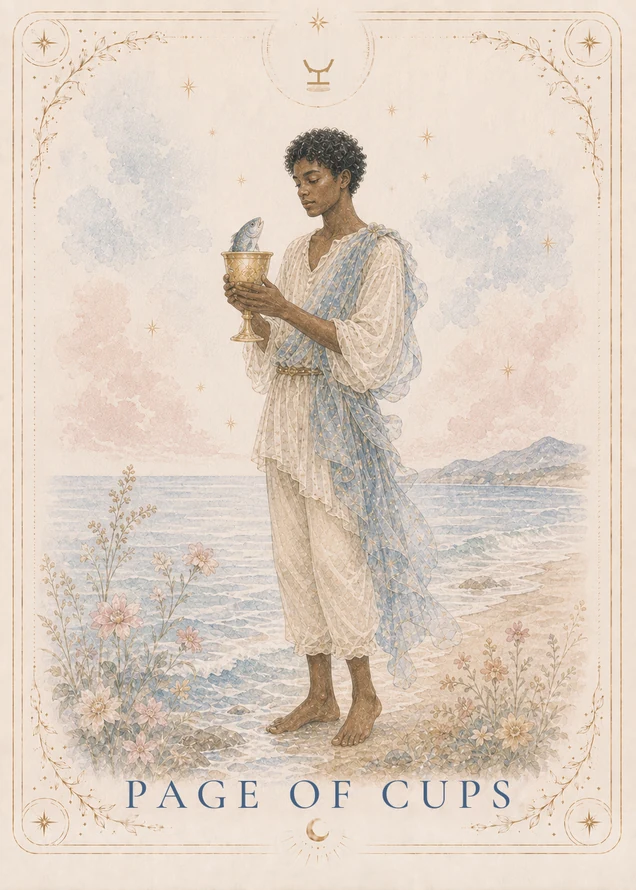
Fish emerging from the cup
A blue and silver fish rises above the rim of the gold cup.
An unexpected feeling or imaginative idea can become something noticeable enough to explore.
Attention to the cup
The figure looks toward the cup and holds it in both hands.
Receptivity gives a small or unfamiliar experience time to take shape before deciding what it means.
Shoreline
The figure stands by the sea, with flowers in the foreground and hills across the water.
The meeting of land and water can suggest giving inner experience a modest outward form.
Similarities & differences
Related cards
Tradition & Lunaire’s interpretation
The traditional foundation
Waite connects the Page with reflection, study, service, and messages, while the fish represents an inward image taking form; his reversal mixes attachment with deceptive artifice. Additional meanings include a favorable omen, disappointment in love, and reversed obstacles.
Lunaire’s reading
Lunaire treats the Page as receptive emotional and imaginative exploration available to anyone, retaining reflection and communication without Waite’s appearance, age, or gender assignments. The selected reversal concerns difficulty expressing a fresh feeling, including the way a wished-for response can obstruct honest expression. This modern adaptation draws on the source’s mixed attachment and obstacle themes without accusing someone of seduction or deception, or equating tentative expression with immaturity.
Read the source in The Pictorial Key to the Tarot ↗
Waite: additional meanings for Page of Cups (Part III §4) ↗
Arthur Edward Waite. The Pictorial Key to the Tarot. W. Rider; [1911]. Illustrations by Pamela Colman Smith. Source edition details ↗