
Scorpio gets the villain edit. Someone is quiet at dinner, remembers exactly what was said, and seems unlikely to be bought by a charming explanation. Scorpio’s reputation precedes it.
Search for Scorpio’s dark side and you quickly meet jealousy, secrecy, revenge, and the claim that it is the “most evil” zodiac sign. That’s a reputation, not an astrological ranking. Still, Scorpio has become the sign we send into the rooms other people would rather leave closed.
Where does Scorpio’s dark reputation come from?
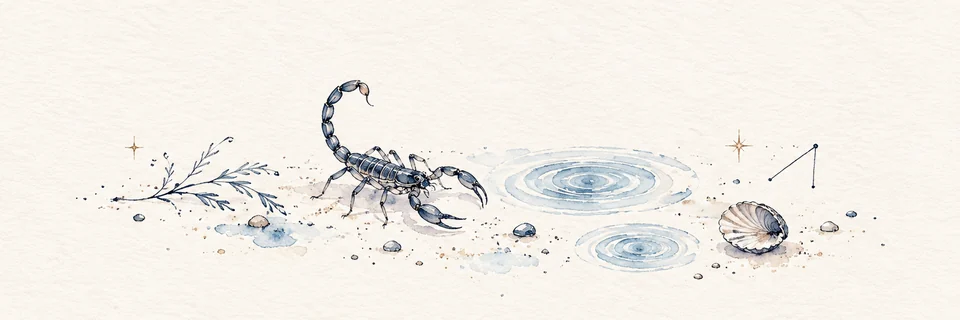
Scorpio’s emblem is a creature with a sting. Its astrological language often concerns desire, defense, intimacy, power, and what is kept beneath the surface. Put those together and a suspicious character practically writes itself.
But privacy can look like secrecy from the other side of a door. Depth can look like obsession from someone who would prefer to skim. A willingness to remain with a difficult subject can look unsettling to a room trying very hard to change the topic.
The familiar stereotype takes those qualities at their most difficult and leaves them there. Lunaire’s Scorpio is more interested in finding out what is true than in making everyone comfortable while it probes.
Fixed water: the feeling that stays
In Western astrology, Scorpio is a fixed water sign, traditionally ruled by Mars and associated with Pluto in many modern approaches. The Astrology Podcast’s Scorpio discussion explores those different strands of its character in detail.
Water gives us the realm of feeling and attachment. Fixed describes something that holds, sustains, and can become difficult to shift. Scorpio’s water stays with the subject. It wants to know what happened after everyone else accepted the gloss.
That persistence can turn into a grudge. It can also become loyalty, patient attention, or the courage to hear a difficult answer without leaving. The same capacity has several possible expressions; a Sun sign does not choose one for you.
Mars guards the door; Pluto asks what is underneath
The planets bring different concerns to a reading. Mars concerns desire, action, conflict, and defense. Read through Scorpio, those concerns become selective: what is worth fighting for, who gets access, and what must be protected?
Pluto adds a modern language of power, buried material, endings, and deep change. Here, Scorpio wants the real terms of the arrangement. Who gets veto power? What is being exchanged? What does everyone know but nobody say aloud?
This is an interpretation of the sign through its planetary associations, not a claim that a scorpion’s sting or a planet’s physical properties produces a personality. It helps explain why Scorpio’s symbolic room contains both intensity and the work of confronting it.
Why does Scorpio feel at home in spooky season?
Tropical Scorpio season falls roughly in late October and November. In the Northern Hemisphere, that places it amid longer nights, Halloween imagery, and a visibly changing landscape. The autumn turn toward darkness gives its themes an especially vivid setting.
That seasonal setting is not universal: the same zodiac season arrives in Southern Hemisphere spring. Scorpio’s astrological character travels; the fallen leaves do not.
Still, the October association has weight: a season of ghosts suits a sign willing to ask what keeps returning. A landscape exposing its branches suits a character that would like to see the structure beneath the display.
Darkness without a verdict
The difficult side deserves its place. Protection can become control. A sharp memory can keep presenting evidence long after the conversation has ended. Intensity can make an ordinary request feel like it has arrived under oath.
The invitation is to give those capacities somewhere useful to go: a clear boundary, an honest conversation, an attachment examined without pretending it has no pull. Scorpio can notice a closed door without having to force it open.
Its gift is a willingness to stay when the subject becomes uncomfortable. After all, many things actually become less frightening once somebody is prepared to look at them closely.