
A Full Moon can make a room feel a little brighter. You can better see the pile on the table, the message you meant to answer, or the plant that has been growing toward the window.
Astronomically, a Full Moon is a moment in the Moon's changing relationship with the Sun. In astrology, it considers what has become obvious or reached a turning point. The sign of the Moon gives that question a particular subject.
What actually makes the Moon full?
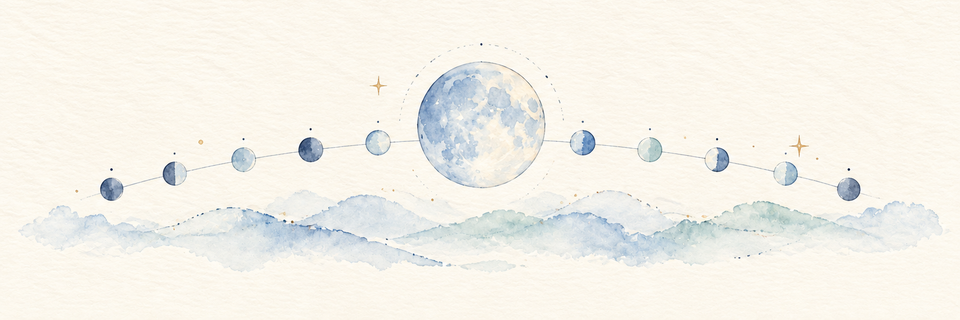
The Moon does not produce its own light. Sunlight illuminates half of it, and as the Moon orbits Earth, we see changing amounts of that sunlit half. At a Full Moon, Earth is roughly between the Sun and Moon; the side facing us is nearly all lit. Lunaire marks the exact phase when their geocentric tropical zodiac longitudes are 180 degrees apart.
That alignment does not make every Full Moon an eclipse. The Moon's orbit is tilted, so it usually passes above or below Earth's shadow. If you want the cycle behind the label, The Moon is keeping time follows the measured phase and the changing light.
What does a Full Moon mean in astrology?
Astrologers often read the Full Moon as a point of culmination, recognition, or contrast. A plan has had time to take shape. A feeling is easier to name. Sometimes it's simply that two needs are visible at once.
The Moon's sign describes the style of the need in the foreground; the Sun sits across the zodiac in the opposing sign. Neither tells you that a relationship will end or a wish will come true. A Full Moon can offer a useful question without insisting on an answer.
How does the Full Moon's sign change the reading?
These are descriptions of the sign hosting the Moon, not forecasts for people born under that Sun sign. The phase supplies visibility; the sign suggests what may be easier to notice.
- Aries: Where do you need room to act without making every hesitation an obstacle?
- Taurus: What feels steady in practice, and what are you maintaining only because it is familiar?
- Gemini: Which conversation, detail, or competing account needs a second hearing?
- Cancer: What does care look like at home, beyond the role you have been playing?
- Leo: Where would being seen feel generous rather than performative?
- Virgo: Which small adjustment would make the work more livable?
- Libra: What has each person agreed to, and is that still fair?
- Scorpio: What remains unspoken about trust, intimacy, or shared resources?
- Sagittarius: Which larger belief still fits the facts you have gathered?
- Capricorn: What is worth your continued effort, and whose standard are you meeting?
- Aquarius: Where does belonging leave room for difference?
- Pisces: What feeling needs space without being asked to become a plan yet?
The Sun's current sign adds another voice to each conversation.
Why is October 2026's Full Moon in Taurus different?
The October 2026 Full Moon falls October 26, at about 12:12 a.m. EDT in tropical Taurus, with the Sun across from it in Scorpio. Taurus pays attention to what can be held, used, tasted, trusted, and returned to. Scorpio asks what that steadiness costs when something has changed below the surface. Together they offer a more interesting question than keep it or leave it: what still supports you, and what needs different terms to keep doing so?
Maybe the weekly dinner still matters, but one person has been doing all the planning. Maybe an object in your home holds a memory you want to keep, even though the room around it needs to change.
This Full Moon is not an eclipse. It follows October's Libra New Moon and arrives while Venus and Mercury are part of a larger Scorpio conversation. Those other stories can add context, but the Moon's own contribution is simpler: look carefully at what has become visible.
To see where we are in the cycle now, check today’s Moon phase and next Full Moon date.
You need not wait for a dramatic revelation. Notice what the light reaches, and decide what deserves to stay in the room.