


You look up when Mercury retrograde starts. Then you search for when it ends. Another tab translates it into your time zone, and somewhere along the way you acquire a list of things you apparently shouldn't do. You only wanted to know whether to update your laptop. Now the whole thing is starting to feel like a math problem.
Mercury (the planet with the best agent) will experience its retrograde from October 24 to November 13, 2026, in Scorpio. It gives us a timely reason to introduce Today's Retrogrades: a place to see which planets are retrograde, which are moving direct, and when each will next change direction. The page updates automatically, so you can return to the same page rather than keep a screenshot that quietly becomes last week's news.
The dates give the period scaffolding. The meanings give you something to consider within the time window.
When does Mercury retrograde start—and end?
This October, Mercury stations retrograde on October 24 at about 3:13 a.m. EDT and direct on November 13 at about 10:54 a.m. EST, by Lunaire's calculation. Both turning points fall in tropical Scorpio. The dashboard shows the station times in your time zone, sparing you investigative work.
Retrograde describes an apparent backward movement through the zodiac as seen from Earth. In reality, Mercury continues along its orbit; it's our earthbound perspective that's changed. Our retrograde guide explains the larger geometry, the pauses (called stations), and the distinction between a retrograde and its shadow periods.
Scorpio gives this Mercury period a particular interest in what words conceal or protect. A question about the coming holiday plans might also be a question about who keeps accommodating whom. It can be worth noticing the second question without deciding you already know the answer. Saying a simple “did you mean that?” out loud still does more work than a mentally well-rehearsed argument without any third party participants.
How to read Today's Retrogrades
Start with the current direction. The dashboard brings the eight planets into two groups: those currently retrograde and those currently direct. Each has its own illustrated entry, a short account of its astrological concerns, and the date and countdown for its next change. Given its PR in the area, Mercury also has a dedicated section answering the question that probably brought you there in the first place: is Mercury in retrograde?
You can read the page in either direction.
Before October 24, Mercury belongs with the direct planets. Read the date, check the time zone, and count down how much time is left before its next station. Once Mercury turns retrograde, it moves into the retrograde group.
As for that laptop update, because Mercury rules communication, today bound up in our technology, the dates might prompt an ordinary useful action: check that your work is backed up and that you have time to finish. You don't need to put your whole digital life on hold, but a little extra introspection may do you well once its direction shifts.
The next boundary becomes its direct station on November 13. The same view that helped you anticipate the beginning now lets you follow the interval toward its end.
The page mirrors this pattern. A planet already retrograde points you toward its return to direct motion; a planet moving direct points you toward its next retrograde. The groupings change as the sky changes. You can easily visualize what is happening now (and see what is approaching) without an alchemy of answers from several annual calendars.
Mercury isn't the whole sky
Mercury is easy to notice because its traditional subjects are so close at hand: messages, thinking, travel, tech, the small arrangements that make a day work. An unclear email or curt text has a pointed way of announcing itself.
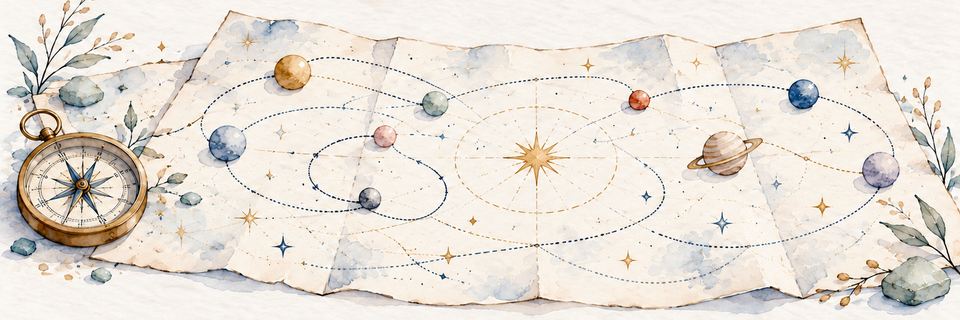
Other planets bring other questions. Venus concerns affection, pleasure and value; Saturn, responsibility, limits and what can be sustained. The artwork is designed to help you recall what each planet's backward movement weighs most heavily on. Their periods can overlap with Mercury's, but they don't all begin or end at once. Today's Retrogrades keeps those different concerns beside one another. A Mercury headline doesn't explain everything you feel.
The short meanings are there to help you distinguish the planets, rather than give eight versions of “be careful.” For a fuller introduction to the cast and what they're thinking about, our guide to the planets follows the different parts they play in astrology. The dashboard is a view of the shared sky; your own circumstances still matter to what you make of it.
Every retrograde has an end. The next one has a beginning.
When a period feels difficult, it can help to know it won't last forever. A simple countdown makes the interval less shapeless: this particular backward walk will end and forward progress will resume.
In the meantime, take stock. What should you reconsider? Is there a detail to correct, a question to ask, or a decision that now has better information behind it? You can act on that information before the countdown reaches zero, too.
And when a planet is direct, the page doesn't lose interest in it. Its next retrograde is still looming. You can look ahead without treating the approaching date as a sentence. Beginnings and endings belong to the same cycle; neither needs to become a verdict on the weeks between them.
Open Today's Retrogrades, find the planet you came to check, then let your eye travel a little further. Take the date, consider the question, and leave room for the rest of your day.