

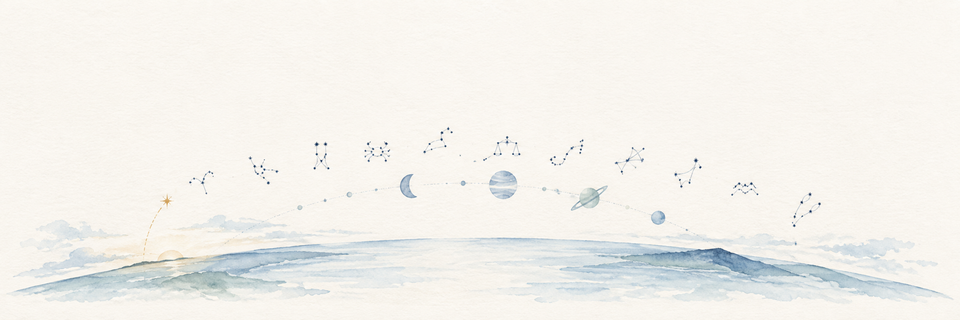
Your rising sign is determined by three things: your birth date, your exact birth time, and your birthplace. At that particular moment, one zodiac sign was rising over the eastern horizon from that location. That sign is your Ascendant, or rising sign.
It is a horizon point, not a planet. And because the horizon keeps moving as the Earth turns, a rising sign changes much faster than the Sun sign most people know first. A few hours can bring a new sign to the eastern edge of the sky; the exact pace varies with location and the part of the zodiac involved. That is why a recorded birth time matters.
Your birth chart holds that one horizon still. Today’s Sky has a different job.
A point that belongs to your beginning
The Sun’s zodiac position can usually be found from a date. Your rising sign needs the rest of the coordinates because it depends on where the sky met the ground when you arrived.
Astrology treats that point as the beginning of a personal chart: the place from which the houses unfold and the part of the pattern that is uniquely yours. It is less like a new body appearing in the sky and more like the frame through which a particular sky is being seen.
When Lunaire’s birth-chart experience arrives, your rising sign will have its proper place there—held at the time and location of your birth, alongside the rest of your chart.
What Today’s Sky is here to read
Today’s Sky is Lunaire’s shared, continuously updated reading of planetary motion. At the same moment, every reader meets the same pattern: where the Sun, Moon, and planets are in the zodiac, how they are moving, and which close exchanges between them are active.
A planet changes signs once. A retrograde station turns once. An exact Full Moon happens once. Those events arrive on different local clocks around the world, but they belong to one moving sky and happen at one real time. Today’s Sky translates that shared instant into the time and date where you are without creating a separate story for each person who opens the page.
It also does not reset when the clock reaches midnight. If Mercury changes signs late on a Tuesday night, that shift is still part of the sky on Wednesday morning. If the Moon is moving toward an exact phase, the approach can matter before the calendar gives it a new day. Today’s Sky follows the sequence of the actual motion: what is current, what has just happened, and what is gathering.
Why it does not show a current rising sign
A current rising sign can be calculated for any chosen place and moment. It would describe the sign lifting over that local eastern horizon right then. But it turns through the zodiac in a few hours, often several times while the larger planetary pattern is still holding.
That makes it a useful detail for a location-specific or moment-specific chart. It does not make it one of the events Today’s Sky is designed to place in the foreground. The Moon can still be in the same phase, Mercury can still be in the same retrograde turn, and a close aspect can still be active while the local horizon has already changed signs.
Today’s Sky keeps its attention on the bodies in motion and the patterns they make together: the changes that give the sky a through-line across hours and days. A rising sign tells you where the horizon is. The page is following what is moving through the sky above it.
There is still something tender about that horizon. It is the edge from which you meet the same sky everyone else is meeting. For now, Today’s Sky keeps its eye on the moving lights—and saves the personal geometry for the forthcoming chart that begins with you.